
Interface News Reporter | Feng Lijun
A decade-long investment marathon ends with a bill that's actually in the red.
In 2013, Ms. Yang looked overseas and enrolled in an investment-linked plan under Investors Trust Assurance SPC (ITA). She paid $1 annually for two years, totaling $2.
In 2026, when Ms. Yang's family contacted ITA again, they discovered the account value had dropped to -$50.59. This means that over the past decade-plus of "investment operations," instead of growing, these $20000 resulted in Ms. Yang owing an additional $50.
ITA is registered in the Cayman Islands and offers investment-linked insurance products to international investors. However, this product is not strictly a trust or insurance policy; rather, it is an offshore financial instrument that combines features of investment-linked insurance, trusts, and funds. Participants' funds are placed in a segregated account (SPC) for investment in external funds.
Interface News reporters discovered that the product Ms. Yang purchased is essentially a Cayman unit-linked life insurance policy held in trust by a trustee. The insurance contract specifies various fee deduction rules. What turned Ms. Yang's account value from 20000 USD to -50 USD was the hidden "fee game" buried within the contract.
"Offshore trust agreements (which are not pure insurance contracts) fall outside the jurisdiction of Chinese law. While this may seem unfair, that is what the contract stipulates," said Wang Guojun, a professor at the School of Insurance, University of International Business and Economics, to Jiemian News.
Pay $20,000 and end up owing 50 dollars.
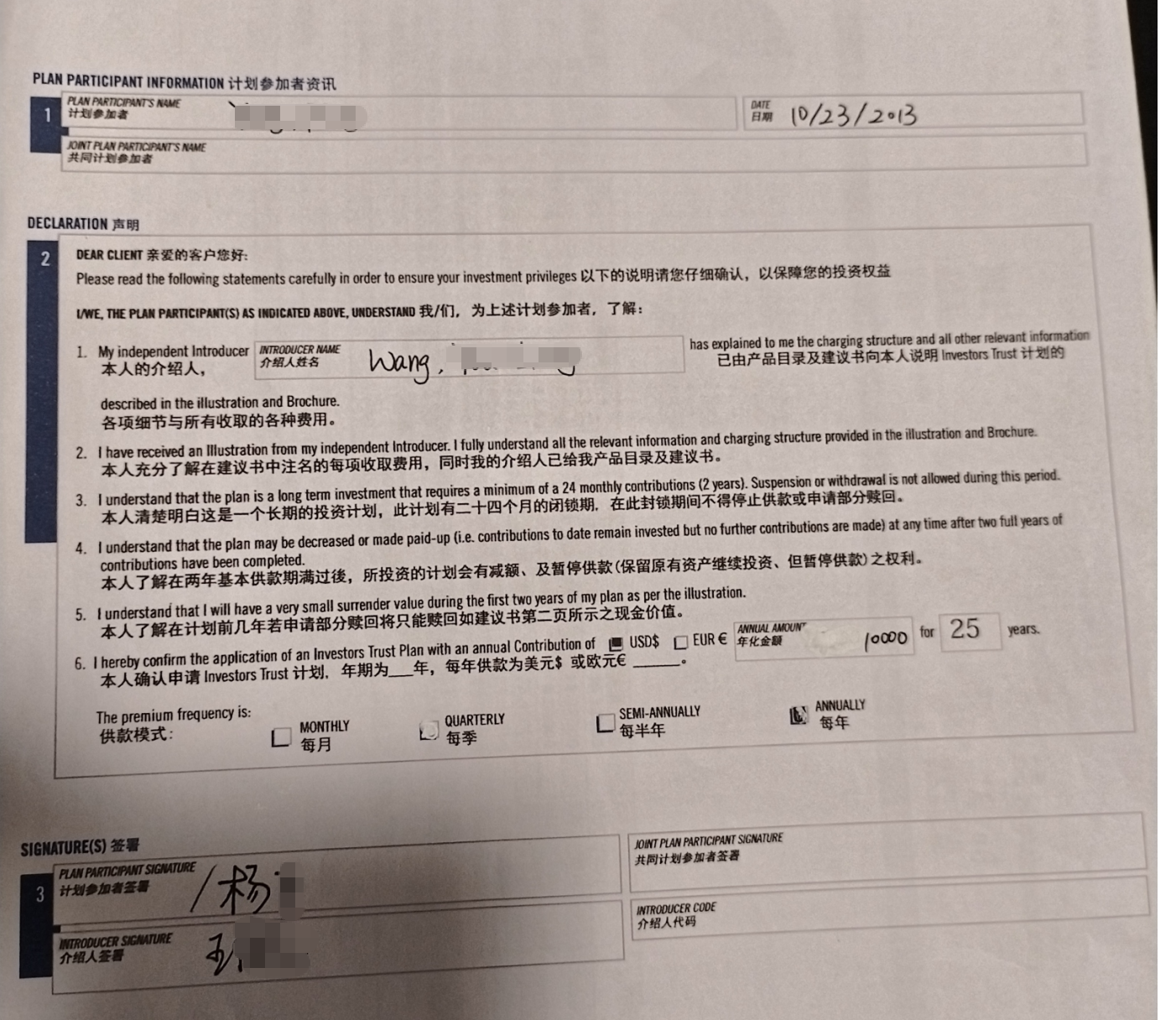
In 2013, Ms. Yang purchased the aforementioned ITA product through Mr. Wang's introduction and signed a Client Plan Confirmation. Notably, Mr. Wang also signed as the introducer on the confirmation.
This confirmation states that the plan is a 25-year long-term investment plan with a 24-month lock-up period. During this lock-up period, contributions cannot be suspended and partial redemptions are not allowed. After the two-year minimum contribution period, the invested plan retains the right to reduce coverage amounts or suspend contributions (while retaining existing assets for continued investment).
The plan confirmation signed by Ms. Yang in 2013. Image source: Provided by the interviewee.
Ms. Yang paid premiums for two consecutive years, from 2013 to 2015, totaling $2. During this period, in 2014, Ms. Yang divorced her husband, Mr. Wei.
In 2020, Ms. Yang passed away, leaving her 17-year-old son, Xiao Wei, as the policy beneficiary. Per the insurance agreement, a death benefit equal to 101% of the account value is payable upon the insured's death. Xiao Wei contacted Mr. Wei and ITA to file a claim.

Compensation standard for death benefit in the contract. Image source: Provided by the respondent.
Mr. Wei told Interface News that the response from ITA Asia Limited in Labuan, Malaysia was: "The policy is currently lapsed because the cash value is insufficient to cover the estimated fees. Lapsed policies cannot be claimed for death benefits. If you choose to reinstate the policy, the system will automatically deduct all accrued fees from the date of lapse to the reinstatement date. After reinstatement, if premiums are not maintained, the policy will lapse again. If heirs wish to apply for reinstatement and transfer ownership but do not intend to continue paying premiums, we recommend keeping the policy in its current lapsed status."
Meanwhile, ITA Asia Limited Labuan, Malaysia provided Xiao Wei with a new reinstatement confirmation letter that removed the clause from the 2013 edition regarding "the right to reduce benefits and suspend premium payments after the two-year basic payment period (while retaining existing assets for continued investment but suspending further payments)."
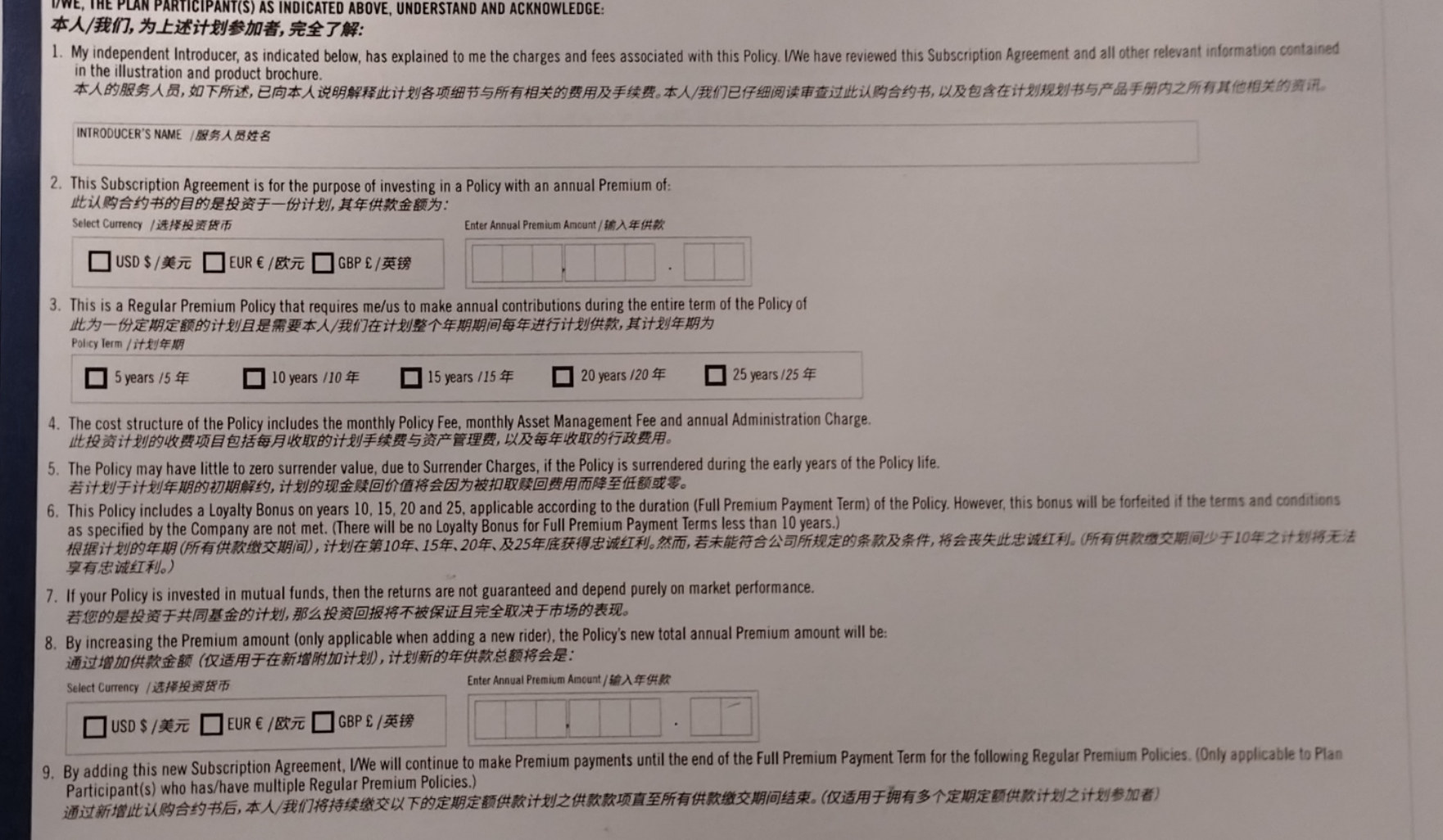
In 2020, ITA provided Xiao Wei with a confirmation of the reinstated plan. Image source: Provided by the respondent.
Since Xiao Wei was still a minor at the time, Xiao Wei and Mr. Wei decided to temporarily suspend the plan. No new confirmation was signed, and no premium was paid.
In 2026, Xiao Wei contacted ITA again with Mr. Wei to check the policy status and attempt a surrender. The Cayman Investors Trust Assurance SPC informed them that the policy had lapsed on 1/4/2017 and provided account statements showing a current account value of -$4.
Based on the account statement, Ms. Yang redeemed 6 funds on 2017/1/4, incurring redemption fees of $4 and causing her account to be depleted.
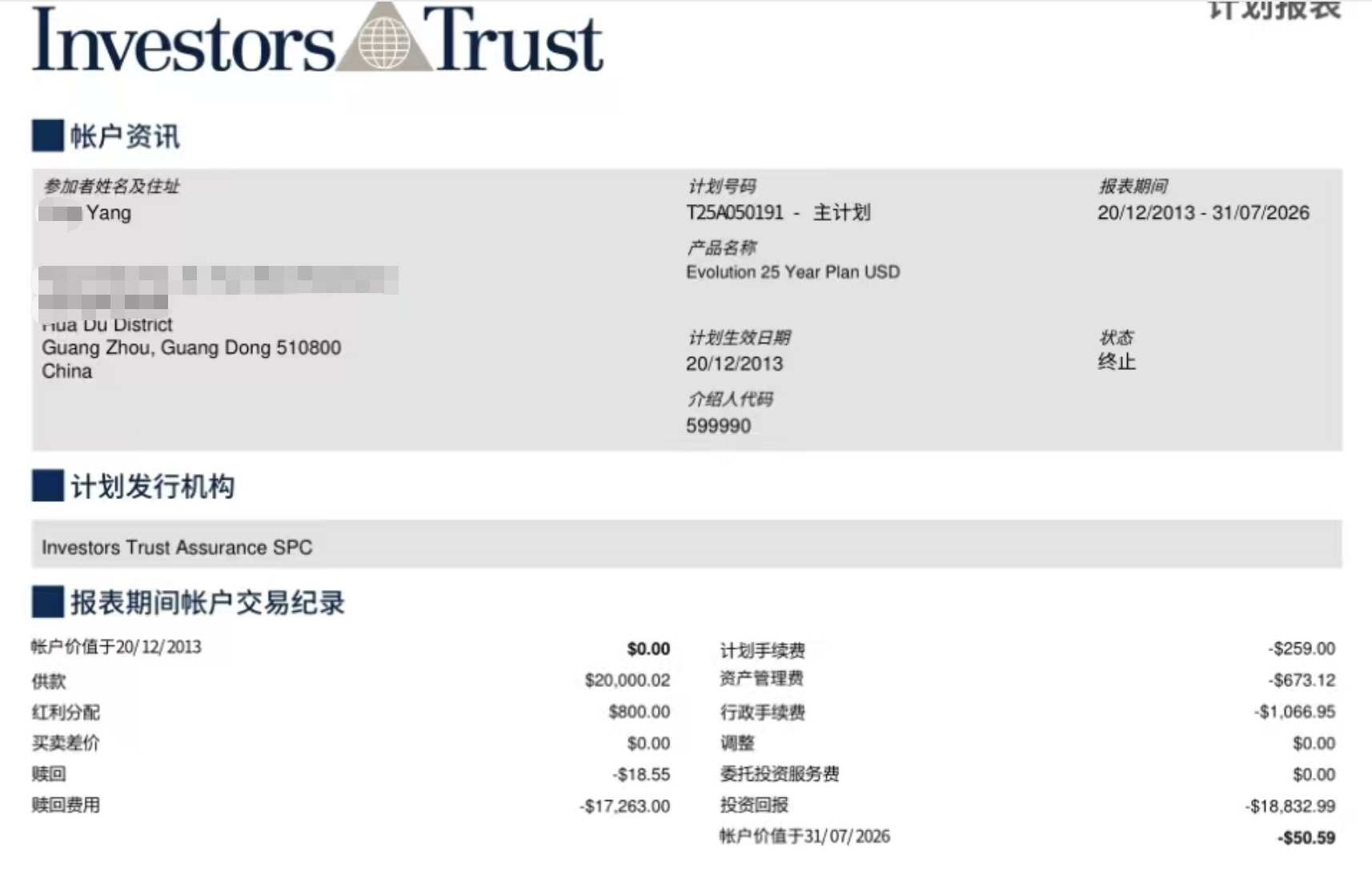
Account details provided to Xiaowei by the ITA. Image source: Provided by the respondent
"Fee Deduction Tricks" in Contracts
According to an email from ITA provided by Mr. Wei to Jiemian News, ITA stated: "Per the policy terms, if premiums cease after the initial period, the policy may become paid-up; however, applicable charges will continue to be deducted. If the surrender value is insufficient to cover these charges, the policy may lapse. These charges—including policy fees, administrative fees, and asset management fees—are detailed in Section 10 (Charges) and the Policy Data Page. Such charges apply regardless of whether premiums are continued. Consequently, as no premiums were paid after 2015/12/20, the surrender value was progressively reduced by applicable charges until 2017/1/4, at which point it became insufficient to cover them. Therefore, the policy has lapsed. Per the policy terms, the death benefit is payable only if the policy is still in force at the time of the insured's death."
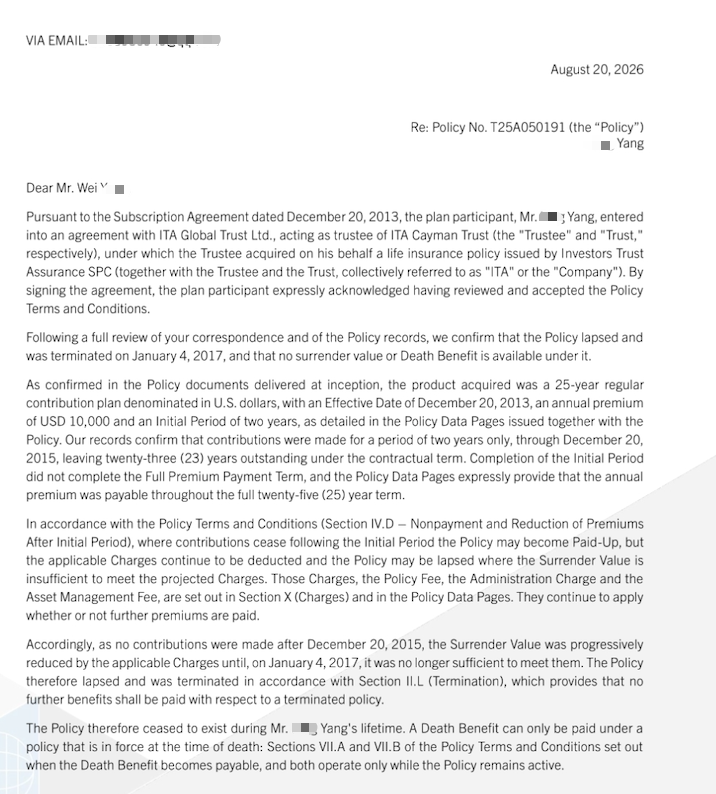
Email sent by ITA to Xiao Wei. Image source: Provided by the interviewee.
Per the insurance policy signed by Ms. Yang, the "Fee Deduction Rules" outlined above are indeed included in the contract. The policy stipulates that premiums are due monthly at $ 7. Management fees are charged annually as follows: from the policy effective date to the relevant policy anniversary date, a fee of 1.9% of the total premium payable is assessed; starting after year 10, the annual fee increases to 0.35% of the total premium payable for each period until the full premium payment term is completed, after which no further management fees will be charged. Asset management fees are calculated annually at 1.5% of the account value.
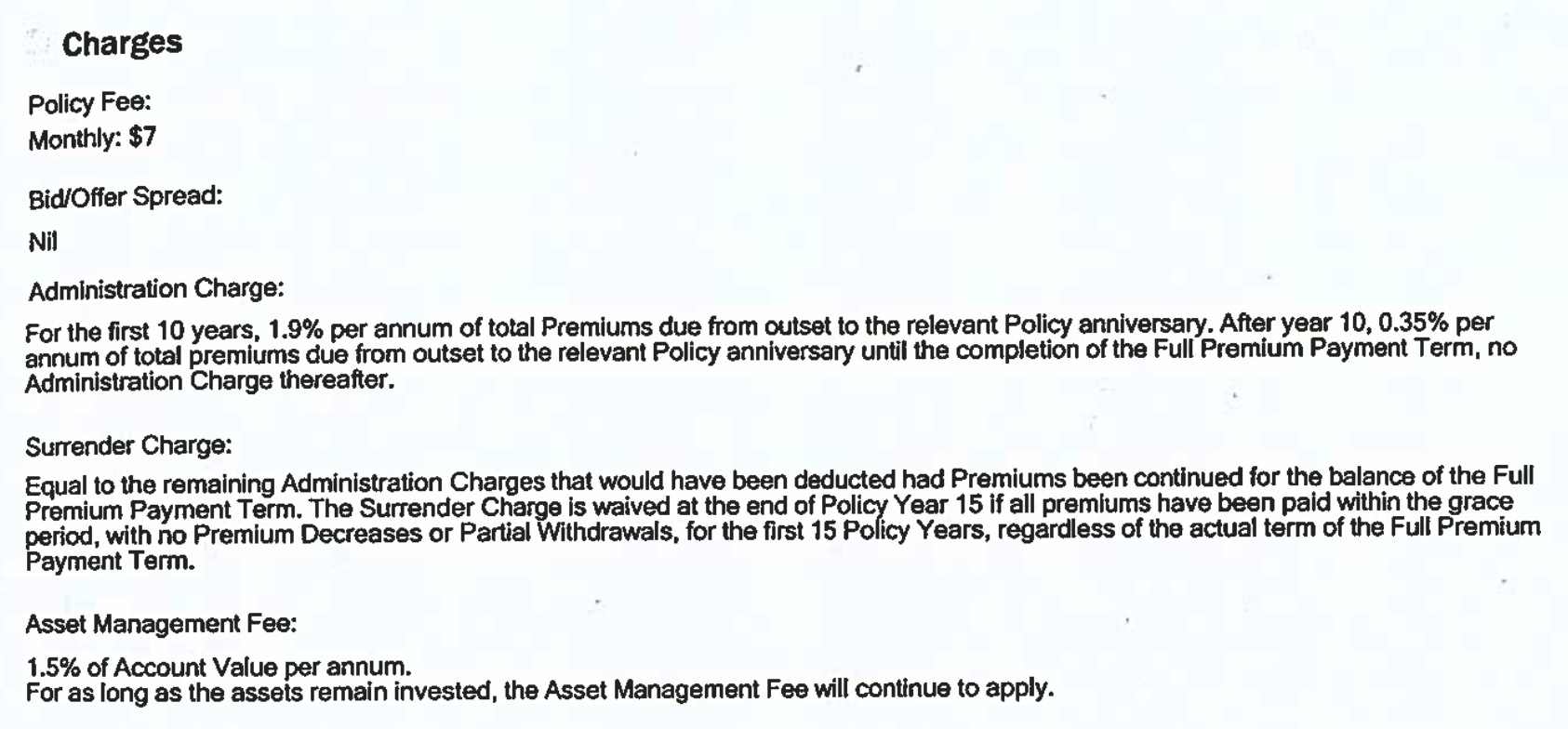
Fees stipulated in the contract. Image source: Provided by the interviewee.
The contract also stipulates that "if the surrender value is insufficient to cover any applicable fees, and sufficient premium payments or loan repayments are not made within the grace period, or if the policy lapses, the Company may, at its discretion, terminate the policy." This is a key piece of evidence cited in the ITA email.
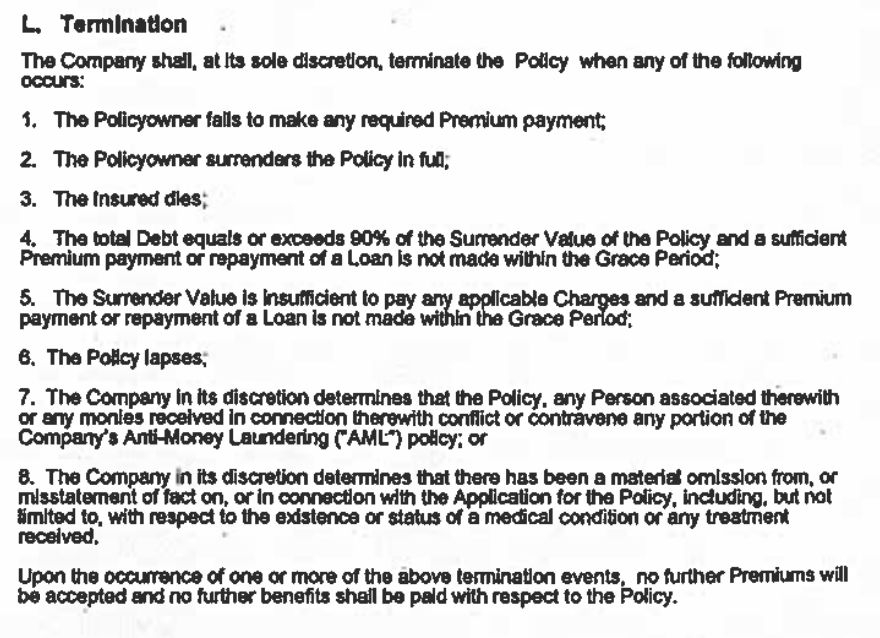
Provisions regarding policy termination in the contract. Image source: Provided by respondent
"The logic of the ITA is: after 2015 year and 12 month, no further premiums were paid. Policy fees, administrative fees, and asset management fees continued to be deducted, eroding the account value until, by 2017 year 1 month 4 day, the surrender value became insufficient. Consequently, the policy was terminated in accordance with Clause II.L of the contract, and a surrender charge was applied at termination based on the total remaining administrative fees per Clause X.F of the contract. All funds invested on that day were liquidated." Li Hanyi, an attorney at Shanghai Guangming (Nanjing) Law Firm, told Interface News. "The $5 redemption fee represents the upfront recovery of approximately 22 years of future administrative costs that have not yet been incurred. It is essentially a recoupment of initial acquisition commissions and costs, not a market investment loss from 2013 to 2017."
"This unfair clause simply doesn't exist in mainland China," Wang Guojun told Interface News. "Many domestic insurers have launched numerous fair products. Even looking back from 2013, many of these products offered excellent coverage and returns."
Xiao Wei emailed ITA to inquire about the specific calculation rules for the 17263 USD redemption fee, but received no response by press time. Interface News reporter also emailed ITA regarding this matter, but received no response by press time.
or misleading during the sales process
"We acknowledge the contract is for 25 years, but the confirmation letter states that payment is required for only two years. We also accept that monthly deductions apply. We calculated that it's just over $100 per month. On 2017/1/4, our account had approximately $4 remaining, which should have been sufficient to cover the charges." Mr. Wei told Interface News. "We were only aware that no further payments would be due after two years; we did not know that failing to pay could result in termination if the remaining account balance was insufficient to cover the fees for the 25-year term."
In fact, selling such "underground policies" carries significant legal risks.
"In 2013, foreign insurers operating in China without approval are suspected of illegal business operations," Li Hanyi told Interface News. "Mr. Wang is an unlicensed insurance intermediary, and we now have signed documentary evidence. The 'Regulations on the Supervision of Insurance Sales Practitioners,' implemented in 2013 7, require practitioners to hold a license. Mr. Wang signed as an 'Independent Introducer' on the ITA confirmation form and questionnaire. If he collected commissions without domestic licensing qualifications, he acted as a commission channel for the foreign insurer within China. If his activities were organized, scaled up, or particularly severe, they may violate Article 225, Item 3 of the Criminal Law regarding illegal operation of insurance businesses. Additionally, if accompanied by fabricated returns or concealed high surrender penalties, it could constitute fraud."
Ms. Yang reported an annual income below 2.5 million USD, violating suitability obligations, as evidenced by the questionnaire. Li Hanyi emphasized that regardless of whether the sale is evaluated against the suitability and disclosure requirements of licensed domestic institutions or against the firm's contractual commitment for independent introducers to "fully disclose all fees, deliver, and explain the product catalog and proposal," the sale was clearly inappropriate. Item 5 of the confirmation only vaguely noted that "the surrender value in the first two years is very small," failing to disclose the fatal consequence: "if payments stop after two years, approximately 86% will still be deducted."
Additionally, Li Hanyi contends that ITA's direct deduction of $0 in redemption fees and its determination that the contract has terminated are still subject to dispute:
First, the contract terms stipulate that lapse is permitted only when the cash surrender value is insufficient to cover the "expected expenses." The 17263 USD represents a lump-sum total of future costs over the next 22 years, not the actual "expected to be collected" expenses at that time. ITA must provide evidence and calculation demonstrating that the cash surrender value was indeed insufficient for the expected expenses on the date of lapse.
Second, termination is permitted only after the "grace period" of 90 days has passed without the deficiency being cured. The clause's grace/remedy structure inherently includes notice and an opportunity to cure; ITA must demonstrate that it provided notice and allowed a 90-day remedy period.
Furthermore, "sole discretion" is not unconstrained. Although the contract frequently grants the company "sole/absolute discretion," under common law and general principles, contractual discretion must be exercised in good faith and for a proper purpose; it cannot be arbitrary, capricious, or exceed reasonable bounds. Where the policyholder also has the right to pay up the policy, the company cannot use discretion as a pretext to bypass grace periods and notice requirements by directly opting for a full surrender that is most detrimental to the policyholder. "This point should be confirmed by local Cayman Islands counsel."


