
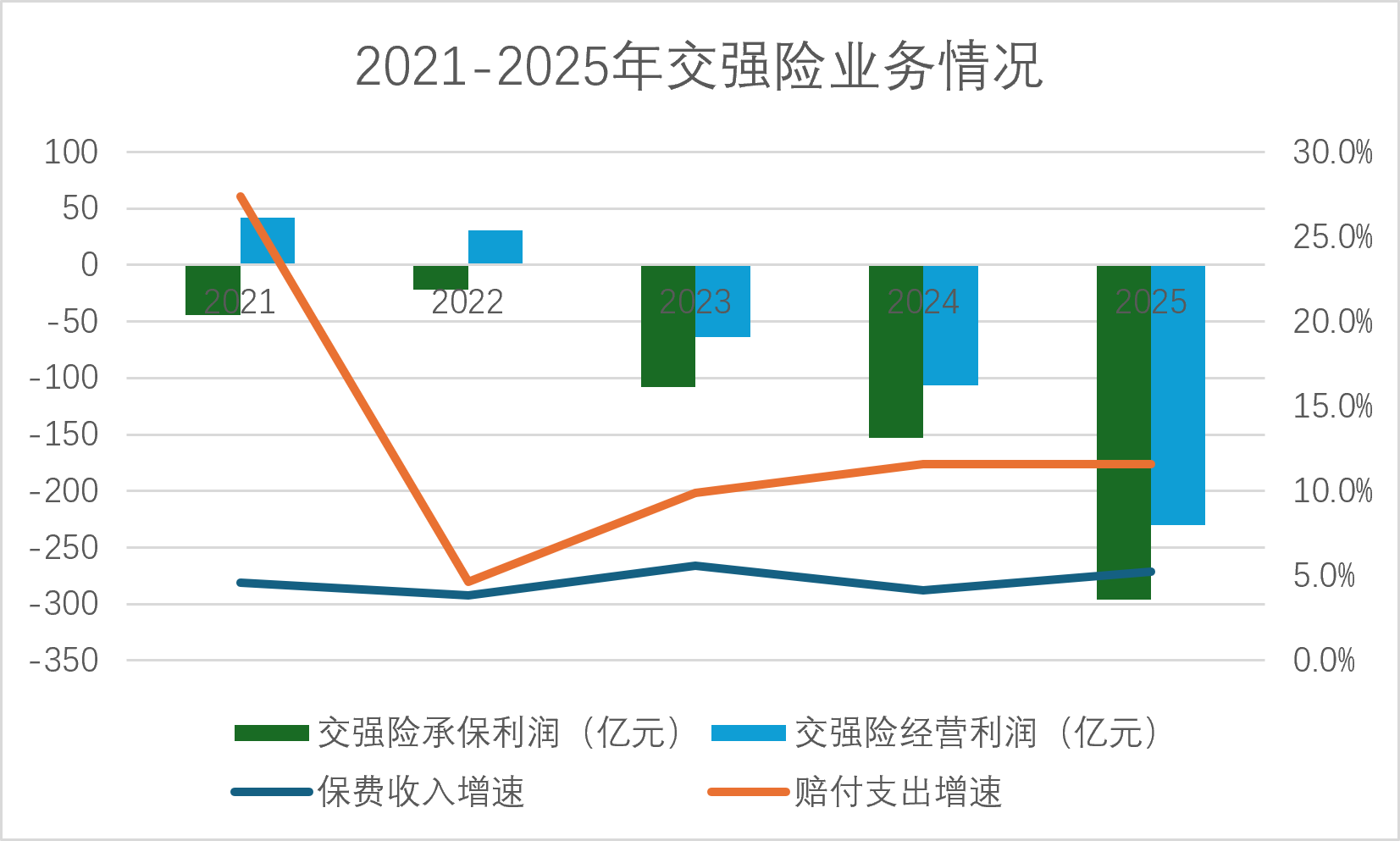
In 2025, compulsory traffic insurance operations incurred losses of 230 billion yuan.
This data comes from the recent announcement by the National Financial Regulatory Administration on compulsory traffic insurance business for 2025. A First Financial reporter's review reveals that since the comprehensive reform of auto insurance in 2020, operating losses in compulsory traffic insurance have expanded for three consecutive years.
The role of Compulsory Traffic Accident Liability Insurance in safeguarding public welfare is undeniable. However, as losses continue to rise, some policyholders are concerned: will premiums for this mandatory insurance increase?
First Financial Daily reporters interviewed multiple insurance industry professionals and experts, who gave consistent answers: raising the basic rate for compulsory traffic accident liability insurance is not easy. Rate adjustments must follow strict legal procedures; a nationwide uniform rate adjustment in the short term is highly unlikely, and short-term losses will not be passed on to consumers.
Underwriting losses have increased 5.7-fold over the past five years.
The Compulsory Traffic Accident Liability Insurance for Motor Vehicles is a mandatory liability insurance where insurers compensate victims (excluding vehicle occupants and the policyholder) for personal injury or property damage resulting from traffic accidents involving the insured motor vehicle, up to the limit of liability. It is China's first state-mandated compulsory insurance system. Since its launch in 2006 year 7 month, it has become one of the most widely covered and highly monitored insurance programs.
Data from the National Financial Regulatory Administration shows that in 2025, the coverage and protection level of compulsory traffic insurance continued to rise: insured motor vehicles reached 3.86 billion, including 3.47 billion cars, representing year-over-year increases of 3.8% and 3.9%, respectively. The total coverage amount for the year was 76.8 trillion yuan, up 3.4% year over year. Meanwhile, the average premium per vehicle was 762.1 yuan, a slight year-over-year decrease of 0.1%, keeping costs stable for vehicle owners.
However, a notable trend is that claims payouts are growing significantly faster than premium income. Data shows that in 2025, compulsory traffic insurance premiums totaled 2852 billion yuan, up 5.2% year over year; while claims payouts reached 2524 billion yuan, up 11.6% year over year—6.4 percentage points higher than the premium growth rate. This resulted in underwriting losses of 296 billion yuan for compulsory traffic insurance in 2025. After factoring in 66 billion yuan in investment income, the final operating loss amounted to 230 billion yuan.
In 2020 year 9 month, as part of the comprehensive reform of auto insurance premiums, the compulsory traffic accident liability insurance coverage limit increased from 12.2 yuan to 20 yuan. The upper bound of the rate floating coefficient remained at 30%, while the lower bound expanded from -30% to -50%. This change significantly increased premium discounts for consumers who did not file claims.
A First Financial reporter's analysis reveals that over the five years following the premium reform, underwriting losses in compulsory traffic insurance have generally widened. Losses expanded from 44 billion yuan in 2021 year to 296 billion yuan in 2025 year, representing a 5.7-fold increase over the five-year period. After allocating investment returns, pre-tax operating profits were 42 billion yuan in 2021 year and 31 billion yuan in 2022 year; however, starting in 2023 year, the company shifted to an operating loss of 64.1 billion yuan, which has continued to widen since then.
Top-tier insurers' reports tell the clearest story. A review of the financial statements for compulsory traffic accident liability insurance (CTALI) from the "Big Three" property-casualty companies in 2025 reveals that all three operated at a loss in their CTALI business during 2025: PICC Property & Casualty's year-end cumulative operating profit shifted from a gain of 81 billion yuan in 2024 to a loss of 23.14 billion yuan in 2025; Ping An Property & Casualty's losses expanded from 16.5 billion yuan in 2024 to 34.04 billion yuan in 2025; and China Pacific Property & Casualty moved from a profit of 2.36 billion yuan in 2024 to a loss of 13.79 billion yuan in 2025. However, when broken down by vehicle type, the bulk of these losses did not come from private passenger vehicles. In 2025, both China Pacific Property & Casualty and Ping An Property & Casualty reported profitable operations on their CTALI business for private cars.
"The payout cost directly impacts the operating results of compulsory traffic insurance," Yu Fei, Assistant President of China Life Property & Casualty, stated at a press conference. In 2025, the rising payout costs for compulsory traffic insurance were the result of multiple converging objective factors.
Specifically, the intensity of motor vehicle usage continues to rise, with compulsory traffic insurance claims increasing by 7.3% year-over-year, forming a foundational driver for higher claim costs. Meanwhile, personal injury coverage has improved, as death and disability compensation is now uniformly calculated based on the disposable income of urban residents; rising income levels have pushed compensation standards upward. Medical expenses are also rising structurally due to advances in medical technology and increased costs for consumables and examinations, directly translating into higher claim costs. The share of new energy vehicles (NEVs) is growing rapidly: in 2025, the industry underwrote 4358 million NEVs, with their market share rising from 8.9% the previous year to 12.1%. Given NEVs' high accident frequency and expensive repair costs, overall profitability remains negative. Additionally, claims services continue to improve through advance payments and expanded police-insurance collaboration for fast handling, resulting in more complete claims data and fuller disbursements.
"From the perspective of premium fluctuation mechanisms, safe drivers and those with no at-fault accidents over multiple years enjoy premium discounts, while premiums for vehicles with claims increase only marginally (given the narrow fluctuation range of compulsory traffic insurance). Combined with background factors such as rising personal injury compensation standards and a growing vehicle ownership base expanding the number of claim cases, the faster growth in payouts compared to premiums is structural and trend-driven. This demonstrates that compulsory traffic insurance is fulfilling its purpose—paying out what it should and providing the necessary safety net, ensuring funds are used where they matter most," said Long Ge, Deputy Director of the Innovation and Risk Management Research Center at University of International Business and Economics, Co-founder, and General Manager of Zhongtuobang.
2026 claims pressure remains high
Based on actuarial reports from leading insurers, the compensation pressure for compulsory traffic insurance in 2026 remains significant.
PICC Property and Casualty Insurance expects the loss ratio for compulsory traffic insurance policies to continue rising in 2026. The pressure stems from two main factors: first, the increasing share of new energy vehicles (NEVs). In 2025, China's NEV production and sales exceeded 1600 million units, with NEVs accounting for 47.9% of total new car sales. The China Association of Automobile Manufacturers forecasts that NEV sales could reach 1900 million units in 2026. Since NEVs have a significantly higher accident frequency than traditional fuel vehicles, their growing market share will directly increase claim costs.
Second, as compensation standards rise with income and inflation levels, they will exert upward pressure on the average claim amount per future policy.
Ping An Property & Casualty's assessment also points to a "modest year-over-year increase" in compulsory traffic insurance claim costs from 2026 to 2025. The final outcome depends on the combined impact of positive and negative factors. Negative factors include higher injury compensation standards, rising labor and parts costs, increasing medical expenses, and growth in non-motorized vehicle ownership. Positive factors encompass improved road environments and the widespread adoption of advanced driver assistance systems (ADAS)—with L2-level ADAS penetration in new vehicles exceeding 45% in 2025, projected to surpass 50% by 2026. Over the long term, this is expected to reduce overall road risk. Additionally, rapid iterations in new energy vehicle manufacturing technology, fluctuating repair costs, and potential updates to injury disability assessment standards introduce significant uncertainty in average claim amounts. Fluctuations in fuel prices and structural shifts between old and new vehicles driven by an overall decline in new car sales in 2026 are also reshaping the risk landscape.
"Rigid factors such as increased compensation standards for personal injury and a rising share of new energy vehicles will likely lead to continued underwriting losses, but coverage levels will steadily improve," said Long Ge.
However, an insurance company's auto insurance head noted that the compulsory traffic accident liability insurance (CTALI) deficit is unlikely to widen rapidly in the short term. This is primarily because, after a slowdown in new car sales—which typically incur higher claims—the proportion of such losses will also decline. Nevertheless, CTALI remains far from turning profitable.
Will premiums increase?
For consumers, the most practical issue caused by continuous losses in compulsory traffic insurance is: Will premiums increase?
Multiple insurers and industry experts interviewed believe the probability of a short-term upward adjustment to the basic Compulsory Traffic Accident Liability Insurance (CTALI) premium is very low.
According to Longe, Compulsory Traffic Accident Liability Insurance (CTALI) operates under a government-approved pricing mechanism designed to be neither profitable nor loss-making, utilizing uniform base rates and terms nationwide. The actual premium is calculated by multiplying the base price by a floating coefficient tied to the driver's claims history; safe driving records qualify for discounts. Adjustments to CTALI base rates require regulatory approval; insurance companies cannot unilaterally increase premiums, and any adjustments must follow strict statutory procedures.
"Adjusting compulsory traffic accident liability insurance rates is not an easy task," said another chief actuary from a major property and casualty insurer. According to the "Regulations on Compulsory Traffic Accident Liability Insurance for Motor Vehicles," if the overall profit or loss of compulsory traffic accident liability insurance operations indicates a need, the insurance regulatory authority under the State Council may require or permit insurers to adjust premiums accordingly. For significant rate adjustments, the regulatory authority must hold a public hearing. In 2007, the former China Banking and Insurance Regulatory Commission held such a hearing regarding compulsory insurance premium adjustments.
"It is highly unlikely that a nationwide standard rate adjustment will occur in the short term," said Long Ge. On a per-vehicle basis, compulsory traffic accident liability insurance premiums have been declining in recent years due to premium rating adjustments, increased emphasis on safe driving, and the implementation of new traffic regulations. In 2025, the average premium was 762.1 yuan, down 0.1% year over year. "Short-term losses will be absorbed by the industry and will not be passed on to consumers. Regulators will prioritize guiding the industry to resolve losses through cost reduction and efficiency improvements," Long Ge added.
PICC Property & Casualty stated in its compulsory traffic insurance report that the company will further enhance refined management of auto insurance, intensify cost reduction and efficiency improvement efforts, and strive to mitigate the impact of external factors on rising claim costs. According to Long Ge, from the perspective of insurers, addressing consecutive operating losses in compulsory traffic insurance can be achieved primarily through standardized competition, expense reduction (e.g., "reporting and execution unification"), and improved claims processing efficiency (e.g., AI-based damage assessment, police-insurance collaboration). For new energy vehicle insurance, insurers can reduce claim costs by collaborating with automakers to optimize repair expenses, while also offsetting losses using investment income.
On the other hand, industry analysts note that consumers typically purchase both compulsory traffic insurance and commercial auto insurance from the same insurer. With commercial auto insurance included, the overall auto insurance business remains profitable, reducing regulatory incentives to adjust rates.
"The impact of the compulsory insurance loss is not significant. After merging with commercial insurance, overall auto insurance profitability remains strong," said the chief actuary. Data from the National Financial Regulatory Administration shows that in 2026, from 1 to 8, the industry's combined ratio for auto insurance dropped to 95.8%, reflecting continued optimization in operations and management.
Individual compulsory traffic accident liability insurance premiums may increase above the base rate due to factors such as at-fault accidents or serious violations like drunk driving. Under the current floating coefficient scheme, vehicles with no at-fault accidents for 3 consecutive years or more can enjoy a premium discount of up to 30%~50%. Conversely, frequent claims will lead to progressive premium increases, capping at an additional 30%.
However, the head of the auto insurance company noted that the long-term trend of compulsory traffic accident liability insurance (CTALI) rates remains uncertain. CTALI premiums have not been adjusted in years, while compensation standards for personal injury and parts prices continue to rise. The extent to which future improvements in intelligent systems and road safety conditions can offset these cost pressures will determine the direction of rate adjustments. He also recommended implementing differentiated pricing for new energy vehicles based on their energy type, given their higher claim costs.


