

Source: Insurance Educators
By Luo Wen
In 2018, Yellow River Property & Casualty Insurance officially launched, with high market expectations: rooted in Northwest China and leveraging expertise in engineering insurance to build a local insurance platform serving the Belt and Road Initiative.
Eight years later, this blueprint is facing a reality check. In the first half of 2026, Yellow River Property Insurance demonstrated remarkable momentum: its comprehensive solvency adequacy ratio reached an impressive 508.75%, placing its capital buffer among the top tier of smaller property insurers. Yet challenges such as equity pledges, regulatory penalties, and a combined ratio persistently exceeding 100% continue to loom.
Underwriting continues to bleed despite healthy book profits.
With massive capital backing, Yellow River Property & Casualty's struggles highlight a key pain point for many P&C insurers: Why is underwriting profitability so hard to achieve despite ample capital? And how should local insurers balance social value with commercial operations?
01 boasts strong solvency, supported by profitable investments.
From a capital metrics perspective, Yellow River Property Insurance has substantial financial reserves.
As of the end of Q2 2026, the company's actual capital stood at RMB 23.36 billion, with a minimum required capital of just RMB 4.59 billion, resulting in a core solvency adequacy ratio of 504.36%. All liquidity indicators meet regulatory standards; there is no liquidity risk, and ample capacity exists to support business experimentation.
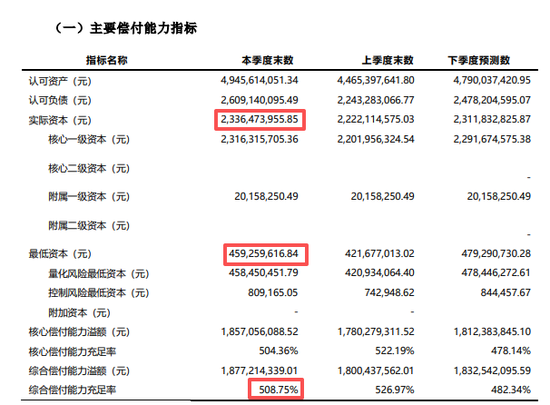
But breaking down the first-half operating results reveals an immediate contradiction.
In the first half of 2026, Yellow River Property & Casualty Insurance reported insurance revenue of 9.57 billion yuan and net profit of 0.69 billion yuan, resulting in a book profit. This profit did not come from selling insurance.
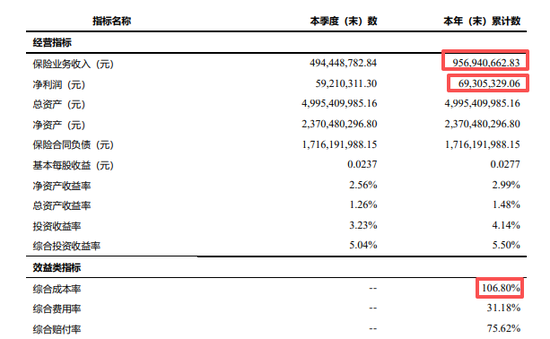
The first-half combined ratio was 106.80%, surpassing the underwriting break-even line. Specifically, the combined loss ratio was 75.62% and the expense ratio was 31.18%. Underwriting operations were unprofitable, with net profit supported by a 5.50% investment income yield.
Simply put, the core insurance business isn't profitable; it relies on investment returns to support its financial statements. Since investment income is highly volatile, market shifts cause reported earnings to become unstable. Premiums decreased by 6.09% year-over-year, and as the business scaled down, growth momentum weakened.
Management recognized the issue early, making loss reduction in underwriting a primary goal in its solvency report and overhauling its performance metrics to place greater weight on profitability. While capital buffers are ready, capital does not automatically convert into underwriting capacity. Stopping the bleeding from underwriting operations became Huanghe Property & Casualty's first challenge.
Ideal of 02 without a real controlling structure collides with the reality of shareholder funding.
Upon establishment, Yellow River Property & Casualty Insurance adopted an equity structure with no controlling shareholder and no actual controller.
Jointly held by multiple companies from provincial state-owned assets, central enterprises, and private sectors. The intent is clear: to mitigate risks associated with a single major shareholder and pool resources from diverse parties to serve infrastructure development and the real economy in Gansu. It was once regarded as an institutional experiment in local insurance operations.
Ideal design meets real-world pressures.
As of the end of Q2, shares held by all three shareholders were in an abnormal state. Specifically, 100% of the equity held by the major shareholder, Gansu Public Road & Travel Group 20, has been pledged to other companies; 8% equity held by Gansu Yuanda Investment Group is also pledged; and 5% equity held by Lanzhou New Area Urban Construction Investment Co., Ltd. has been frozen by judicial authorities. The prolonged duration of these equity anomalies makes them highly likely to result in deductions during comprehensive risk assessments.
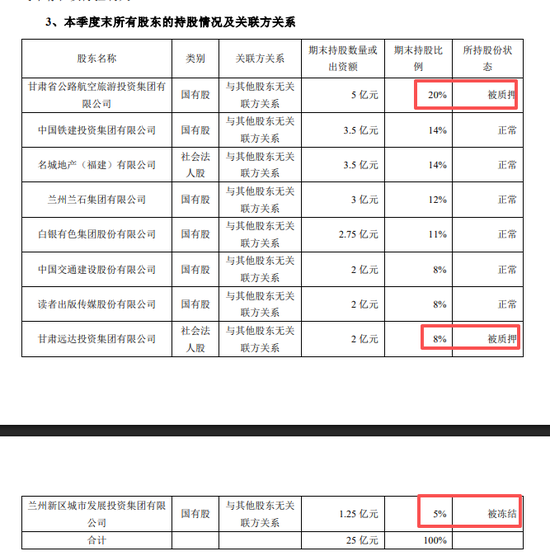
The company has established a routine monitoring mechanism to track shareholder operations and equity changes, actively promoting the release of pledged shares. The absence of a controlling shareholder is a double-edged sword: it helps prevent risk transmission from any single shareholder, but it also increases financial pressure on certain shareholders and raises communication costs among them. Future actions such as capital injections or equity transfers remain highly uncertain.
Governance gaps also extend to compliance.
During the reporting period, two administrative penalties were imposed. The head office was fined 170.09 million yuan by the People's Bank of China Gansu Branch for anti-money laundering violations. Wuwei Branch was fined 7 million yuan for providing contract-benefit inducements to policyholders. Additionally, a director was fined 110 million yuan by the China Securities Regulatory Commission for illegal activities committed during his tenure at a former shareholder company.
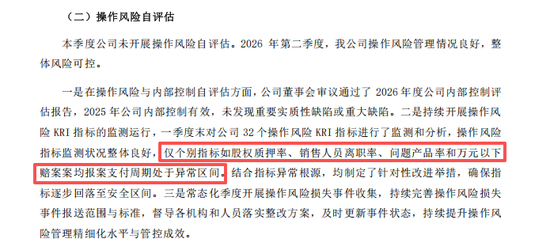
Operational risk monitoring reveals anomalies across multiple indicators, including staff turnover among sales personnel, claim payment cycles for cases under $10,000, and the rate of problematic products. The report explicitly cites recurring violations at branch offices and notes that a negative list has been established and special compliance inspections are underway. Both penalty notices and anomalous metrics point to the same issue: gaps remain in the head office's penetrative internal control over branch operations.
03 Say goodbye to reliance on engineering insurance; the government-backed insurance sector hides volatility.
In its early days, engineering insurance was Yellow River P&C's cornerstone. In its first year, engineering insurance premiums accounted for over 80% of total revenue, deeply aligning with the Northwest infrastructure boom.
Infrastructure projects are highly cyclical with significant volatility. Yellow River Property Insurance is actively scaling back its engineering insurance portfolio, seeking to break free from path dependency by shifting focus to liability insurance, agricultural insurance, and government-backed health coverage.
Rooted in Gansu, Yellow River Property & Casualty Insurance holds a natural advantage.
During the reporting period, the Company signed a reinsurance agreement for agricultural insurance with Zhongnong Re and effectively implemented local agricultural protection measures. The Company also continued to win bids for government-related insurance products, including official vehicle insurance and work safety liability insurance. As a locally incorporated financial institution, we benefit from a streamlined decision-making process that enables us to closely address local public welfare needs.
Local advantages are difficult to replicate outside the home region. Yellow River Property & Casualty Insurance operates only in Beijing, Hebei, and Gansu. Beyond its core markets, it faces stiff competition from top-tier insurers and lacks competitive edge in channels, brand recognition, and talent. Expanding further entails high costs.
In niche business segments, short-term health insurance is under pressure. In the first half of 2026, Huanghe Property & Casualty Insurance reported a loss ratio of 394.87% for this line of business, ranking first among small and medium-sized property and casualty insurers that publicly disclose short-term health insurance loss statistics.
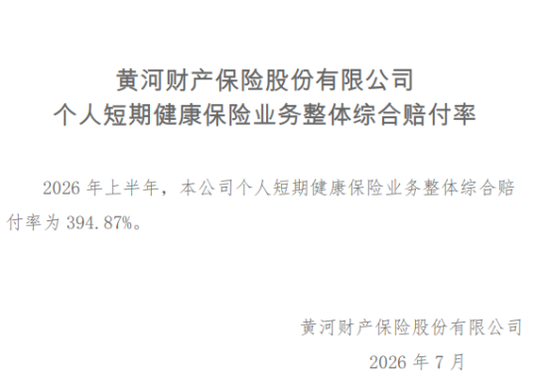
Please note: this figure reflects claims statistics for the short-term health insurance line only and does not represent the company's overall loss ratio. Due to the relatively small premium base in short-term health insurance, concentrated claims or reserve adjustments can cause significant spikes in the loss ratio.
The government-backed livelihood business has two sides. On one hand, it offers high social value and strong demand; on the other, pricing risk is challenging and profitability is weak. By leaving its familiar engineering insurance market to enter the livelihood protection sector, the company faces risks of business volatility.
This is a matter of trade-offs.
How do we define success for 04 regional legal entity insurance?
Many regions have established property and casualty (P&C) insurers with the goal of supporting local infrastructure and public welfare. However, once operational, they often face similar challenges: while they leverage local resources to secure government-backed projects, they also grapple with shareholder governance pressures and product homogeneity, making it difficult to break out of this cycle.
The comprehensive risk rating is Class B, indicating that Yellow River Property & Casualty Insurance's overall risks are manageable and the report confirms no material internal control deficiencies. However, three challenges remain: legacy equity issues, pressure to reduce underwriting losses, and compliance gaps at branch offices.
For local insurers, success is never a single answer. Is it premium volume? Annual book profit? Or the ability to provide stable, long-term risk protection for the local community?
Yellow River Property & Casualty Insurance's transformation is far from over. How this company, rooted in Northwest China, converts its capital advantages into underwriting competitiveness while balancing commercial operations with social value remains a journey worth watching closely.


