
Sun Shihui, reporter for 21 Century Economic News
Auto insurance is getting "wild" lately: insurers say they're losing money, while policyholders say premiums are going up.
Recently, the National Financial Regulatory Administration released an announcement on the business status of Compulsory Traffic Accident Liability Insurance for 2025, revealing key figures: the total number of insured motor vehicles nationwide reached 3.86 billion, a year-on-year increase of 3.8%; in 2025, underwriting losses amounted to 296 billion yuan, while allocated investment income totaled 66 billion yuan.
Let's start with a few key figures:
While the industry claims losses, you're paying more. Where did that money go? What exactly does compulsory auto insurance cover—and what doesn't? Is buying only compulsory coverage enough? Can you decline bundled seat protection? This article clears it all up.
First, let's clarify: where does the money for compulsory traffic insurance go wrong?
Let's start with a basic concept. Compulsory Traffic Accident Liability Insurance is China's first legally mandated insurance, introduced in 2006. Its two key features are: it is mandatory—you must purchase it if you drive on the road;
Second, it is not profit-driven; coverage applies only to third-party victims in traffic accidents. It does not cover the insured vehicle itself, its occupants, or the policyholder.
Therefore, this 296 billion yuan underwriting loss reflects an enhancement in protection: higher payouts and broader coverage. It functions more like a "safety cost" shared across society, ensuring that every victim of a traffic accident receives at least basic compensation.
But here's the puzzle: if the books show such losses, why do owners feel like it's getting more expensive?
The industry lost 296 billion yuan. Why is your premium still rising?
This isn't an illusion. Some policyholders report that their quotes increased despite three consecutive claim-free years, while others say they were bundled with unwanted "seat insurance."
Long Ge, Deputy Director of the Center for Innovation and Risk Management at the University of International Business and Economics, stated that the industry will absorb pressure through commercial vehicle insurance quoting, underwriting, and bundling. Therefore, what drivers truly experience is "operating losses on mandatory insurance paired with hidden high costs in commercial coverage."
One-sentence summary: The compulsory insurance account loses, while the commercial auto policy bill rises.
What does a 20k limit mean in the face of an accident?
Many have considered this: buy only compulsory insurance to save money. Let's do the math first.
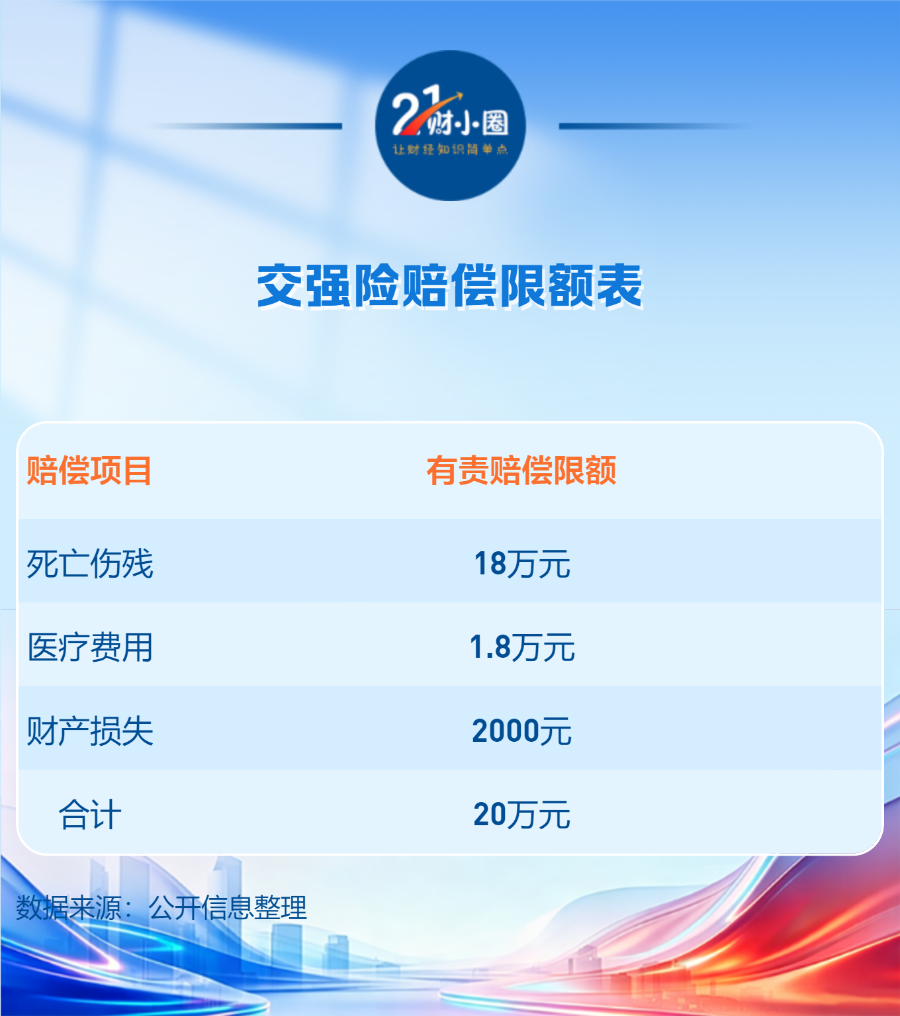
After the 2020 comprehensive reform, the liability compensation limits for Compulsory Traffic Accident Liability Insurance are as follows:
Compare side by side:
Consider another real case. In a 202024-year-old case concluded by the Qidong Court, Wan drove a vehicle that collided with an electric bike, causing Tao to suffer severe injuries, resulting in a vegetative state and Class I disability. Since the vehicle was only insured with compulsory traffic liability insurance, the court ordered the insurer to compensate 18 ten thousand yuan within the insurance limit, leaving the remaining 95 ten thousand yuan to be paid out of pocket by Wan.
Long Ge pointed out that in 2025, compulsory third-party liability insurance coverage reached 76.8 trillion yuan, but the limit per claim is very low. Essentially, it functions as a "statutory safety net"—ensuring compensation is available, but not guaranteeing it will be sufficient.
Who covers large payouts? Commercial auto insurance. The China Insurance Association's New Energy Vehicle Commercial Insurance Model Terms list vehicle damage liability, third-party liability, and passenger liability as three independent primary coverages. Policyholders may choose to purchase all or select some of these coverages, with coverage amounts determined through negotiation between the policyholder and the insurer.
Compare Compulsory Traffic Accident Liability Insurance with Commercial Third-Party Liability Insurance side by side for a clearer picture:
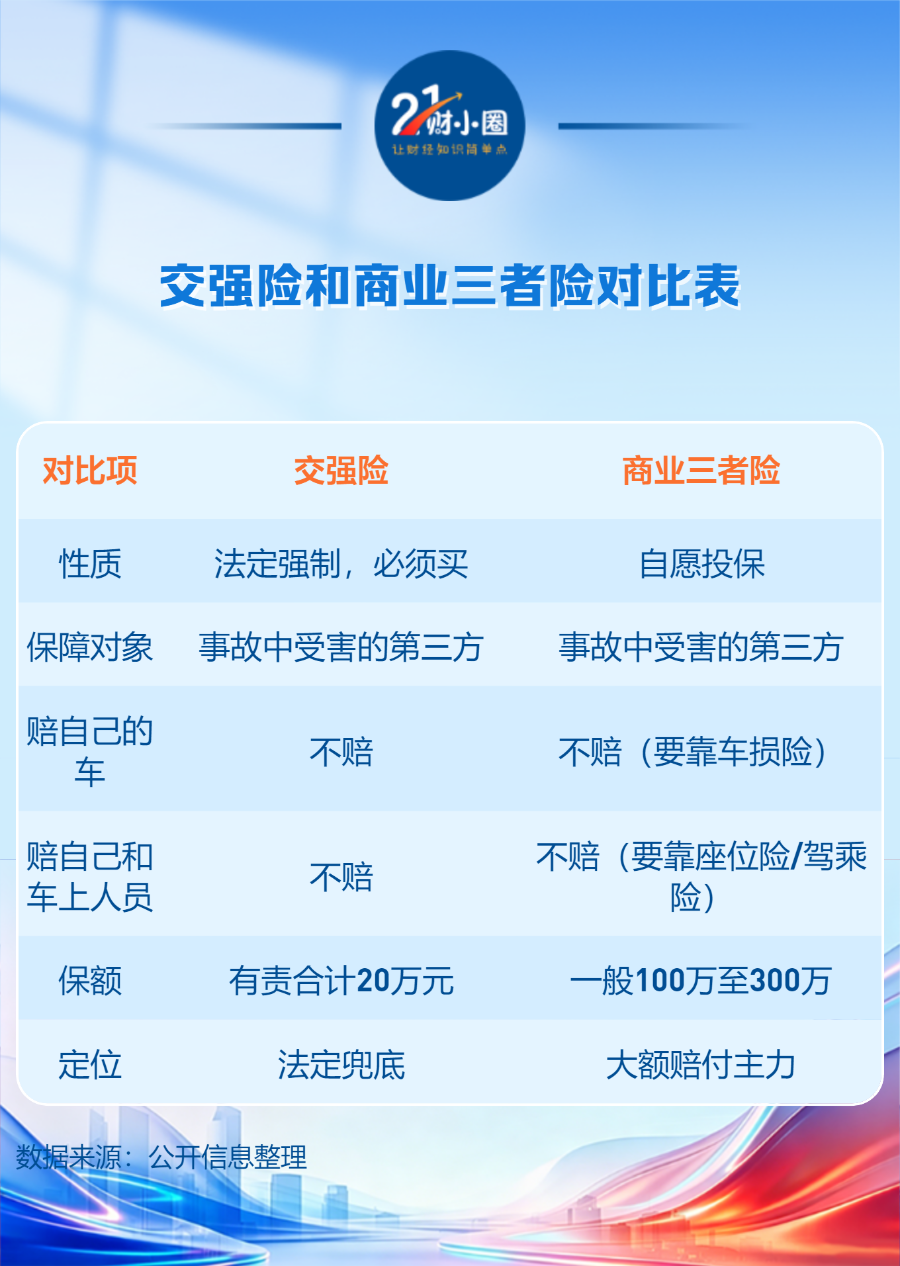
One often-overlooked blind spot: compulsory liability insurance does not cover injuries to occupants of your own vehicle. If you or passengers in your car are injured in an accident, this coverage provides no payout. To fill this gap, consider purchasing seat occupancy insurance (occupant liability insurance) or driver and passenger accident insurance.
Can you refuse when seat insurance shifts from "optional" to "mandatory"?
Legally, the Insurance Law is clear: except where laws or administrative regulations mandate insurance, insurance contracts are entered into voluntarily. For commercial auto insurance, you can theoretically choose whatever coverage you want.
However, in reality, some car owners have reported: despite explicitly stating they only wanted compulsory traffic insurance and third-party liability coverage, sales staff claimed that without adding other protections, "the system would significantly increase premiums, making underwriting and policy issuance impossible due to head office risk control requirements."
Where's the difference? It's not in collision coverage or third-party liability. It's in the new quote, which adds driver liability and passenger liability for all four seats—45 million yuan per seat, with total premiums exceeding 1000 yuan.
An auto insurance professional revealed that this situation is not uncommon. In telemarketing scenarios, most insurers evaluate sales agents based on the proportion of "non-auto" coverage—such as driver and passenger insurance or personal accident insurance sold alongside mandatory third-party liability and vehicle damage policies. The expert stated that while seat insurance is optional by default, policyholders can firmly decline bundled offers and even threaten to file a complaint; in most cases, this resolves the issue immediately.
The issue is that filing a complaint isn't always a low-cost solution. After one owner complained, they received a call from a sales representative who offered to remove the seat insurance but raised premiums on other commercial policies instead: "No discount without seat coverage; you must accept this price." In the end, the plan without seat insurance ended up costing more than the original package with full coverage.
Longe pointed out that, under the 2023 "Administrative Measures for Insurance Sales Conduct," forced bundling, pre-checked options, and coercing additional purchases by threatening to withhold policies are all violations. Vehicle owners may request a detailed quote, switch insurers, or use the "Car Insurance Easy Purchase" platform; after recording the transaction details, they can file a complaint with 12378.
Moreover, the reality is often more complex than "forced bundling." One insider admitted, "If the proportion of non-vehicle items drops too low, KPIs are penalized."
Sales teams face pressure not just from internal targets, but from a deeper challenge: new energy vehicle insurance is disrupting traditional auto insurance profitability models.
First, consider the scale:
However, scaling up has not led to improved profitability. According to data released by the Society of Actuaries of China, in 2025, new energy vehicle insurance underwriting losses still reached 56 billion yuan, with a year-over-year loss reduction of only 1 billion yuan, and the combined ratio decreased by 1.3 percentage points—meaning the industry as a whole has yet to cross the break-even point.
How to Buy Car Insurance: A Complete Guide
Runge provided a clear framework you can directly follow:
Must-buy:
Recommended purchase:
Buy as needed
One thing to clarify: if an add-on is forced due to "the system cannot process the order," it's not a recommended guarantee—it's a prohibited bundled sale.
Who should seriously consider adding coverage? Who shouldn't rush to pay yet?
Recommend adding extra coverage:
Don't rush to pay:
Ultimately, this is a safety cost shared by society as a whole.
For car owners, the 296 billion yuan loss in compulsory traffic accident liability insurance is an industry statistic; but "Is buying only compulsory insurance enough?" is a decision directly tied to their own risk.
The law of large numbers applies to insurance companies' overall risk management, not to individual accidents. A serious accident causing severe injury or death can result in compensation ranging from hundreds of thousands to over a million yuan. In this context, the 20 yuan limit of compulsory traffic insurance is negligible.
Special Notice
This article analyzes and interprets data on Compulsory Traffic Accident Liability Insurance (CTALI) and commercial auto insurance based solely on publicly available market information. The goal is to help readers understand relevant products and regulations; it does not constitute any form of investment or underwriting advice. Specific insurance coverage, rates, and claims handling are subject to the terms of the insurance contract and the latest regulations issued by insurance companies. For issues related to bundled sales complaints or claims disputes, please refer to regulatory authority guidelines and official interpretations from the respective insurance companies.


