
Sun Shihui, reporter for 21 Century Economic News
On 10/8, the central financial institutions' special treasury bond issuance (Phase 1) for the year 2026 successfully concluded its competitive bidding, with a total face value of 1500 billion yuan in the initial round.
In accordance with the Ministry of Finance's Q4 government bond issuance plan, the proceeds from this bond issuance will be exclusively allocated to replenish core Tier 1 capital for 8 central financial institutions, including China Export & Credit Insurance Corporation, China Life Insurance Group, PICC Group, China Taiping Insurance Group, and China Reinsurance Group.
Meanwhile, according to an incomplete tally by reporters from 21 Century Economic Daily, more than 20 insurance companies have announced capital injection plans this year. From special treasury bond injections by central financial institutions to shareholder capital increases and strategic investor introductions by local insurers, the pace of capital supplementation in the insurance sector is accelerating.
Central SOE Insurance Company Included in Capital Injection Scope for the First Time
On 9 6, 10 central financial institutions—including ICBC, ABC, the Export-Import Bank of China, Sinosure, China Life Insurance Group, PICC, CPIC, and China Reinsurance—announced capital increases. The three institutions plan a total capital injection of 3600 billion yuan, with the Ministry of Finance contributing 3000 billion yuan through special treasury bonds.
Unlike the initial focus on capital replenishment for major state-owned banks at the start of the year, this round's plan marks the first time that policy-based financial institutions and state-owned insurance groups have been fully included in the capital injection scope. China Life Insurance Group, PICC, China Taiping, China Reinsurance, and China Export & Credit Insurance Corporation—5 central state-owned insurance enterprises—are now on the injection list. This represents the first time in recent years that special treasury bonds have been used for targeted capital injections into central state-owned insurance firms, surpassing market expectations in both coverage breadth and support strength for the financial system.
Everbright Securities' research report estimates that, using data as of the end of Q2 2026 as a static benchmark, the core solvency adequacy ratios of PICC Group, China Reinsurance Group, China Life Insurance Group, and China Taiping Insurance Group will increase by 6.1, 3.9, 5.2, and 5.0 percentage points, respectively, following the implementation of this capital injection.
Zhou Jin, a Partner at Tianzhi International Financial Services Consulting, analyzed that the purpose of this capital increase is to hedge against the erosion caused by low interest rates and mitigate the impact on core capital stemming from the downward shift in the 750-day government bond yield curve over recent years (Note: The 750-day moving average government bond yield curve serves as the key benchmark for insurers to assess insurance liability costs). Direct capital injection bolsters capital reserves and stabilizes the solvency adequacy ratio. Furthermore, once solvency is reinforced, it can further alleviate capital constraints on increasing equity allocations, enabling insurers to better respond to calls for long-term capital entering the market.
Over 860 billion in capital increases by 23 insurers this year
According to incomplete statistics by reporters from the 21 Century Economic News, at least 23 insurance companies have announced capital increase plans this year (including 5 central state-owned insurance enterprises that received capital injections from the Ministry of Finance), covering life insurance, property insurance, reinsurance and other sectors. The total amount of capital increases exceeds 860 billion yuan.
Among 23 insurance institutions, there are 11 life insurers, 5 property insurers, 5 insurance groups, 1 reinsurers, and 1 mutual insurance organizations.
From the perspective of capital increase methods, there are three main categories: direct equity injection by shareholders (including pro-rata increases by existing shareholders and introduction of new shareholders); external financing through instruments such as capital supplementary bonds and perpetual bonds; and optimization of capital structure via equity transfers or introducing strategic investors.
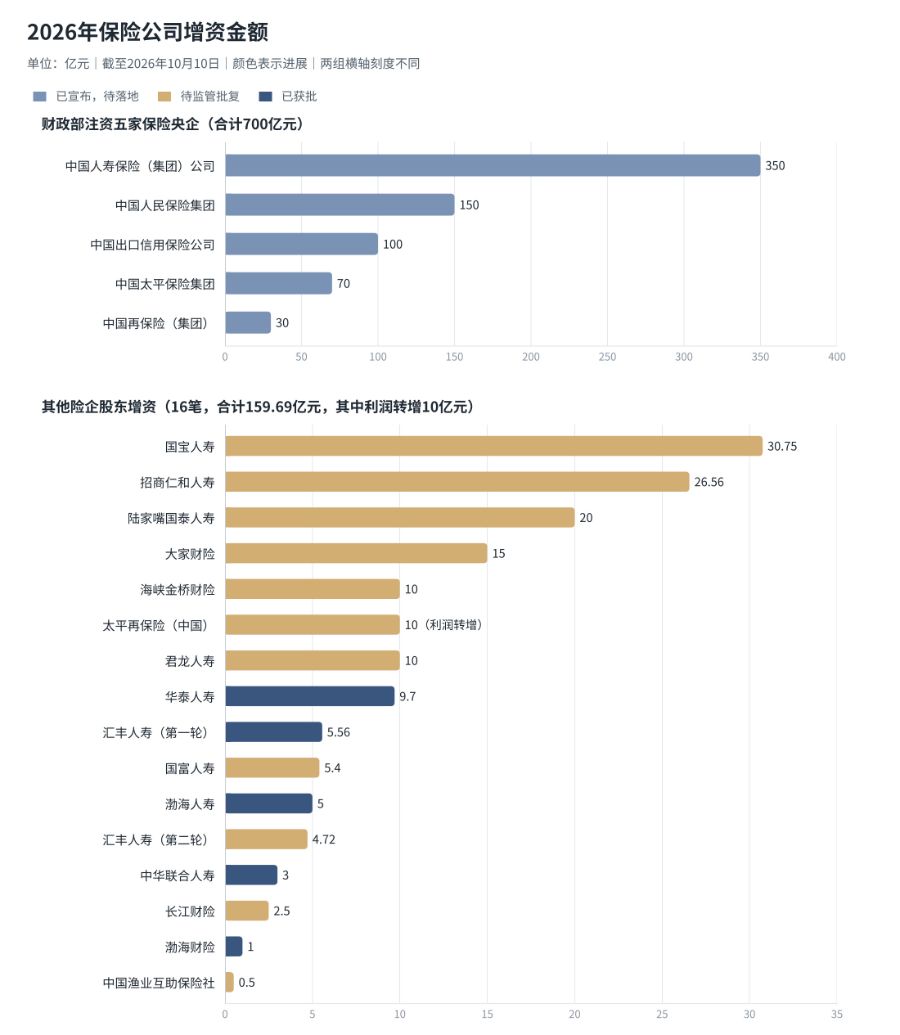
Looking at the scale of capital increases, the injection by central insurance SOEs far exceeds market-based capital raises. Through special treasury bonds, the Ministry of Finance injected a total of 700 billion yuan into 5 central insurance SOEs: China Life Insurance Group, PICC, Sinosure, China Taiping, and China Reinsurance. Among them, China Life Insurance Group led with 350 billion yuan, followed by PICC (150 billion yuan), Sinosure (100 billion yuan), China Taiping (70 billion yuan), and China Reinsurance (30 billion yuan).
In market-driven capital increases, proportional contributions by existing shareholders remain the prevailing approach. Dajia Property Insurance received a 15 billion yuan injection from Dajia Insurance Group, raising its registered capital from 40 billion to 55 billion yuan. China United Life Insurance saw capital injections of 2.4 billion and 0.6 billion yuan from China Insurance Group and China United Property Insurance, respectively, increasing its registered capital from 41 billion to 44 billion yuan. HSBC Life completed two rounds of capital increases this year; its sole shareholder, HSBC Insurance (Asia), contributed a total of 10.28 billion yuan, boosting registered capital from 26.76 billion to 37.04 billion yuan.
Meanwhile, new shareholder introductions and equity transfers are being advanced in parallel. For instance, Yangtze Property & Casualty Insurance has brought in the Hubei Provincial Water Resources and Hydropower Planning Survey Design Institute as a new shareholder with an investment of approximately 2.5 billion yuan; Guofu Life Insurance received investments of 4.8 billion yuan from Guangtou Financial Holdings and 0.6 billion yuan from Vipshop; Guobao Life Insurance welcomed 8 new shareholders, contributing a total of about 30.75 billion yuan and increasing its registered capital to 45.21 billion yuan, marking one of the largest market-based capital increases this year.
Capitalizing retained earnings is one method of supplementing capital. Taiping Reinsurance (China) capitalized 10 billion yuan from retained earnings as of year-end 2025, increasing registered capital from 15 billion to 25 billion yuan without new capital inflow.
In addition to central state-owned insurance enterprises, major single capital increases include China Merchants Renhe Life (26.56 billion yuan), Lujiazui Guotai Life (20 billion yuan), and Junlong Life (10 billion yuan).
As of now, capital increase plans for HSBC Life, China United Property & Casualty Insurance, Huatai Life, and Bohai Property & Casualty Insurance have been approved. Plans for Dajia Property & Casualty Insurance and Changjiang Property & Casualty Insurance are still pending regulatory approval. Additionally, capital increase proposals from Bohai Life and Zhongan Online were based on prior years or previously undisclosed information but have already been approved this year.
Apart from shareholder capital injections, bond issuance is another key channel for insurers to bolster their capital. According to incomplete statistics, 19 insurers have completed or obtained approval for 21 bond issuances this year, totaling approximately 600 billion yuan. Among these, perpetual bonds amount to 399 billion yuan, accounting for nearly 70%—marking the first time they have surpassed traditional capital-supplementing bonds in scale. PICC Life and New China Life Insurance each received approval to issue a 10-billion-yuan perpetual bond in 7 and 8, respectively.
C-ROSS Phase II Final Exam
Industry insiders cite several factors behind the surge in capital injections by insurers this year. The end of the Phase II transition period for C-ROSS (China Risk Oriented Solvency System) combined with the switch to new accounting standards has increased reserve requirements, putting pressure on solvency ratios. Additionally, the shift toward participating life insurance products and post-reform expansion in non-auto lines within property and casualty insurance have driven demand for stronger capital reserves.
Industry-wide data shows that as of the end of Q2 2026, insurers' average comprehensive solvency ratio was 180.6% and core solvency ratio was 133.5%, both significantly above regulatory standards. However, some smaller and mid-sized insurers remain near the regulatory threshold.
At the end of 2021, the former CBIRC released "Insurance Company Solvency Regulatory Rules (II)," which stipulated that the Phase II "C-ROSS" framework would take effect in Q1 of 2022, with a three-year transition period under the "one company, one policy" approach. This period was subsequently extended by one year to the end of 2025. Starting in 2026, the transition period officially ended, and stricter capital and risk measurement rules were fully implemented.
Zhu Junseng, a postdoctoral fellow in applied economics at Peking University and professor, analyzes that after the transition period ends, capital constraints will become fully rigid and minimum capital requirements will rise across the board. The industry's average minimum capital is projected to increase by 5% to 8%. Among them, property & casualty insurers face a minimum capital growth of approximately 7.5% due to the upward adjustment of risk weights for non-auto insurance business (credit insurance, guarantee insurance, and catastrophe insurance).
The transition to new accounting standards constitutes a second source of pressure. Non-listed insurers have implemented the new financial instruments and insurance contract standards since 2026. The new standards require that insurance reserve liabilities be measured using current interest rates for discounting. Given that interest rates remain at low levels, the present value of discounted reserves has increased, directly impacting the net assets of insurers.
Overall, 5 insurers failed to meet solvency requirements by the end of Q2, including Huahui Life, Anhua Agricultural Insurance, Changsheng Life, Qianhai Property & Casualty, and Asia Pacific Property & Casualty. According to Changsheng Life's Q2 solvency report (the "Report"), the company was subject to three mandatory measures by the Shanghai Bureau of the National Financial Regulatory Administration during the reporting period, including a requirement to increase capital within one year. The comprehensive adequacy ratios of Happy Life, Hongkang Life, and Hetai Life also approached the key review threshold of 120%.
Notably, under the combined influence of regulatory guidance and market mechanisms, the "toolkit" for industry capital replenishment is expanding. From special treasury bonds issued by the Ministry of Finance to inject capital into state-owned insurance enterprises, to small and medium-sized insurers raising capital through shareholder capital increases, strategic investor introductions, and perpetual bond issuances, a multi-layered and multi-channel capital replenishment system is rapidly taking shape.
Industry experts believe that as capital replenishment takes effect and business structures continue to optimize, the sector's overall risk resilience will be further strengthened.


