
Special: Golden Pixiu · 2026 7th Bank-Insurance Cooperation and Development Forum
Source: Insurance Experts
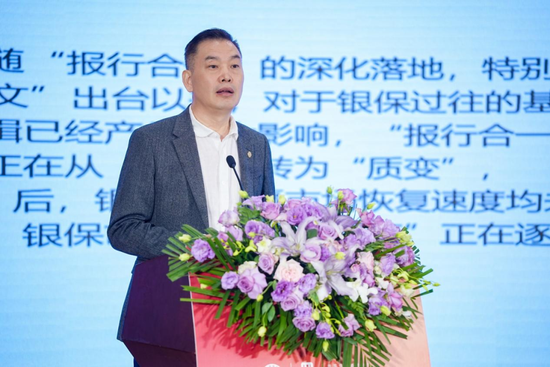
With "reporting and execution unity" shifting from quantitative to qualitative change and the insurance-banking market reaching a turning point, Zhang Baojun believes the way forward is to let go of past success stories and re-evaluate the market with a "zero mindset."
On 2026年9月22日, the 7th Bank-Insurance Cooperation and Development Forum of "Golden Pixiu" · 2026, along with the award ceremony for bank-insurance series awards, was held in Beijing. Hosted by Yiqu Finance Media and "Insurance Enterprise High Reference", this year's forum centered on the theme "Offensive and Defensive Strategies: Harmonizing Light and Dust". Senior leaders from regulatory bodies, banking, and insurance sectors engaged in insightful discussions on the development of bank-insurance cooperation following "Document No. 65".
Zhang Baojun, a member of the Party Committee and Deputy General Manager of Dajia Life Insurance, outlined the direction of going with the flow and rebuilding a foundation for professionalized operations in light of market shifts following policy implementation.
Zhang Baojun stated that "integration of reporting and operations" continues to deepen. Since Notice No. 65 officially took effect on 7/1, the business logic that the bancassurance industry has relied on for decades is undergoing a fundamental shift, along with its growth model. Scale is no longer the sole performance metric; high quality and sustainability are now paramount. Zhang believes that customer demand for retirement savings and wealth succession remains, as does banks' drive to expand fee-based income. The long-term value of bancassurance channels persists; what needs rebuilding is the foundation of professionalized operations.
The inflection point for bancassurance has arrived.
Regulatory measures target a high-quality liability framework
In his opening remarks, Zhang Baojun noted that based on monthly data for the year on single-premium and regular-premium market sizes, figures were generally high at the start of the year, followed by fluctuations in subsequent months. New business recovery after 6 month 30 did not meet industry expectations, while the mix between regular and single premiums continued to shift. A turning point in the bancassurance market has now emerged. At this juncture, it is essential to reassess the market, clearly understand the challenges facing bank insurance, and identify viable paths forward.
Reflecting on the industry's journey, Zhang Baojun divides more than 30 years of bancassurance development into several phases. Bancassurance began in the late 1990s; after establishing the legal status of agency in 1996, it entered a萌芽期 (germination phase). Around 2006, regulations on branch cooperation tightened, making the long-term on-site direct sales model in bank halls mainstream. Leveraging channel dividends and participating universal life insurance products at the time, bancassurance grew rapidly. In 2008, bancassurance premiums surpassed individual insurance, accounting for over 50% of total premiums. However, this growth also gave rise to issues such as weak channel oversight, uncontrolled commission hikes, and misleading sales practices at branches.
From 2011 to 2023, Zhang Baojun considered this a period of industry transformation and upgrading, with business model and product transitions advancing alternately. In 2010, Document No. 90 established regulatory red lines, prohibiting on-site sales and mandating a "1+3" branch cooperation model, making banks the legal entities for branch sales. From 2017 to 2019, documents such as No. 173, No. 176, and No. 179 were issued successively, further solidifying regulatory bottom lines. Starting from 9 1, 2023, the bancassurance channel began implementing "reporting and execution alignment," marking a new phase of deep transformation in the industry. With the relaxation of restrictions on "1+3", channel access has moved toward marketization, and the industry is gradually moving away from old models.
According to Zhang Baojun, the policy package aims to help the life insurance sector build a high-quality liability framework by strictly controlling three types of risks on the liability side: interest rate spread, mortality spread, and expense spread. For participating policies, both guaranteed and illustrated rates are capped from both sides, curbing exposure to interest rate spread losses at the systemic level. The updated mortality table accounts for longevity trends, recalibrating pricing and reserve assumptions to strengthen the foundation of mortality spread control. Document 65 imposes requirements for authenticity and reasonableness in product pricing and expense structures, with a focus on mitigating expense spread risks. Zhang emphasizes that the full rollout of "reporting and execution consistency" has initially curbed chaotic competition over expenses. In a low-interest-rate environment, life insurers cannot focus solely on the liability side; asset-liability matching will become the benchmark for bancassurance management. The old growth-at-all-costs approach no longer aligns with current regulatory guidance and market conditions. Under multiple constraints, achieving structured liability management is the essential path for sustainable development of bancassurance business.
Back to Basics
Rebuild the foundation of collaboration among customers, banks, and insurers
The pressure to transform is significant, but Zhang Baojun sees opportunities from both the client and bank sides.
In a low-interest-rate environment compounded by capital market volatility, households are increasingly seeking defensive asset allocation. There is growing demand for guaranteed, stable assets that lock in long-term returns—a need perfectly met by insurance's long-term savings attributes. Against the backdrop of an aging population, structural demands for retirement wealth and intergenerational transfer continue to emerge, driving household financial assets toward retirement reserves, long-term care funding, and legacy planning.
On the banking side, net interest margins continue to narrow and operational pressures intensify, creating an urgent need for new pathways to convert large volumes of idle deposits. Zhang Baojun noted that banks' net interest margins have fallen to 1.42%, with non-performing asset pressures far exceeding margin space. As a result, shifting toward retail banking and expanding non-interest income has become a practical necessity; insurance distribution now serves as a key lever for optimizing asset allocation. Banks also maintain extensive offline branch networks and dedicated relationship manager teams. The fee income generated from high-value insurance products can help banks establish a second growth curve.
Zhang Baojun believes that the core needs on both ends remain unchanged; what won't work is the old business approach.
To return to the core, Zhang Baojun explains that the model achieves a win-win for all three parties. Bank-insurance collaboration involves customers, banks, and insurers; sustainable success requires balancing the interests of all three.
From the customer perspective, insurance is valued for its dual functions: long-term savings and risk protection—this is its core purpose. From the bank's perspective, a stable supply of insurance products that consistently generate fee-based income is essential, supported by a comprehensive marketing and service knowledge system. From the insurer's perspective, building a healthy asset-liability matching structure and adhering to long-term, steady operations are fundamental to serving both customers and banks effectively.
Against the backdrop of Document No. 65, Zhang Baojun predicts a new collaborative landscape is emerging: banks will handle compliance-driven sales execution at branch locations, while insurance companies will lead professional customer lifecycle management. To realize this new partnership, insurers must focus on refining branch operations, restructuring insurance-banking teams through tiered segmentation, building a multi-segment customer management system, diversifying product and service offerings, and maintaining strict compliance—shifting the operational focus back to customer-centricity.
Five Areas of Exploration for Specialized Operations
Dajia Life's Practice and the Art of "Offense and Defense"
Customer management ultimately hinges on capability. Guideline 65 has expanded cost management scope to include all types of expenses, and channel competition now centers on the comprehensive battle of products, services, and ecosystems. Insurers have much more than one area to improve. Zhang Baojun outlined five key areas of exploration based on Dashu Life's recent practices.
In branch operations, Dazhong Life is advancing a reform in human-resource and network management to drive refined branch operations and build "core branches." This initiative is supported by a transformation of the bancassurance team. According to Zhang Baojun, the company is developing a "Three Specializations, Five Actions" team: the Three Specializations are Professional, Dedicated, and Expert; the Five Actions are Cultural Competence, Professional Excellence, Service Orientation, Adaptability, and Continuous Learning. The recruitment, development, and retention systems are all aligned with branch operations. Recruitment focuses on hiring talent that matches branch needs, resources and training plans are coordinated, and long-term retention mechanisms are established to encourage qualified professionals to stay in the bancassurance line for the long term.
Leveraging its own health and wellness resources, Dajia Life has built a more compelling customer engagement system through the Dajia Insurance Group. This includes "Dajia's Home" urban medical-nursing communities and travel-based wellness retreats. Zhang Baojun emphasized that ecological resources must be transformed into products and scenarios for frontline teams to use. This approach delivers practical value to customers, provides emotional value through scenario-based services, and creates marketing opportunities for partner banks while alleviating their pressure.
At the product level, Zhang Baojun proposed building a comprehensive "Product + Service + Ecosystem" framework. To support end-to-end customer lifecycle management, this system must be complete: anchored by wealth management products and augmented with protection offerings, supporting services, and ecosystem benefits, creating a full-featured catalog for long-term customer engagement.
Compliance is the bottom line repeatedly emphasized by Zhang Baojun. Document No. 65 imposes strict requirements on expense management, making compliance the prerequisite for all current business operations. Dajin Life has established a full-process closed-loop management system spanning from headquarters to frontline teams, creating a complete cycle of pre-event, during-event, and post-event controls. This ensures implementation of key requirements such as product budgeting, prior filing, detailed account categorization, post-event audits, and lifetime accountability—bringing the mandates of Document No. 65 into practical business execution.
Zhang Baojun acknowledged that the bancassurance industry is at a pivotal moment where outdated models are fading and new opportunities are emerging. The era of chasing scale and competing on fees has ended, yet demand for clients' retirement savings and wealth transfer persists, as does banks' pursuit of fee-based income; the long-term value of the bancassurance channel remains intact. "Offense and defense" means defending compliance boundaries, asset-liability safety, and the core essence of insurance, while aggressively seeking change by reconstructing branches, teams, products, and service systems. "Harmonizing with the world" entails deeply integrating the interests of banks, insurers, and customers to achieve collaborative success. Zhang believes future competition in bancassurance will center on refined channel operations, professional team capabilities, product-service ecosystems, and robust compliance management. Only by returning to fundamentals and rebuilding professional operational capabilities can bancassurance achieve sustainable long-term growth.


