
Special: Golden Pixiu · 2026 7th Bank-Insurance Cooperation and Development Forum
Source: Insurance Experts
Against the dual backdrop of comprehensive fee management and declining interest rates, the bancassurance channel is undergoing a repositioning following a regulatory shift.
On 2026年9月22日, the 7th Bank-Insurance Cooperation and Development Forum of "Golden Pixiu" · 2026, along with the award ceremony for bank-insurance series awards, was held in Beijing. Hosted by Yiqu Finance Media and "Insurance Enterprise High Reference", this year's forum centered on the theme "Offensive and Defensive Strategies: Harmonizing Light and Dust". Senior leaders from regulatory bodies, banking, and insurance sectors engaged in insightful discussions on the development of bank-insurance cooperation following "Document No. 65".
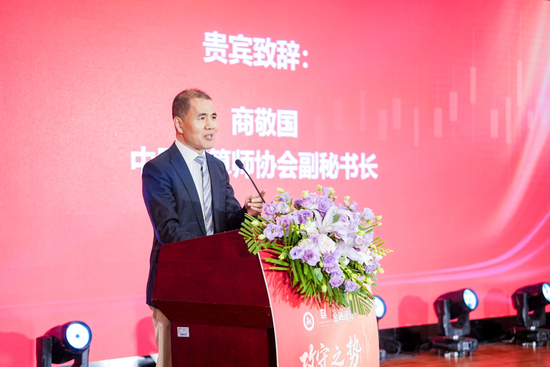
Shang Jingguo, Deputy Secretary-General of the China Institute of Actuaries, explored the potential for collaboration in bancassurance within capital markets, social security, and the AI era from the perspectives of market dynamics and strategic assessment.
In his speech, Shang Jingguo stated that insurance-banking has moved beyond simple business operations and deserves greater industry attention. He shared five key insights on market dynamics, strategic assessment, capital market linkages, livelihood protection, and collaboration opportunities in the AI era.
Respect market principles
The insurance-banking model should not be dictated by textbooks.
According to industry exchange data, the 2025 year new business premium volume in bancassurance channels was approximately 8446 billion yuan, representing a 15.2% year-over-year growth. With a share of over 60%, it has re-established itself as the leading new business channel for life insurance.
Shang Jingguo admitted that the bancassurance business was initially viewed skeptically. Many companies firmly refused to enter this space, only to later adopt it themselves—a clear sign of market choice. He noted that the market allows diverse models to coexist across different development stages. Business models are not fixed; no textbook formula should dictate which channels a company should or should not pursue. The market is always right.
He believes that the shift from extensive growth to high-quality development is a process of market rationalization, driven by both market selection and competition among market participants. The resulting model will ultimately be determined by the market. Assessing market trends without considering the industry's context at the time is inappropriate; judging past events through today's lens is not sound. He therefore emphasizes the need for an error-tolerance mechanism within the industry.
Since modes are selected by the market, there shouldn't be just one metric to judge channel quality.
Evaluating bancassurance requires looking beyond current profits.
Strategic dimensions are equally important.
According to industry data, in the first half of 2026, new single-premium direct-writing premiums for bancassurance grew year-over-year by approximately 10%, while single-premium lump-sum premiums reached about 2904 billion yuan, down approximately 3% year-over-year. The "Old Seven" insurers recorded 1088 billion yuan in periodical premiums for bancassurance, up 31% year-over-year, with their market share rising from 33.8% to 40.38% compared to the same period last year. While scale metrics cooled, periodical and value metrics continued to rise.
Shang Jingguo believes that views on banks and insurers require a more multidimensional approach, particularly from a strategic perspective encompassing both corporate and industry development. At this stage of industry evolution, profit should not be the sole guiding principle; instead, we must prioritize long-term vision and century-spanning goals rather than focusing only on short-term gains or losses. He also cautioned that financial actuarial models alone are not fully reliable for determining whether a business is profitable. Actuarial assumptions, financial projections—especially those regarding the future—are often inaccurate. These assumptions can serve as a foundational basis for judgment but should never be the sole criterion for evaluating a business's success or failure.
For large corporations, bancassurance is often a strategic decision. Shang Jingguo notes that while some companies may not profit from their bancassurance operations this year, the diversification of business lines and risk hedging can yield greater benefits. When other channels experience overall declines, bancassurance typically steps in as a cornerstone, filling any shortfall to maintain volume. Treating bancassurance as a strategic initiative yields different outcomes compared to viewing it as optional. Previously, companies that focused exclusively on individual agent distribution have now embraced bancassurance, while those once committed to avoiding it are now participating—a reflection of market dynamics.
In Shang Jingguo's view, conducting strategic assessments beyond the business level itself signals the industry's maturation. Meanwhile, the interconnections among bancassurance, capital markets, and social security are strengthening, broadening the scope for collaboration.
Capital Markets, Livelihood Protection, and AI
There is still room for expansion in bank-insurance cooperation.
The high-quality development of bancassurance is closely tied to the high-quality development of capital markets. Shang Jingguo admits that looking back at the evolution of bancassurance, strong performance in capital markets has consistently coincided with robust growth in bancassurance—the market doesn't lie, and the correlation between the two continues to strengthen. This linkage is underpinned by asset scale. According to regulatory data, as of the end of Q2 2026, total assets managed by insurance companies reached 40.82 trillion yuan, with equity allocations accounting for 10.41%—the highest level since such data began being disclosed.
He further emphasized that high-quality development of the capital market requires high-quality growth in bancassurance. Only through this mutual support can both sectors thrive. Bancassurance holds distinct advantages across short-, medium-, and long-term funding horizons; it is inaccurate to assume all bancassurance funds are short-term. In the future, medium- and long-term funds could become a significant source of capital for the market. This seemingly incidental yet meaningful support rests on solid logic and warrants deeper industry research and discussion.
Social security is another emerging area. Shang Jingguo notes that in a K-shaped economic environment, where traditional economic growth is slowing, the role of social security as a safety net has become increasingly critical. Governments are increasingly relying on market mechanisms to fulfill this role, which amplifies insurers' responsibilities. The complementary relationship between banks and insurers is also becoming more pronounced. As key participants, insurers collaborate closely with banks on enterprise annuities. Meanwhile, individual pension schemes are gradually expanding, and medical insurance reforms are advancing. Such cooperation facilitates the implementation of numerous pilot programs and projects aimed at improving social welfare. According to the "2025 National Aging Development Report," by the end of 2025, China's population aged 60 and above reached 3.23 billion, accounting for 23.0% of the total population. The number of people covered by long-term care insurance exceeds 3.2 billion.
Shang Jingguo highlighted the value of bank branches. Financial license data shows there are approximately 22 thousand bank branches nationwide—the scenario customers are most eager to visit and hardest to replace. Some believe branch value will decline as business expansion slows, but Shang disagrees. He argues that while future branches may be fewer in number, their value will rise. Not all services can be handled by AI or digital channels; customers still need face-to-face interactions. Currently, many call center agents provide irrelevant responses, making it difficult for customers to reach a real person.
The space for collaboration in the AI era was the focal point of Shang Jingguo's remarks. He stated that finance, dominated by banking, is a unique feature of China and will not undergo significant long-term changes. Banks are trusted, irreplaceable infrastructure for the public, providing a solid foundation for both parties to jointly advance AI development. Instead of investing heavily separately, insurance and banking should aim for 1 + 1 > 2 in their investments to achieve mutual success. Collaboration between insurance and banking can be more diverse and cover broader areas. Although insurance operations are more complex than banking, they can become simpler in the AI era. Industry investment in AI is accelerating: in 2025, the insurance sector invested 480 billion yuan in information technology, including 15 billion yuan specifically for AI—a year-over-year increase of 50%. AI penetration in sales channels has reached 50%.
According to Shang Jingguo, what insurance-banking partnerships do and don't do is determined by the market and the industry's stage of development. How far they can go depends on how much more there is for banks and insurers to achieve together.


