

Every Economic Daily Reporter | Yuan Yuan, Editor-in-Charge | Dong Xingsheng
"We began internal reviews of our marketing and management processes starting in March and April this year, including compliance language for live streaming, agent account management, and identity verification." As an insurance professional, Xiao Zhang (pseudonym) had already prompted his insurance intermediary to initiate internal process adjustments and standardization ahead of the implementation of the "Financial Product Online Marketing Management Measures" (commonly referred to in the industry as "930 New Regulations").
In Xiao Zhang's view, this foundational groundwork is an industry must-do. Online customer acquisition has long become a core channel for many insurance agents. According to him, the top three sales elites on his agency's 2025 performance leaderboard all operate personal social media accounts and conduct live streams online to identify customers through digital channels. "This ratio is even higher than in 2024, which means we must keep pace with our agents by strengthening management and support."
At the time, Xiao Zhang's biggest concern was how major social media platforms would regulate insurance livestreaming and marketing accounts. As the implementation of the "Financial 930 New Regulations" approaches, platforms have begun taking action to align their content with the new requirements. The most closely watched development has been Xiaohongshu's strict qualification verification for insurance agents.
While Xiaohongshu isn't the first platform to certify insurance agents, its recent launch has drawn significant market attention. Will identity verification become a hurdle for agents' professionalized accounts? And will it drive traffic to their personal profiles? A reporter from The Daily Economic News investigated these questions.
Labor contracts or agency agreements can both serve as verification documents.
"Obtaining official 'professional certification' is equivalent to securing a compliance 'pass' for business operations." "For insurance practitioners seeking stable content creation and reduced violation risks, professional certification is the most fundamental and secure first step." ... Recently, Xiaohongshu launched a qualification certification program for insurance professionals. Consequently, guides detailing the certification process have become increasingly common. Wang Yue (pseudonym), an insurance agent, completed this certification immediately upon its release.
"The verification process is quite straightforward, similar to the one for Video Accounts." Wang Yue has already submitted the required credentials. The platform indicated, "Review expected to be completed within 7 business days."
When reporters opened the Xiaohongshu personal verification page, they found that professional qualification verification is categorized into healthcare, legal, business and finance, media, public officials, education, and travel. Insurance practitioners are classified under "Business and Finance," further divided into two subcategories based on whether they signed an employment contract or an agency agreement.
Agents employed by insurance companies or intermediary agencies must submit an employment contract or certificate of employment (containing name, ID number, hire date, job title, and company seal; issued within the last month). Agents with agency agreements who cannot provide an employment contract or certificate of employment must submit their agency agreement as proof of identity (containing valid information such as name and ID number; issued within the last month).
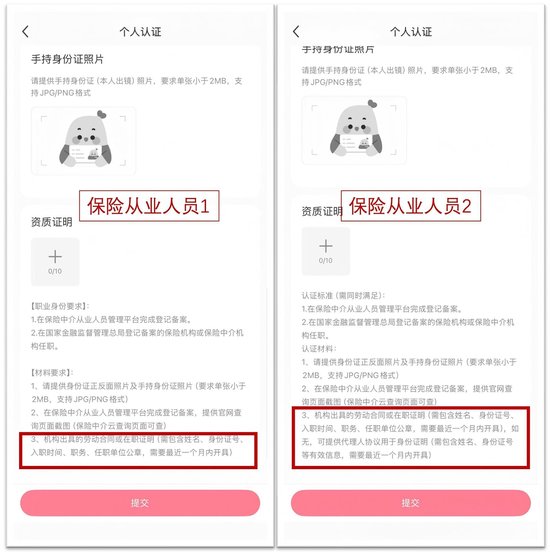
Platform rules indicate that the labor contract is not the sole entry requirement; proof of employment and agency agreements also carry certification validity. "Most insurance agents sign commission-based agency contracts rather than labor contracts," an insider from an insurance company told reporters. The agency model remains the dominant structure for insurance sales teams in China, where agents and agencies maintain a civil entrustment relationship without the employer-employee hierarchy defined by labor law. Compensation is primarily commission-based, and agents do not receive employee social security benefits. Strict adherence to labor contract requirements would render the vast majority of frontline agents ineligible from the outset.
Both the employment verification letter and the agency agreement will now serve as certification credentials, making the rules more flexible for agents. Once an agent completes certification on the Xiaohongshu platform, the title "Insurance Professional" will appear in the bio section of their profile.
Multiple institutions have adjusted their identity verification processes.
In response, multiple insurance companies and intermediary platforms have made adjustments.
Taking DATONG Insurance Services as an example, its sales enablement tool "Kuai Bao" features a unified portal for issuing proof of employment. Agents select the intended use and submit an application; upon approval, an electronic proof of employment is generated. To prevent ambiguity or misunderstanding, the document explicitly states that the relationship with the agent is one of commissioned sales. Beyond providing certified documentation support, DATONG Insurance Services maintains close communication with three major platforms—Douyin, WeChat Channels, and Xiaohongshu—to proactively address common issues encountered during the certification process.
"For the new regulations regarding 930, we have indeed adjusted our processes to be more proactive," said an insider at a certain insurance company. Currently, the company not only requires agents to complete Xiaohongshu verification but also sets "Professional Qualification Validity" as a mandatory validation item for KOS (Key Opinion Sales) account operations and content distribution within its internal management system. If an agent's professional status becomes abnormal, the system will directly restrict the marketing permissions of associated accounts, plugging the loophole of unqualified marketing at the source. Additionally, for collaborations with external influencers, the company has established a stricter qualification access review process to ensure that all outward-facing content marketing activities are built on compliant qualifications.
Reporters noted that Xiaohongshu is not the first platform to introduce professional verification. In 3 this year, WeChat Channels already required accounts claiming professional qualifications to complete either individual or organizational verification, ensuring consistency among the on-screen person, verified information, and supporting credentials.
How much does enabling professional certification impact frontline agents? According to Wang Yue, who already completed video account professional certification, the impact on personal business operations beyond compliance is minimal. "I finished my certification in the first half of the year, but traffic hasn't changed much," she said. "My main goal was to be able to discuss insurance topics." For her, certification primarily serves to activate private domain traffic.
However, the impact of "930 new regulations" extends further than that. Wang Yue's concerns have not subsided. "After the implementation of '930 new regulations', we can no longer discuss products freely. This means we're limited to insurance education, and live streaming comes with many restricted terms. I'm waiting to see what changes occur after '930'."
Practitioners: Unclear boundaries remain an issue.
It is worth noting that during the agent certification process, both affiliated institutions and practitioners identified issues with unclear boundaries between certain platforms and financial qualification requirements.
"930 new regulations require authorization and the use of institutional accounts for online marketing of financial products. Based on actual practices across platforms, only two account types fully comply: enterprise accounts verified as financial institutions (commonly known as 'Blue V') and employee accounts owned by companies where agents have usage rights only." A representative from a certain insurance intermediary platform told The Daily Economic News reporter that many personal insurance practitioner certifications still exist on the platform—such as on Video Accounts, Douyin, and Xiaohongshu, which recently opened insurance practitioner certification—and non-compliant financial activities may still be prevalent.
Additionally, one of the requirements for Douyin's Personal Insurance Practitioner Certification is to "hold an insurance intermediary practice certificate for at least 5 years." However, the inquiry portal on the Insurance Intermediary Cloud Platform only displays the most recent institution registration information, with no way to access past practice records. This effectively imposes a requirement that practitioners must remain continuously employed by the same insurance intermediary agency for 5 years with an active agency relationship, inadvertently raising the certification threshold.
Practitioners cite data issues as the most significant challenge. Staff at an insurance intermediary platform noted that platform certifications and data from the Banking and Insurance Credit Information Center are not integrated, leaving the platform unable to verify authentication materials provided by institutions, agents, or other financial professionals—particularly whether professional license numbers are genuine. This gap could create major risks for non-compliant financial activities.
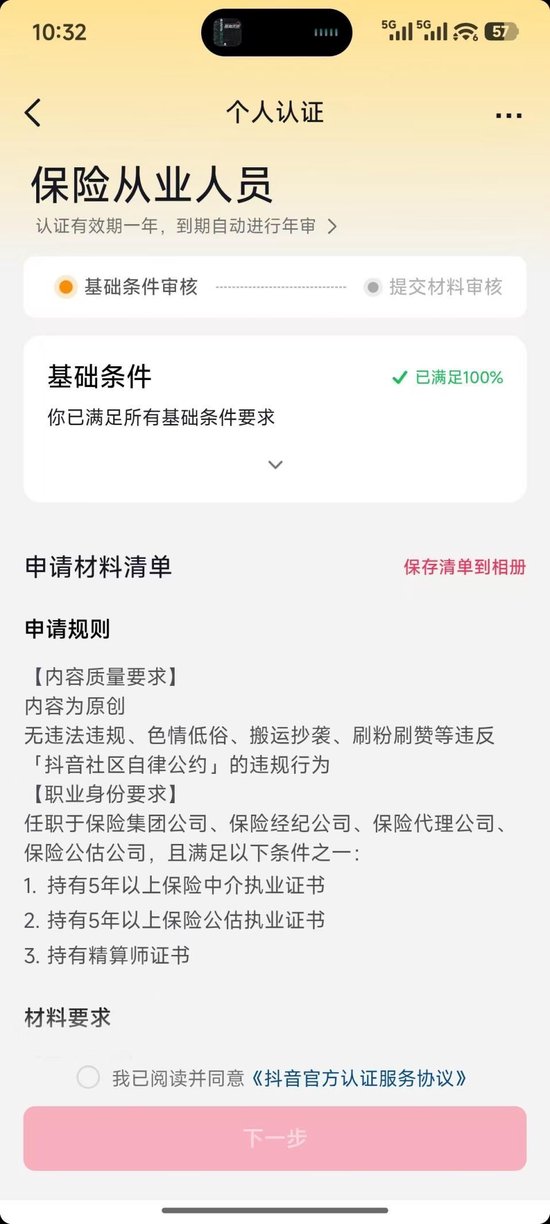
However, the aforementioned experts also noted that given the lack of integration between platform verification and CBIRC data, submitting employment certificates remains a crucial piece of evidence to validate the authenticity of an agent's professional status. This practice has long-term rationality and necessity. As finance is a licensed industry, regulatory scrutiny is expected to tighten over time; consequently, platform rules are more likely to become stricter rather than more lenient. Nevertheless, addressing boundary issues will require enhanced multi-party collaboration in practice.
"The 'Administrative Measures for Online Marketing of Financial Products' requires third-party platforms to verify the qualifications of marketing entities, aiming to standardize online insurance product marketing and implement the principle of 'licensed institutions and certified personnel,'" said an industry insider. "Digitalization is a societal trend; adapting to it is not optional but essential for survival. In fact, in some respects, an institution's support for its agents entering self-media determines whether it can survive."
Cover image source: Meijing Media Library


