
Dividend policies have recently gained significant traction. According to industry exchange data released earlier by the China Insurance Association, dividend insurance gross written premiums totaled 10126 billion yuan from 1 to 6 in 2026, representing a year-over-year increase of 94.4%. As a result, dividend insurance has become one of the most frequently recommended products by bank relationship managers.
So, for individual investors, is participating insurance worth buying? Below, Cai Xiaoquan breaks it down from an investor's perspective.
A participating insurance policy is a type of life insurance in which the insurer distributes a portion of its distributable surplus from the previous year to policyholders annually. Its returns typically consist of two components: a guaranteed return, which is contractually specified (though net of fees it may be slightly lower), and a dividend return, which is variable and depends on the insurer's actual investment performance.
Regulatory requirements mandate that insurers distribute at least 70% of distributable surplus to policyholders annually; however, the timing and amount of these distributions are not guaranteed.
By coverage type, there are 3 common categories in the market:
Participating Whole Life Insurance (Coverage + Lifetime Savings);
Participating Endowment Insurance (Lump-sum maturity benefit paid at maturity);
Dividend-Paying Annuity Insurance (Annual/Monthly Payouts, Ideal for Retirement Planning).
Note that the demonstration rate shown by your account manager is not a guaranteed return—it's like "a promise on paper" and may not materialize. Instead, focus on the base salary, which represents the guaranteed minimum return (also known as the guaranteed interest or guaranteed benefit). This is the amount you are certain to receive. Under current regulations, this cap is 1.75%. The actual return rate after dividends has a benchmark guideline of 3.2%.
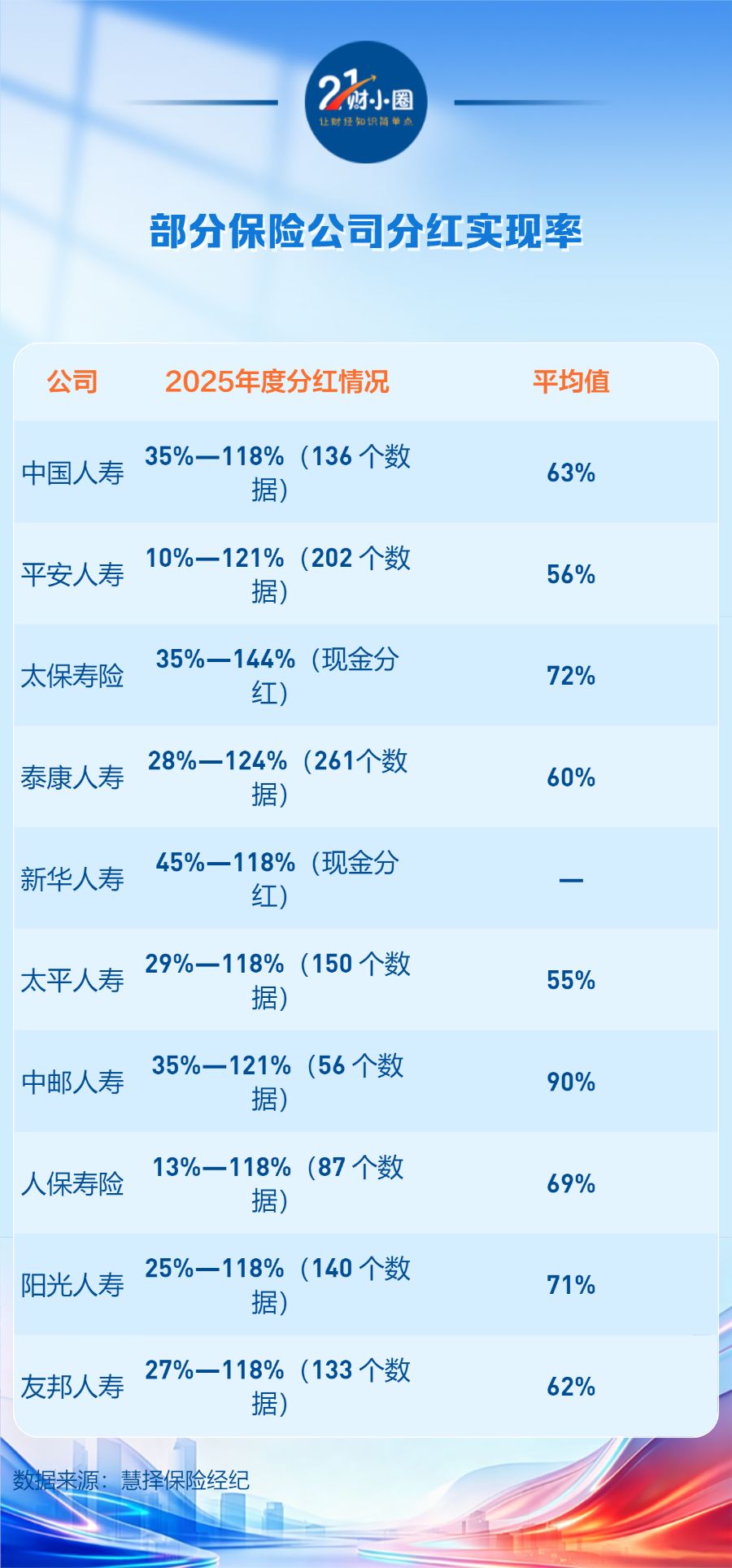
Based on statistics from 13 actuaries covering 72 life insurance companies' 2025-year data on 4200 participating insurance products, the industry's average dividend realization rate for the 2025 fiscal year was 67.8%, representing a year-over-year increase of 7 percentage points and marking two consecutive years of improvement.
According to Huize Insurance Broker's review, here are the dividend realization rates for insurance companies in the 100-billion-yuan premium tier:
Note that the latest actual performance rate for some participating policies is 0%. Don't jump to conclusions, though. The guaranteed interest rate itself is 3.5%, with a demonstrated rate of 4.5%. Even relying solely on the guaranteed return yields 3.5%, and the floating dividend of 0 ensures you don't lose out.
This highlights that relying solely on the implementation rate can lead to misjudging a product. It must be evaluated alongside the guaranteed interest rate and minimum return.
High or low fulfillment rate doesn't equal high or low returns: Legacy products have a 54% fulfillment rate, new products have a 106% fulfillment rate, but customers' actual return rates may both be around 3.2%.
The realization rate is a relative metric calculated as "actual payout ÷ demonstrated rate," so it cannot be directly compared across different product batches. However, when reviewing the demonstrated rate, you can use this company's realization rate to gauge how well its past promises have been fulfilled.
Once you purchase a participating insurance policy, it becomes a contract lasting 10 years, 20 years, or even for life. Before buying, make sure to clarify these 3 key details:
1. Focus on long-term dividend realization rates. Viewing over 5, 10, and 20 years provides a more meaningful picture than single-year data.
2. Focus on long-term investment returns, defined as the average total investment return rate of insurance companies over the past 5 to 10 years. Companies with strong investment capabilities are more likely to achieve dividend distributions.
3 Solvency + Comprehensive Risk Rating: The solvency adequacy ratio must meet requirements, and the comprehensive risk rating should be at least BB.
Participating insurance is a marathon runner, not a sprinter. Whether it's worth buying depends on whether it suits you. If you have idle funds that won't be needed for 10 years or more and want to avoid stock market volatility while aiming for higher returns above a guaranteed rate, consider participating insurance. However, if you might need this money within 5 years, skip it—it lacks flexibility and carries surrender charges.
Risk Disclosure: This article is for investor education purposes only and does not constitute specific investment advice. Dividend insurance is a long-term contract; early surrender may result in loss of principal. Dividend levels depend on the insurer's actual operating results and are not guaranteed. Specific product details are subject to official disclosures by the insurer.


