
Source: Guan Chao Finance
Editor's Note: On 9 month 22, the Shanghai Financial Regulatory Bureau approved Sun Yuanbiao as Chairman of Lloyd's China, more than five months after he stepped down as General Manager on 4 month 1. This marks the first time in the foreign insurer's 19 years in China that a local general manager has been promoted to chairman. However, the transition is far from complete: General Manager duties remain temporarily with Shen Furen, born in the "post-80" generation, and the position remains unfilled for six months. This leadership change coincides closely with the appointment of a new CEO at London headquarters and the rollout of a new strategy targeting a 12% capital return, while premiums in China have fallen from a peak of 22 billion to single digits.
Recently, the Shanghai Financial Regulatory Bureau issued an approval appointing Sun Yuanbiao as Chairman. The approval requires him to take office within 2 months. This marks the first time in Lloyd's China's 19-year history that a general manager promoted internally has directly assumed the role of chairman; previously, the leadership was either a London-based expatriate executive or a transitional appointment prior to retirement.
However, another critical position remains vacant. As of press time, no formal appointment has been made for the General Manager role. According to the latest roster on Lloyd's official website as of 10/9, Shen Fu's title is still "Deputy General Manager and Chief Compliance Officer," prefixed with "Acting." The interim arrangement has now been in place for over six months, from 4 to 10.
Roll back the clock to 4 1, 5 months ago. That early morning, Lloyd's China issued a temporary disclosure report: former Chairman Christopher Mackinnon stepped down; former Executive Director and General Manager Sun Yuanbiao was relieved of his GM duties and appointed as a Non-Executive Director. The Board designated Deputy General Manager Shen Furén as Acting Head. With this announcement, two top executives changed roles simultaneously—a move unique to the entire insurance sector that quarter.
This is no ordinary rotation. To understand the chessboard, you must view it through three lenses: Lloyd's China's 19-year personnel trajectory, the global organizational restructuring under London HQ's 2026-year five-year strategy, and the broader industry context of foreign property-casualty insurers entering a "selective phase" in China.
The old London hall rises in mist and waves; the new Shanghai tower faces the Huangpu River.
Two generals resign their commissions together; one stands alone to govern the central hall.
The old guard departs for their homeland; the new appointee takes charge to uphold the rules.
Half the seat remains empty, leaving me to gaze wistfully at the clouds and sails heading far away.
01
The HR Chessboard: A Governance Update Over Eight Months
Lloyd's China's latest personnel changes did not happen suddenly on 4/1; the strategic lineup began in 2 and continued through 9, when Sun Yuanbiao was approved as chairman, creating a tightly orchestrated timeline reminiscent of a rehearsed relay race.
On 2 6, the company first addressed the middle-layer gap. Zhang Chong was appointed Vice President. Since 2016, Mr. Chong has served as the Company's Audit Responsible Officer until 2025, when he stepped down due to a job change after nearly a decade at Lloyd's China. On the same day, Jing Jing was officially appointed as the Audit Responsible Officer. Born in 1987, Ms. Jing joined Lloyd's China in 2019, where she held roles including Internal Audit Manager, Asia-Pacific Internal Audit Manager, and Acting Audit Responsible Officer prior to her appointment. Before joining, she worked at PwC.
Zhang Chong: Served as Deputy General Manager of Lloyd's China since 2026/2/6. Previously, he served as the company's Audit Responsible Officer since 2016/11/25, and stepped down from this role on 2025/5/12 due to a change in responsibilities. Prior to joining Lloyd's China, he held positions at Hikari Life Insurance, AIA Shanghai Branch, and Swiss Re Corporate Solutions.
Jing Jing: Has served as the Audit Lead for Lloyd's China since 2026 2, 6. She joined Lloyd's China in 2019 1, holding roles including Internal Audit Manager, Asia-Pacific Internal Audit Manager, and Interim Audit Lead. Prior to joining Lloyd's China, she worked at PwC.
On 3 and 10, representatives from the London headquarters arrived. Tracey Bryan and Stephane Flaquet were appointed as non-executive directors.
Tracey Bryan: Non-executive Director of Lloyd's China since 2026/3/10. She has dedicated her career to legal compliance since 1995, accumulating over 30 years of experience, including 25 years in the insurance sector. After spending ten years at AAMI, she joined Lloyd's Australia in 2010, serving as Compliance Manager and Head of Market Operations for Lloyd's Australia & New Zealand, and currently holds the role of Deputy Chief Executive Officer for Lloyd's Asia Pacific/Middle East/Africa.
Stephane Flaquet: Non-Executive Director of Lloyd's China since 2026/3/11. He began his career in banking in 1996, holding senior roles at BNP Paribas and Capital One. In 2007, he moved into insurance, serving as a senior executive at AIG France and Hiscox across multiple functions. He joined Lloyd's UK in 2025 as Chief Operating Officer, leading the development of its global operations strategy.
Tracey Bryan is Deputy CEO of Lloyd's Asia-Pacific, Middle East & Africa. She has over 30 years of experience in legal and compliance, with 25 years in insurance. After spending 10 years at AAMI, she joined Lloyd's Australia in 2010.
Stephane Flaquet brings even greater credentials—he joined Lloyd's of London as Chief Operating Officer in 2025, overseeing global operational strategy. Previously, he held leadership roles at BNP Paribas, Capital One, AIG France, and Hiscox, and is a core member of new CEO Patrick Tiernan's executive team.
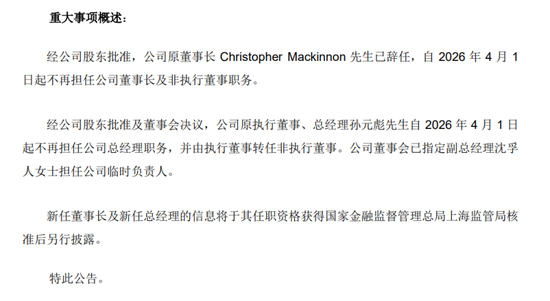
4 1: Dual leadership changes. Christopher Mackinnon steps down as Chairman; Sun Yuanbiao resigns as CEO and transitions to Non-Executive Director, with Shen Furen appointed as Interim Head.
Christopher Mackinnon: Born in 1969, he served as Chairman and Non-Executive Director of Lloyd's China from 2024 to 6/24 through 2026/4/1. With extensive experience spanning the Australian and London insurance markets, Christopher has held director and executive roles at several globally renowned insurance brokerages. He joined Lloyd's in 2015 as Managing Director of Lloyd's Australia, became Deputy Regional Director for Asia-Pacific, Middle East, and Africa (APMEA) in 2023, and was appointed Regional Director for APMEA on 2024/4/1.
Sun Yuanbiao: Served as a Non-Executive Director of Lloyd's China since 2026/4/1 and was appointed Chairman in 9. He served as Executive Director and General Manager of Lloyd's China from 2021/12 to 2026/3. Previously, he was General Manager at Yongcheng Insurance and Huatai Property & Casualty Insurance.
Shen Furong: Born in 1981, served as the Interim Head of Lloyd's China. Starting from 10 2019, he took on the role of Chief Compliance Officer for Lloyd's China, and in 4 2023, was appointed Assistant General Manager. From 7 2023 to 3 2026, he concurrently served as Head of Beijing Branch, and assumed the role of Deputy General Manager in 9 2025. Beginning in 2 2026, he has been serving as the Company's Chief Compliance Officer. Prior to joining Lloyd's China, he held positions at Tokio Marine & HCC Insurance, where he focused on legal compliance and product review.
9 1: Another adjustment. Jean-Paul Cyr, Vice President, has assumed the role of Vice President at the Beijing Branch. Born in 1985, this French-Canadian joined Lloyd's China in 2023 1. He was officially approved as Vice President in 2025 11. He now holds multiple roles: Chief Financial Officer for Lloyd's Asia-Pacific/Middle East/Africa, Chief Investment Officer for Lloyd's China, and Acting Head of the Beijing Branch.
Jean-Paul Cyr: Since 2025, has served as Deputy General Manager of Lloyd's China. He joined Lloyd's China in 2023 as Senior Manager, Projects and Governance. Since 2025, he has concurrently served as Head of Finance for the Asia-Pacific/Middle East/Africa region; since 2026-4-1, he has additionally served as Chief Financial Officer for the Asia-Pacific/Middle East/Africa region and Chief Investment Officer of Lloyd's China; since 2026-9-1, Mr. Cyr has also served as Deputy General Manager of Beijing Branch.
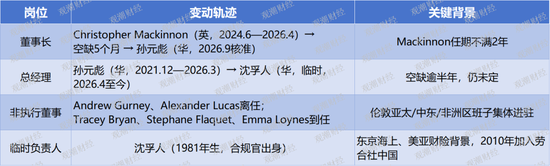
On 9 22, Sun Yuanbiao's appointment as Chairman was approved by the regulator.
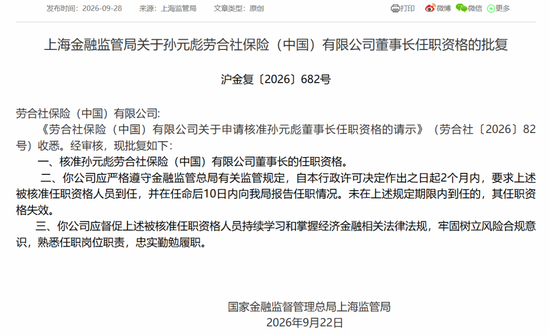
Lay out this list, and a clear power structure emerges.
Most intriguing is Sun Yuanbiao's "indirect promotion." Born in 1966, he graduated from Wuhan University of Technology with a Bachelor of Engineering in Transportation Management and from the University of Central Oklahoma with an MBA. Before joining Lloyd's China, he served as General Manager at Yongcheng Insurance and Huatai Property & Casualty Insurance, establishing himself as a seasoned local executive in China's property insurance sector. In 12 of 2021, he was appointed to Lloyd's China as Executive Director and General Manager, leading the company for four years.
When 4 was removed as CEO on 1, speculation arose that London headquarters was dissatisfied with his performance, given the company's total assets had declined steadily over those four years. Yet five months later, he was promoted to Chairman in a non-executive director role.
This marks a historic first in Lloyd's China's 19-year history. Among the previous four CEOs, only the inaugural CEO, lan Faragher, concurrently served as Chairman and Managing Director. The other three—Gao Cong, Iain Ferguson, and Christopher Mackinnon—were either seasoned China veterans or London-based expatriate executives. Never before has an internal Managing Director been promoted directly to Chairman.
Shen Furan, a post-80 female executive holding the title of acting head, still lacks formal approval from regulators to become general manager. The six-month transition period from 4 to 10 without an announcement on the permanent GM suggests significant disagreement at London HQ regarding the type of leader needed to execute the new strategy.
Following the series of adjustments from 2 to 4, the leadership team at Lloyd's China has been completely refreshed. Notably, the executive group is now significantly younger, with a management team of 7 members, including 4 women, and an average age under 45.
First, let's look at the changes in the board of directors.
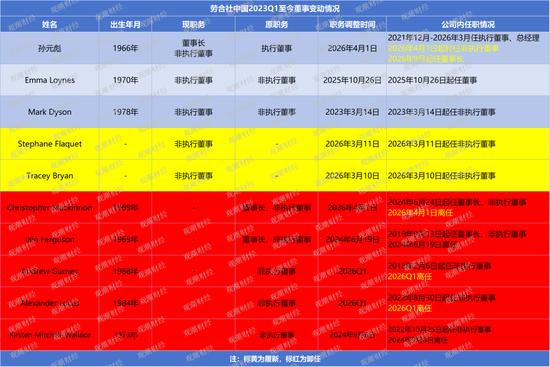
Based on the Q2 2026 Solvency Report, the company's Board of Directors consists of 6 directors, including 1 executive directors (currently vacant) and 5 non-executive directors.
The five non-executive directors are: Sun Yuanbiao (China), Mark Dyson (UK, Chief Financial Officer of Lloyd's International Markets), Emma Loynes (UK, CEO for Asia-Pacific/Middle East/Africa), Stephane Flaquet (France, Global Chief Operating Officer), and Tracey Bryan (Australia, Deputy CEO for Asia-Pacific/Middle East/Africa). The supervisor is Emma Hardaker, Head of Lloyd's Global Financial Crime Risk Prevention and Compliance, who holds a Master of Laws from the University of Oxford.
Emma Loynes: Appointed as the Director of Lloyd's China effective 2025/10/26. Joined Lloyd's in 2018, serving previously as Senior Manager of Market Oversight and Delivery and Head of Market Innovation. Currently serves as Chief Executive Officer for Lloyd's Asia-Pacific, Middle East, and Africa region.
Mark Dyson: Appointed as a Non-Executive Director for Lloyd's China, effective 2023/3/14. He joined Lloyd's of London in 2020/2 and currently serves as Chief Financial Officer for International Markets.

Looking at the senior management team. Currently, among the 7 executive leaders, besides interim head Shen Furen, the team includes: Vice Presidents Jean-Paul Cyr (born 1985) and Zhang Chong (born 1978); Chief Actuary Yan Xiaolan (born 1977); Head of Finance He Ruicong (born 1978); Board Secretary, General Manager Assistant, and Chief Risk Officer Qian Jingjiang (born 1975); and Audit Responsible Person Jing Jing (born 1987).
Yan Xiaolan: Appointed as Chief Actuary of Lloyd's China since 2016/5/7. Joined Lloyd's China in 2011/1 and has served as the Actuarial Function Holder for Lloyd's China since 2011/2.
Raymond He: Joined Lloyd's China in 2015, and has served as the Head of Finance for Lloyd's China since 2015-8-7.
Qian Jingjiang: Serves as the Company Secretary of Lloyd's China since 2019/10/22. He also serves as Assistant to the General Manager and Chief Risk Officer. Mr. Qian joined Lloyd's China in 2010/9 and has held positions including Manager of Business Operations and Director of Risk Management.
Excluding the general manager who has not yet been officially appointed, there are no post-60 executives among the current 7 senior leaders. The core management team consists of 4 post-75 and 3 post-80 members. Notably, four women serve as senior executives—Shen Furen, Yan Xiaolan, He Ruicong, and Jing Jing—accounting for over half of the leadership team.
This stands in sharp contrast to the founding team when Sun Yuanbiao first took office in 2021. At that time, while there were women among senior executives, the core decision-making body was predominantly a mix of "post-60" and "early 70" Chinese and foreign professionals. After five years of evolution—and especially following the major overhaul in 2026—the senior leadership at Lloyd's China has not only become significantly younger but also more deeply rooted in localization, professionalism, and compliance.
02
A Unique Model Rooted in China: From Reinsurance to Property & Casualty, Five CEOs Over 19 Years
To grasp the significance of this leadership change, we must first answer a fundamental question: What type of institution is Lloyd's?
Counterintuitively, Lloyd's is not an insurance company in the traditional sense.

Lloyd's China (Platform Provider): A foreign insurance company approved by the former China Banking and Insurance Regulatory Commission, holding licenses for non-life reinsurance and direct non-life insurance. Acting as a service provider and guarantor rather than a direct risk bearer, Lloyd's China has established operational infrastructure—including office space, compliance, legal affairs, and support functions—to serve as the "home base" in China for each syndicate on its platform.
Lloyd's Syndicate (Underwriter): A pool of capital from one or more Lloyd's members that underwrites insurance business through a managing agent in the Lloyd's market. The Council of Lloyd's assigns a unique syndicate number to each syndicate. While membership may change annually, the syndicate number typically remains constant unless otherwise specified.
It is a non-corporate society established under the UK 1871 Lloyd's Act, more accurately described as an "insurance marketplace." The market comprises dozens of syndicates. Each syndicate is funded by member capital and managed by managing agents who hire underwriters, conduct operations, and report results to members. Syndicate members are liable for their share of risk but do not directly perform underwriting.
Clients submit risk coverage needs through insurance brokers. Brokers or authorized underwriters assign the business to underwriters, who determine pricing and assess risk. Once an underwriter makes a coverage decision, the syndicate managed by their managing agency assumes the risk.
This model originated at Lloyd's Coffee House on the banks of the Thames in 17th-century London. For over 300 years, it has been the ultimate backstop for global special risks—including space launches, maritime shipping, cybersecurity, kidnapping and ransom, political violence, fine art, clinical trials, film and television production, and satellite deployment. Behind the insurance claims for the Titanic, the 9-11 incident, and pandemic-related cancellations, stood Lloyd's syndicates.
China is Lloyd's only market globally where entry was achieved through the establishment of a legally incorporated subsidiary.
On 2007-3-9, the former China Insurance Regulatory Commission approved the establishment of Lloyd's Reinsurance (China) with a registered capital of 2 billion yuan. This marks the first time in Lloyd's 300-year history that a subsidiary with independent assets and legal operating rights has been established for syndicate members serving the global market.
The reason is practical: Due to Lloyd's unique "insurance market" operating model having no corresponding legal framework under China's current insurance laws, Lloyd's had to abandon its established approach used in over 60 other countries and regions worldwide. For the first time, it entered China by establishing a corporate subsidiary.
This shell company plays a triple role: it is a licensed property insurer approved by Chinese regulators, holding both non-life reinsurance and direct non-life insurance licenses; it provides compliance, legal, operational, and claims infrastructure for the 28 syndicate underwriting units based here; and as a separate legal entity, it assumes responsibility to Chinese regulators, serving as the London syndicates' "home base" and "risk filter" in China.
At the regulatory level, it adheres to the unified Insurance Law and C-ROSS framework. However, due to its unique nature, it is also subject to the specifically formulated "C-ROSS Solvency Regulation Rule No. 20: Lloyd's of London (China) Co., Ltd." — notably, control risk minimum capital is not calculated for it, making this provision unique among all insurance licenses in China.
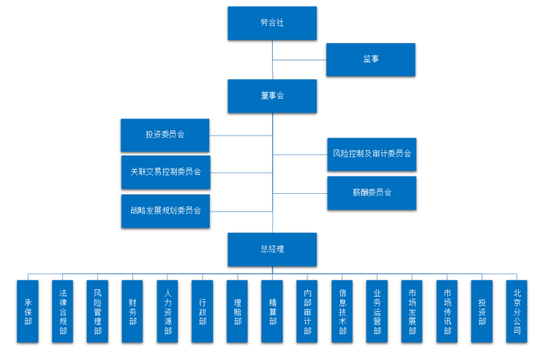
(Lloyd's of London China Office Setup)
From a reinsurer to a property insurer, Lloyd's China has undergone two key phases of expansion.

In 2010 year, 5 month, the former CIRC approved the company to expand from non-life reinsurance business to direct non-life insurance business. The company's nature changed from a reinsurer to a property insurer. In the same year, in 10 month, it was officially renamed "Lloyd's Insurance (China) Co., Ltd."
Its direct insurance business is primarily confined to the Shanghai administrative region. However, marine, aviation, and transit-related insurance, as well as specific lines such as property and casualty insurance with individual policy amounts exceeding 40 million RMB, may be conducted nationwide.
Notably, its capital side also underwent two rounds of capital increases.


In 2013, registered capital increased from 2 billion yuan to 2.2 billion yuan. In 2014, to comply with China's "C-ROSS II" regulatory requirements, Lloyd's made a significant capital injection into its Chinese subsidiary, raising paid-in capital from 2.2 billion yuan to 10 billion yuan to maintain a solvency adequacy ratio above 200%.
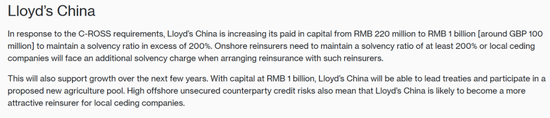
(Lloyd's Announcement)
This capital injection has enabled Lloyd's China to qualify as the lead party for reinsurance agreements and to participate in establishing major projects such as agricultural insurance co-insurance pools.

Over the past 19 years, Lloyd's China has seen 5 chairpersons and 4 general managers (excluding interim heads), with frequent leadership changes:

Ian Robert Faragher served as the first Chairman and General Manager. This industry veteran, with over 25 years of experience in insurance, was dispatched to China in 2006 year, 4 month to establish the company. He officially assumed the roles of Chairman and General Manager in 2007 year, 3 month but resigned and returned to Australia in 2008 year, 6 month, serving for just over a year.
Robert Faragher: Appointed as Chief Operating Officer (COO) of Lloyd's China (in setup) in 2006 4, effective from 5 15. In 2007 3, he officially assumed the roles of Chairman and General Manager of Lloyd's Reinsurance (China). In 2007 6, he was appointed as a Distinguished Researcher at the International Insurance Institute of Nankai University School of Economics and as a Visiting Professor at the Department of Risk Management and Insurance. He resigned from his positions as Chairman and General Manager of Lloyd's China in 2008 6 and returned to Australia.

Gao Cong took over and served for eleven years. He joined the insurance industry in 1979, initially working at the Reinsurance Department of PICC Group, before moving to Swiss Re as Chief Representative and later General Manager of its Beijing Branch. In 2008 9, he was approved to serve as Chairman and Managing Director of Lloyd's China, was promoted to Head of Greater China in 2016, and officially retired on 2019 1 1. During his tenure, he led two capital increases in 2013 and 2014, making him the true founding leader of Lloyd's China.
Gao Cong joined the insurance industry in 1979, initially working at the Reinsurance Department of PICC Group. He later served at Chongxin Insurance's Hong Kong branch. From 1996 to 2008, he moved to Swiss Re, where he was Chief Representative of Swiss Re Beijing Office and General Manager of Swiss Re China Limited. In 2008, he became Chairman and Managing Director of Lloyd's China. In 2016, he was promoted to Head of Greater China for Lloyd's, overseeing markets in mainland China, Hong Kong, Macau, and Taiwan. He retired on 1/1/2019.


Linmao Li is the third general manager cultivated within the Lloyd's ecosystem. He assumed office in 2019 8, having previously served as an underwriter at Lloyd's of London for many years, where he was responsible for Caledonian's Greater China operations. However, his tenure lasted less than two years; he resigned in 2021 5, with Deputy General Manager Xu Jun serving as interim leader for six months. His co-chairman was Iain Ferguson — a British national born in 1965, who took office in 2019 9 and stepped down on 2024 6 19.
Iain Ferguson: Born in 1965, he served as Chairman and Non-Executive Director of Lloyd's China from 13 9, 2019, until his resignation on 19 6, 2024. He joined Lloyd's in the UK in 10 2007, where he previously held roles including Director for Asia Pacific, Middle East and Africa, and President of Lloyd's Japan. Prior to joining Lloyd's, he worked at RSA Insurance Group.
Linmao Li: Born in 1974, he has served as Executive Director of Lloyd's China since 2019/7/3, Managing Director of Lloyd's China since 2019/8/2, and Interim Head of Investments since 2020/8/27. He resigned on 2021/5/19. Prior to this, he worked at Catlin Group (later renamed XL Catlin Group) in the UK and Fosun International Insurance Group.
Xu Jun: Served as Deputy General Manager of Lloyd's China since 2014/2, concurrently appointed Chief Operating Officer since 2022/1, and retired on 2025/7/1. He joined Lloyd's China in 2010/5, having previously held positions at Ping An Property & Casualty Insurance Company and Hannover Re Shanghai Representative Office.


Sun Yuanbiao filled the vacant general manager position in 2021 and held the role for over four years. In 2024, Christopher Graham Mackinnon took over as chairman. This was followed by a dual leadership change on 2026/4/1, and later, on 9/22, Sun Yuanbiao officially assumed the role of chairman.
From Faragher to Gao Cong, and from Linmao Li to Sun Yuanbiao, the leadership of Lloyd's China has evolved through four distinct phases: "foreign founder," "China expert veteran," "London system insider," and "domestic property insurance veteran." Sun Yuanbiao's promotion from General Manager to Chairman marks a historic breakthrough in governance structure—the first time the company achieved full localization of its chairman.
03
Shrinking scale, profit pressure
Behind the personnel upheaval lies Lloyd's China's lackluster performance in recent years.
Total assets peaked in 2018 and have since declined. The company experienced rapid growth from 2009 to 2018, surging past 10 billion yuan after capital injection in 2014. It crossed 50 billion yuan in 2016 and reached a peak of 72.89 billion yuan in 2018. Over the following years, assets fell consistently, dropping to 47.99 billion by year-end 2025. In seven years, nearly 25 billion yuan evaporated—a decline of over one-third.

Net assets surged to nearly 10 billion yuan after capital injection in 2014, then steadily grew to 13.56 billion yuan by 2022. They dropped significantly in 2023 and have since remained around 10.8 billion yuan.

Insurance premium revenue plummeted from a peak of 22 billion to single digits. The company's direct insurance revenue surged after obtaining its direct license in 2010, reaching a historic high of 22.12 billion in 2017. It then declined consecutively to 5.27 billion by 2022, saw a slight recovery between 2023 and 2024, and dipped again slightly in 2025. Over seven years, the premium scale shrank by more than 70%.

Net profit has long hovered between 0.3 and 0.7 billion yuan. Except for a slight loss in 2010-2011, the company remained profitable in all other years. Starting from 2015, net profit stabilized at 0.3-0.7 billion yuan, peaking at 0.67 billion yuan in 2018. It subsequently declined, dropping to 0.25 billion yuan in 2025. For a company with registered capital of 10 billion yuan and net assets of approximately 10.8 billion yuan, the annual return on equity is less than 3%.

Investment returns fluctuate with scale. The company's investment returns reached 2015 billion yuan in year 0.30, peaked at 0.42 billion yuan in year 2019, and subsequently declined with fluctuations, stabilizing between 0.31 and 0.32 billion yuan from years 2023 to 2024.

Operating and administrative expenses rose alongside business expansion. Claims expenditures surged between 2016 and 2019 years before declining consecutively, while commissions and brokerage fees increased noticeably after 2015, though remaining low in absolute terms. This reflects that Lloyd's China's business structure is primarily focused on reinsurance and direct insurance for specialty risks, with relatively lower reliance on broker channels.

Lloyd's China's latest solvency data (as of Q2 2026) remains extremely robust. As of the end of 6 2026, its core solvency adequacy ratio was 561.35% and total solvency adequacy ratio was 563.73%. Although this represents a decline of approximately 16 percentage points from the end of Q1 (577.23% and 579.24%, respectively), it still far exceeds the regulatory threshold of 100%.
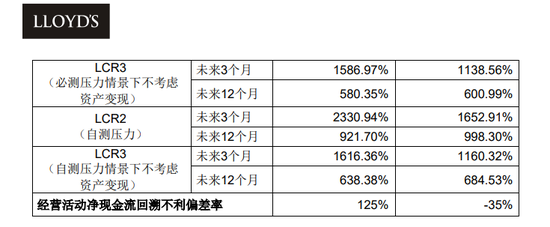
(Lloyd's China 2026Q2 Solvency Report)
Its liquidity coverage ratio under the base case scenario for the next 3 months will reach as high as 1621.48%, and even 2283.15% under stress scenarios—idle funds that cannot be deployed are, in a sense, a mirror image of business contraction.
(Lloyd's China 2026Q2 Solvency Report)
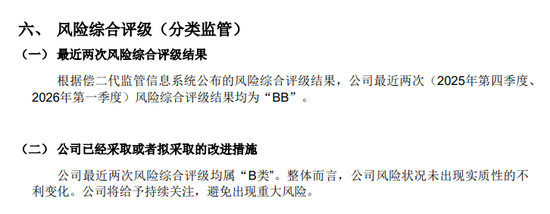
However, it is worth noting that the company received a "BB" risk composite rating in both its most recent reporting periods (Q4 2025 and Q1 2026), placing it in Category B. Despite its strong solvency, the BB rating indicates that regulators remain cautious about its risk management capabilities and operational efficiency.
(Lloyd's China 2026Q2 Solvency Report)
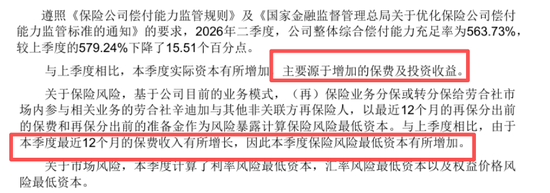
The Q2 report explains the slight decline in solvency: Actual capital increased this quarter, primarily driven by higher premiums and investment income. However, due to premium growth over the past 12 months, the minimum capital required for insurance risk rose. Additionally, the company expanded its investment portfolio, reducing holdings of government bonds that do not require credit risk measurement while increasing investments in corporate bonds and other securities. This led to increases in the minimum capital required for interest rate risk and credit spread risk.
04
Why Now? — Global Leadership Transition at London Headquarters
The "dual leadership swap" in China on 4/1 is no longer an isolated event when viewed against the backdrop of the global organizational restructuring at London HQ spanning from 2025 to 2026.
The CEO has changed. Patrick Tiernan took the helm at Lloyd's in 2025. A veteran with deep roots in the Lloyd's ecosystem, he had already hinted at a new global strategy when delivering a speech at the London Market Conference in 2025 11.
Patrick Tiernan: Appointed CEO in 2025 5. Previously served as Managing Director, Commercial Lines and Global Corporate & Professional at Aviva (2018-21) and Chair of the International Insurance Association. Other key roles include CFO of Aviva Insurance (2017-18), COO of StarStone Group (2014-17), and CEO of Zurich Central Management (2011-13). He has held senior leadership positions since joining Lloyd's in 2021 as Head of Market, concurrently serving as Director of Performance and Chief Business Officer.
In 2026 year 3 month, the new five-year strategy was officially launched, anchored on one core metric: a 12% return on capital. The four strategic pillars are: leading underwriting performance, an efficient and agile market, maximizing capital advantage, and building a Lloyd's to be proud of. As Tiernan stated, Lloyd's must strike a balance between "earning investor trust through disciplined core businesses" and "having the courage to take on emerging complex risks that no one else can handle."
CFO change. On 2026 1, Lloyd's announced the appointment of Jim Bichard as its new CFO. In an official press release, Tiernan stated that Bichard "has deep knowledge of the global insurance market and a clear understanding of how capital, risk, and clients intersect," as Lloyd's "enters an exciting phase with a new strategy unfolding with greater global ambition."
Jim Bichard: Joined Lloyd's in 2026 as Chief Financial Officer, overseeing UK insurance operations along with the London market and brokerage businesses. He spent 30 years at PwC, beginning in audit before transitioning to advisory roles, including leading capital, risk, and regulatory practices across the UK and EMEA.
The COO role has changed. Stephane Flaquet, a veteran with nearly 20 years of senior leadership experience at AIG France and Hiscox, joined Lloyd's as Chief Operating Officer in 2025 to lead global operational strategy. Just six months later, he was appointed to Lloyd's China Board.
A Global COO personally sits on the board of a foreign subsidiary with registered capital of only 10 billion RMB. This arrangement alone underscores London HQ's commitment to the operational efficiency of its China platform.
The Asia-Pacific leadership has changed. Emma Loynes joined Lloyd's in 2018 after 20 years at Royal & Sun Alliance, where she served as Senior Manager for Market Supervision and Delivery and Head of Market Innovation. She became CEO of Lloyd's Asia-Pacific/Middle East/Africa in 2025 and joined the Lloyd's China Board on 2025/10/26.
Her predecessor, Christopher Mackinnon—who just stepped down as Chairman of Lloyd's China and has served as the Managing Director for Asia-Pacific, Middle East, and Africa since 2024—is the person in question.
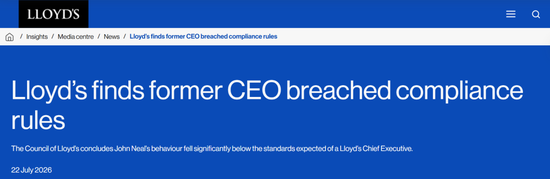
Scandals surrounding governance have also been exposed. On 2026 7, 22, Lloyd's officially announced: An investigation revealed that the former CEO violated internal compliance procedures when handling whistleblower reports in 2023 11.
(Lloyd's Announcement)
Chairman Sir Charles Roxburgh launched an independent investigation after receiving new information in 2025. This incident directly catalyzed the strengthening of Lloyd's global compliance and risk management framework—explaining why Lloyd's China appointed a female leader born in the 80s, who previously served as Head of Compliance, to the role of Acting Head.
Sir Charles Roxburgh: Formerly Global Co-Leader of McKinsey's Strategy Business, Head of the UK Financial Institutions Group, Co-Leader of Global Corporate and Institutional Banking, and a member of McKinsey's Global Board. He served as Permanent Secretary for Financial Services and Second Permanent Secretary at HM Treasury from 2013 to 2022, representing the UK on the Financial Stability Board and the Bank of England's Financial Policy Committee. Currently Chairman of Lloyd's, Independent Non-Executive Director of Shell PLC, and Non-Executive Member of Herbert Smith Freehills' Global Council. Prior to this, he was Non-Executive Chairman of Legal & General America until early 2025.
The global system re-platforming is ongoing. Lloyd's half-year report for 2025 indicates that market testing for the re-platforming will not begin until 2026. Due to early design choices, extensive testing is critical to verify whether the new platform meets market needs; rehearsals and parallel runs require time, so a rushed cutover is not feasible. As the only legally incorporated subsidiary platform globally, China must integrate with this new global system.
This global timeline clarifies the HR logic in China:
First, Mackinnon's departure from the China Board is an extension of the Asia-Pacific leadership transition—since Emma Loynes has replaced him, the Chairman seat for China naturally requires reassignment.
Second, Sun Yuanbiao's transition from Executive Director and General Manager to Non-Executive Director, and finally to Chairman, reflects London HQ's strategic redefinition of China's governance structure: delegating day-to-day operations to a younger, locally rooted team with stronger compliance expertise, while appointing an experienced veteran familiar with local regulations to stabilize the Board as Chairman.
Third, Stephane Flaquet's appointment to the China Board as Global COO signals that the London headquarters is directly overseeing cost control, operational efficiency, and system integration for the China platform—fully aligned with the new strategy of "reducing costs, minimizing friction, and modernizing technology and data."
In other words, this leadership change at Lloyd's China is not about "something going wrong in the China region," but rather that the London headquarters has adopted a new strategy and requires a fresh team in China to execute it.
05
Industry Benchmark: Foreign Property & Casualty Insurers Enter a "Selective Phase" in China
The personnel shake-up at Lloyd's China sends a signal that extends beyond the individual company, resonating across the entire landscape of foreign property & casualty insurers operating in China.
First, foreign insurers in China are shifting from an "expansion phase" to a "selection phase." Over the past decade, foreign property and casualty insurers have generally moved from establishing branches and expanding their footprint to consolidating operations and focusing on high-margin, specialized risks.
Lloyd's China has 28 underwriting syndicates, specializing in long-tail lines of business including cyber security, life sciences, clinical trials, product liability and recalls, financial liability, renewable energy, marine liability, film and TV production, fine art, satellite launch and orbiting, agriculture, political violence and terrorism, and kidnapping and ransom. At its core, this is about doing the work others are unwilling or unable to do.
This aligns with the broader trend among foreign property and casualty insurers in China to pursue a "small but refined, small but specialized" strategy—rather than competing on price in the saturated auto and commercial property insurance markets, they focus on securing their niche in specialty risks.
Second, "localization governance" is replacing "expatriate-led management" as the new trend. The appointment of Sun Yuanbiao, a seasoned local executive, as Chairman and the interim leadership by a female compliance officer born in the "80s," signal that Lloyd's China's governance logic has shifted from being driven by London-based expatriates to a two-tier structure combining local professional managers with strategic oversight from London headquarters.
This is not an isolated case among foreign insurers in China, but as Lloyd's—a unique "market-based" entity—it marks a move with stronger symbolic weight. Nineteen years ago, Lloyd's established a legal subsidiary to fit London's exchange within China's regulatory framework; now, for the first time, the decision-making body inside this structure is predominantly Chinese.
Third, executives with a compliance background stepping into leadership roles are an inevitable outcome of the industry's current period of stringent regulation. Shen Furen's career path—from head of compliance to chief compliance officer and then interim leader—is uncommon among foreign insurers in the past, where top leaders typically had underwriting or actuarial backgrounds.
However, with the tightening of regulatory requirements under C-ROSS Phase II, anti-money laundering (AML), data security, and related-party transactions, a top executive who understands regulation, law, and compliance is often safer for a foreign-owned insurance entity than an experienced underwriter focused solely on business. The whistleblower incident involving Lloyd's former CEO, reported globally in 7, further reinforced this direction at the corporate headquarters level.
Fourth, the prolonged vacancy of the General Manager role itself signals strategic hesitation. From 4 to 10, the position remained unfilled, with Shen Furen serving as interim head for six months. Per regulatory requirements, an interim leader cannot remain in place indefinitely; this means Lloyd's China must announce a formal GM appointment within the coming months.
The choice between promoting Shen Furen internally to complete the localization of "80 after female commander" or deploying a seasoned underwriting expert from Hong Kong/Singapore will directly determine this company's business trajectory over the next three years.
The approval on 9/22 is a halfway answer to Lloyd's China's leadership shakeup. Sun Yuanbiao taking the chair means London has officially handed governance of the China region to a local veteran; yet the half-year vacancy for general manager shows London is still weighing who will execute the new strategy.
Key milestones to watch over the next two months: whether Sun Yuanbiao can take office and report to the Shanghai Regulatory Bureau by 11/22.
Second, when will the formal CEO be announced? Will Shen Furun be promoted internally to complete the localization cycle, or will a seasoned underwriter be brought in from the regional market?
300 years ago, shipowners and underwriters at Lloyd's began insuring ocean-going merchant vessels; 300 years later, this "market within a market" is undergoing its most profound governance transformation since entering China from its office on the 25th floor of Lujiazui in Shanghai. The chimes of the financial district still ring, but the desks of Lujiazui have changed hands. This 19-year chess game has only just entered the middle game.