
Source: Baoguan
The insurance industry is undergoing a major technological transformation. AI and big data have become powerful tools for insurers to develop products, assess risks, and reach customers.
Against this backdrop, FinTech Global released its Top 100 Global Insurtech Companies for 2026.
This year's selection identified 100 of the most innovative and influential companies from over 2100 insurance technology firms globally. The criteria went beyond launching new tools, focusing instead on using innovative approaches to tackle major industry challenges in underwriting, claims processing, risk assessment, distribution, and customer engagement.
Notably, unlike previous years, two Chinese insurers made it to this year's list: nanoinsure, headquartered in Hong Kong, and Peak Horizon, founded in 2026 and based on the mainland.
This article analyzes the composition and evaluation logic of the Top 100 ranking to forecast the latest trends in global insurance technology innovation.
1
Top 100 Distribution:
The US and UK continue to lead, with over 60% related to artificial intelligence.
By region, the United States continues to hold a dominant position.
Specifically, the United States maintains an absolute dominant position with 56 companies on the list, accounting for half; the United Kingdom follows closely with 18; France and Singapore also performed well, each contributing 5 companies; other countries and regions such as Israel, Canada, and Switzerland also have multiple enterprises on the list.
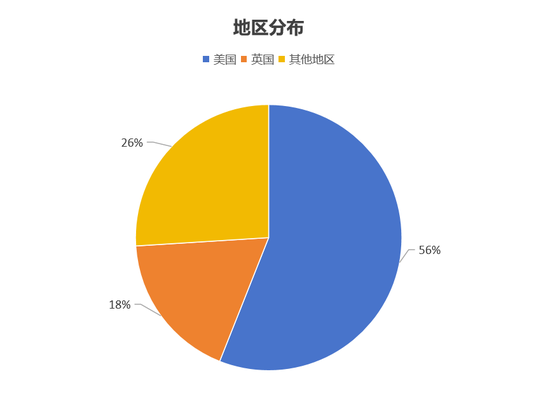
Notably, two Chinese companies—nanoinsure and Peak Horizon—appeared on the 2026 list, ending the previous trend of having only a single Chinese representative.
Using Nanoinsure as an example, the company was founded in 2019 and is a Hong Kong-based insurtech firm that provides digital software solutions to life insurers, including product and app development, digital sales, distribution and commission management, and policy administration modernization.
By founding date: 28 startups
Specifically, 28 startups were founded 2020 years ago, a clear decrease from the previous year's 37.
These new-generation companies are increasingly concentrated in AI and vertical use cases, evolving from mere "technology suppliers" into ecosystem builders. Notable startups to watch include Earnix (AI insurance decision platform), ICover (AI underwriting platform), and Trigger Parametric (full-stack parametric insurance platform).
By sector: Over 60% are related to artificial intelligence, with AI-native infrastructure emerging as a key focus.
Over 60% of this year's featured companies are AI-related, covering core areas such as underwriting, claims processing, risk assessment, and decision engines.
Another notable trend is that Agentic AI and AI-native infrastructure have become core keywords on this year's list. With multiple companies positioning themselves around AI-native infrastructure, insurtech is shifting from "AI as a tool" to "AI as infrastructure."
2
Representative companies overview
A disruptor reshaping the industry
This year's InsurTech awards evaluate candidates across five key criteria: their ability to solve major industry challenges, growth performance (funding raised, revenue, and customer acquisition), innovation of the technology solution, cost savings and efficiency gains for customers, and market attention.
To highlight industry innovation, we selected 8 companies from the Top 100 that demonstrate notable innovation in core technology, business models, or market positioning. Many are startups entering the rankings for the first time.
1.Orus
Region: France
Founded: 2021 years ago | Latest Funding Round: Series B
Company Positioning: Customized Insurance for SMEs

Orus is a Paris-based insurtech founded in 2021, having raised approximately $1 million. It operates as a digital insurance platform for European SMEs and is recognized as an innovative leader in the niche SME insurance market.
Specifically, Orus uses proprietary algorithms to integrate risk data across multiple dimensions—including financial health, climate risks, and behavioral trends—enabling real-time online risk assessment and personalized coverage solutions. This directly addresses key pain points faced by SMEs in traditional insurance systems: slow processes, lack of transparency, and cumbersome claims handling.
Additionally, Orus has launched a dedicated platform for insurance brokers, enabling intermediaries to quote, customize, and manage policies through a single digital interface.
2. nCino
Region: United States
Established: 2011 years ago
Latest funding round: Equity financing
Company Positioning: Digital Insurance Brokerage Services

nCino was founded in 2011. It is not a traditional insurance company; its origins lie in a commercial bank that was later spun off and gradually expanded into the insurance sector.
nCino's core insurance business provides technology tools for brokers, underwriters, and insurance intermediaries to drive organic growth, acquire customers efficiently, and ensure compliant operations.
For brokers, nCino offers the core product "SmartBroker," which provides financial data, industry insights, customer risk profiles, and compliance monitoring. This platform enables brokers to precisely target specific industries, continuously monitor customer status, and unlock greater productivity.
For underwriters, nCino embeds vast enterprise data and risk insights directly into the workflow. Most risks are underwritten automatically without manual intervention, enabling underwriters to assess and price complex risks in seconds.
Overall, providing differentiated tools for different customer segments is one of the core reasons nCino made the list.
3. InsureMO
Region: Singapore
Established: 2000 years ago
Company Positioning: Insurance Mid-Platform for the AI Era
InsureMO was founded in 2000 and is headquartered in Singapore. Positioned as an insurance mid-platform for the AI era, we do not underwrite directly but enable insurers to rapidly configure products, connect ecosystems, and integrate AI capabilities.
Specifically, InsureMO's core capabilities are built around three pillars: API, Data, and AI. In the API domain, InsureMO delivers end-to-end lifecycle services spanning product configuration, quoting, policy administration, and claims processing. Regarding data, it maintains a proprietary insurance database covering policies, claims, and distribution channels. For AI, InsureMO integrates AI capabilities across every stage of the insurance value chain, providing customers with secure and scalable AI solutions.
InsureMO's market positioning has been fully validated: deployed across 50+ countries and regions worldwide, serving over 500 insurers and distributors, with total underwritten premiums exceeding $2 billion.
4. Zinnia
Region: United States
Established: 2005 years ago
Latest Funding Round: Strategic Financing
Company Positioning: Integrated Policy Management System

Zinnia, founded in 2005, is a technology platform—not a traditional insurer—that provides core engines for insurers and distributors to build sales and service capabilities for insurance products, while simplifying life insurance and annuity policy management.
Specifically, Zinnia provides a modular technology platform that helps insurers and distributors overcome legacy system limitations to accelerate time-to-market for life insurance and annuity products, as well as policy management.
For example, launching the digital platform "Zinnia Launch" to help insurers rapidly design, deploy, and distribute new products while supporting long-term policy servicing. Another example is introducing a core policy management system that enables insurers to bring new life or annuity products to market within three months, with support for AI and automation strategies.
Zinnia's ability to fundamentally transform how the insurance industry operates through technological innovation is a key reason it made the list.
5. insured.io
Region: United States
Established: 2011 years ago
Company Positioning: Omnichannel Customer Experience Platform

insured.io, founded in 2011, is a provider of digital customer engagement tools for insurance companies. Its core value lies in helping small and mid-sized insurers rapidly build modern customer service capabilities.
Many mid-sized and small insurance companies currently lack the technical capabilities to meet customers' growing demand for real-time, omnichannel service, causing them to lose market share to industry leaders. insured.io addresses this gap by consolidating fragmented customer interaction channels into a unified platform that integrates directly with insurers' existing core systems. This enables real-time data synchronization, helping businesses maintain competitiveness in a crowded market.
Sure. Beyond integrating customer interaction channels, insured.io also offers AI-powered virtual claims agents, policy management and inquiry services, and data-driven insights to further help small and mid-sized insurers improve retention rates while reducing service costs.
Currently, the insured.io platform serves over 200 million policyholders and manages premiums exceeding $1 billion.
6. FraudOps
Region: United States
Established: 2025 years ago
Company Positioning: Insurance Fraud Platform

FraudOps, founded in 2025 and headquartered in the U.S., is an insurtech company specializing in insurance claims and fraud.
Insurers currently invest heavily in identifying suspicious claims. While detection tools can flag potential cases, follow-up investigations still rely on manual processes.
Against this backdrop, FraudOps has built a Fraud Intelligence Platform specifically for investigation teams. The platform integrates referrals, cases, documents, tasks, and outcomes. Powered by AI-driven automation, it automatically ingests referral emails or screenshots to extract claim, party, and policy details, then constructs cases without manual re-entry. Additionally, its AI identifies involved parties, gathers intelligence, and generates structured case summaries.
Notably, since its launch, the platform has managed over 5 closed investigations involving more than £1.5 billion in suspicious claims.
7. Quensus
Region: United Kingdom
Established: 2015 years ago
Latest Funding Round: Strategic Financing
Company Positioning: IoT Monitoring & Smart Management

Founded in 2015, Quensus is the intelligent management expert within the insurance ecosystem, delivering leak prevention and risk assessment solutions to insurers through IoT and AI technologies.
Water leakage is one of the most common and costly claims in home insurance. Traditional models rely on "post-loss claims," while Quensus uses smart hardware and a software platform to intervene before damage escalates, helping insurers reduce both claim frequency and severity.
Quensus's core isn't built on a single IoT device, but on an integrated ecosystem combining hardware, software, and a service network. Using AI and machine learning, it analyzes building water usage patterns, automatically learns to detect abnormal flow, and shuts off the main water valve upon detecting leaks—stopping water damage at the source.
Quensus has formed a strategic partnership with Aviva, directly integrating preventive technology into Aviva's risk management solutions.
8. KYND
Region: United Kingdom
Established: 2018 years ago
Latest Funding Round: Series A
Company Positioning: Cybersecurity Risk

Founded in 2018, KYND is a provider that uses non-invasive technology to transform complex cyber risks into clear, actionable insights for insurers and brokers.
Unlike traditional cybersecurity insurance players, cyber risk data is highly technical and opaque, making rapid assessment difficult for insurers. KYN does not underwrite risks directly. Instead, using external scanning technology, it maps a company's digital footprint from just a domain name, identifies risks closely tied to losses and claims, and pinpoints the critical network vulnerabilities that drive actual payouts.
In simple terms, it provides policyholders with a real-time view of their network risk posture within a short timeframe, enabling enterprises to intervene before risks escalate into incidents.
Currently, KYND has established partnerships with leading insurance providers including Beazley, Howden, Paragon, and Alliant, building a solid reputation in the industry.
Here are some representative and innovative companies from the top 100 global insurtech firms of 2026.
Finally, reviewing the Top 100 Global InsurTech Firms of 2026, two clear trends emerge in the industry.
First, AI has become the primary driver of insurance tech innovation. Over 60% of the上榜 companies are related to artificial intelligence. Meanwhile, the competitive focus of insurtech firms has shifted from single-point tools to a comprehensive overhaul of the entire value chain—from underwriting and claims processing to risk management, distribution, and customer engagement.
Second, innovation is becoming more vertical and closer to real-world scenarios. As mentioned earlier, Orus focuses on insurance for small and medium-sized enterprises, FraudOps specializes in fraud investigations, and Quensus addresses water leak prevention. These companies are not merely "technology vendors"; they act as ecosystem builders within their respective domains.
Without a doubt, this Top 100 list not only reviews the insurance technology innovation achievements of 2026 but also previews the next industry cycle. Baoguan will continue to follow these developments closely.