

(Source: Coupon Research Society)
A female investment researcher at an insurance asset management firm secretly traded stocks using two other people's accounts, following the portfolio she managed. Over 3 years and 8 months, she not only failed to make a profit but also paid a fine of 50 million yuan.
This isn't a joke; it's a real penalty notice just disclosed by the Shanghai Securities Regulatory Bureau.
More intriguing is her role. In most people's view, researchers focus solely on research while fund managers handle trading orders. Yet this individual, Yun, officially holds the title of researcher, yet the penalty notice explicitly states she was responsible for investment decisions and other duties related to the portfolio in question.
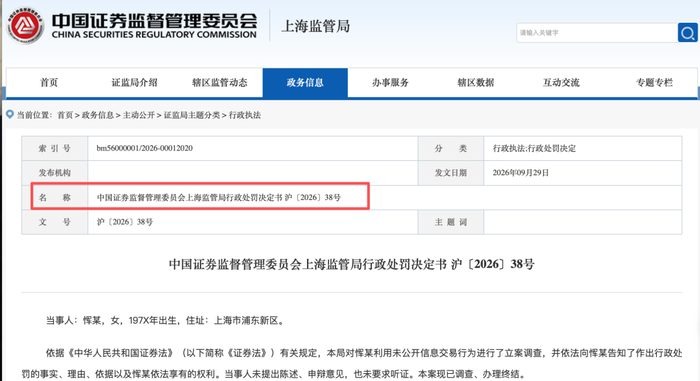
How did a "researcher" gain access to the core of investment decisions? And how did they turn insider trading into a losing proposition over more than three years?
One: Over three years and eight months, lost money and got fined.
View ticket details first.
Yin, female, born in 197X, works in the research department of an insurance asset management company. From 2022 to 1, she controlled two Everbright Securities accounts under the names "Huang X J" and "Zhu X X". Using her position, she accessed non-public information, including portfolio holdings and trading details, and executed or directed others to conduct convergent trades.
Convergent trading means following institutions: buy what they buy, sell what they sell. In theory, it's the most reliable way to copy their moves.
Result? Related convergent trading losses. The penalty notice contains only these five characters, does not disclose the specific loss amount, but clearly states "no illegal gains."
Under Article 191 of the Securities Law, insider trading with no illegal gains or illegal gains under 500,000 yuan is subject to a fine between 500,000 and 5 million yuan. Since a loss was incurred, 50 million represents the statutory minimum fine.
However, even the minimum penalty applies. The Shanghai CSRC ordered her to dispose of the illegally held securities and imposed a fine of 50 ten thousand yuan.
Over three years and eight months, with two accounts, I ended up losing half a million. This deal is a loss no matter how you calculate it.
II. Why are researchers responsible for investment decisions?
The most striking aspect of this fine is the mismatch between Yun's role and their permissions.
In established asset management firms, investment research and portfolio management are separate functions. Researchers provide analytical support, while portfolio managers make the final trading decisions. Researchers know which assets the firm favors but do not have visibility into when specific trades will be executed, their size, or exit timing within a portfolio.
The penalty notice against Yun designated her as "responsible for investment decisions and other duties regarding the portfolio in question, with knowledge of non-public information such as holdings and trading details related to said portfolios."
Bi Mengran, a fund researcher at Geshang Fund, told the media that the standard for determining insiders in capital markets is based on substantive authority and responsibility, not the job title listed by an institution.
What's printed on your business card doesn't matter. What you can actually reach matters.
This is not uncommon among mid-sized and small asset management firms. While public funds have relatively standardized investment research divisions, insurance asset management, securities firm asset management, and bank wealth management subsidiaries operate with more flexible organizational structures where the "one-person handles all" investment-research model does exist. If a research analyst deeply participates in portfolio decision-making and has real-time visibility into holdings and trading plans, they are considered an insider under regulatory standards.
Title: Researcher, Duties: Investment Manager, Liability: Front-Running. This is entirely justified.
III. Why Are the "Rat Trades" of Insurance Asset Management Only Coming to Light Now?
Previously, "rat trading" cases mostly involved mutual fund managers and private equity traders. Penalties against insurance asset management firms are indeed rare.
The reason isn't complicated. Public mutual funds are primarily evaluated on relative returns, while private equity firms pursue absolute returns. Both types of institutions employ high-turnover stock strategies with frequent trading signals; when individual accounts follow these trades, their convergence patterns are easily detected by big data models. In contrast, insurance asset management has long-duration capital and a long-term allocation style with low rebalancing frequency, making it naturally less likely to leave traces of high-frequency convergence.
Additionally, in the early stages of regulatory big data screening, the focus was indeed primarily on mutual fund product accounts. Screening intensity for insurance asset management and securities asset management accounts was relatively lower.
But that was in the past.
According to statistics from Han Kun Law Offices, there were 17 administrative penalties for "rat trading" in both 2024 and 2025, compared to only 2 each year in 2021 and 2022. The intensity of enforcement is rising in a spiral pattern. The Shanghai Bureau ranks first among regional offices with 18 cases.
Clear signal: The sieve is getting finer; what used to slip through may not anymore.
4. Ten Pathways for Regulators to Detect Front-Running
Many wonder how regulators detect front-running. Even when accounts belong to others, funds are routed through multiple layers, and trades aren't executed from the trader's own computer. Below are ten typical pathways regulators use in practice to identify front-running cases.
Path 1: Convergent Trade Comparison. This is the core weapon. The exchange's big data system compares every trade in an institution's portfolio against all market accounts. The closer the timing, the more aligned the direction, and the higher the overlap, the louder the alarm. Even though individual trades were small, Mr. Yun's persistent convergent trading over three-plus years accumulated enough overlap to trigger the model.
Path 2: Tracing account linkages. Although the accounts are nominally held by "Huang X J" and "Zhu X X," the primary sources and destinations of funds belong to Yun X and their spouse. Regulators investigating insider trading never focus solely on account names; they trace the money trail. Where the funds originate, who benefits from profits, and who bears losses—once this chain is connected, the nominal account holder becomes merely a shell.
Path 3: Communication Records and Device Footprints. The penalty evidence explicitly lists "relevant communication records." Details such as who called or messaged whom, when, and whether the timing of trading instructions aligns with communication logs serve as key leads. Even if you don't place orders using your own phone, the process of instructing others to do so will leave a digital trail.
Path 4: Job Authority and Information Access Records. The regulator will retrieve the party's system access logs. This includes login times, specific systems accessed, portfolios and transaction details viewed, duration of viewing, and whether these activities can form a causal chain with subsequent convergent trading. The determination that Yun was "responsible for investment decisions" is itself a result of the authority investigation.
Path 5: Sudden shift in trading style. A long-term investor suddenly starts making frequent short-term trades; someone with no background in a specific industry repeatedly buys and sells only a few stocks in that sector. Style drift itself is not illegal, but when combined with convergent data, it becomes an abnormal signal.
Path 6: Reporting and Internal Risk Control Referral. Many insider trading cases originate from abnormal transaction monitoring by institutional compliance departments or whistleblower reports from colleagues. Asset management firms' risk control systems monitor trading activities of employees and associated accounts; upon detecting anomalies, they report to regulators.
Path 7: Collateral Cases. Investigators uncovered insider trading involving A, and when reviewing A's account transactions, they found trading records highly similar to those of B, leading to B's exposure. Many "rat-farm" cases are not targeted directly but are discovered incidentally during investigations into other matters.
Path 8: Exit Audit and Post-Mortem Investigation. A key feature of big data systems is that historical transaction records remain accessible even after the individual has ceased their activities. Since the 2013 year, when the big data system was launched, regulators have been able to conduct retrospective investigations into transactions from years past. Leaving a job does not guarantee safety.
Path 9: Account Group Clustering Analysis. Regulators group potentially linked accounts for review. Accounts that opened within the same timeframe, belong to the same brokerage branch, exhibit overlapping fund flows, or demonstrate highly similar trading instruments and patterns are clustered together. These clusters are then compared against institutional portfolios to identify convergent trends. In the Xu Wenfeng case, regulators determined he controlled 9 accounts, plus an additional 8 accounts jointly controlled with Jin Liu, based on this clustering capability.
Path 10: Interrogation Records and Evidence Chain Encirclement. Penalty records include "interrogation transcripts of relevant personnel." Big data provides leads; investigators interview the parties involved and surrounding individuals to integrate the financial chain, communication chain, and transaction chain. Even if the suspect denies involvement, a complete evidence chain is sufficient for determination. One officer noted that some suspects remained defiant one day, but upon seeing the evidence laid out the next, their first words were, "I want to surrender."
Final Thoughts
Yun's fate is indeed regrettable, but he certainly got what he deserved.
For three years and eight months, she thought she was "copying homework," but in reality, she was running naked in an increasingly transparent system. Big data doesn't care about your job title or whose name is on the account; it only cares about one thing: whether your trades and the information you know are too similar.
50 is the statutory minimum. This isn't a light penalty due to financial loss, but because trading on non-public information carries consequences regardless of profit or loss. Dong Yaohui, President of the Shenzhen Institute for Financial Stability and Development, stated clearly: engaging in convergent trading using non-public information obtained through one's position constitutes a violation, irrespective of whether it results in gains or losses.
1
Losing money and still getting fined is what keeps people up at night. Some used to think insider trading was harmless if no profit was made. Yun's penalty notice proves otherwise: you were wrong.
The detail that "researchers are responsible for investment decisions" warrants every asset management firm to review its Chinese Wall policies. Whether confidentiality is determined by role or by authority can make the difference between compliance and a fine.


