
A catastrophe bond with a total value of 1200 million USD, approximately 9400 million HKD, marks the first breakthrough of this "sidecar" instrument—long established in the global insurance market—in domestic Chinese insurers.
First Financial News learned that PICC Property and Casualty Company successfully issued a "sidecar" insurance-linked security (ILS) in Hong Kong recently. This marks the first sidecar-structured ILS issuance in the Hong Kong market and the first such issuance by a mainland-based insurer.
Industry insiders state that sidecar vehicles are an effective securitization tool for diversifying catastrophe and other insurance risks. With China's catastrophe insurance system continuing to mature, the market outlook is promising.
Domestic insurance institutions break ground on issuing "sidecar" policies
PICC Property and Casualty Company Limited has issued a "sidecar" to provide reinsurance coverage for its marine wind power insurance business. According to the Hong Kong Government News website, the total issuance amount of this "sidecar" security is 1200 million USD, approximately equivalent to 9400 million HKD.
An executive at a property insurer told Yicai that offshore wind was chosen as the first target due to its risk profile. These projects involve large individual investment scales, concentrated risk exposure, and frequent threats from major disasters such as typhoons. Issuing "sidecar" reinsurance allows risks to be transferred to capital markets via quota share reinsurance, effectively supplementing reinsurance capacity. PICC Property and Casualty stated that this issuance introduces China's offshore wind insurance risks into international capital markets, enhances global investors' understanding of China's green energy insurance business, and expands risk diversification channels for insurance services supporting green energy development.
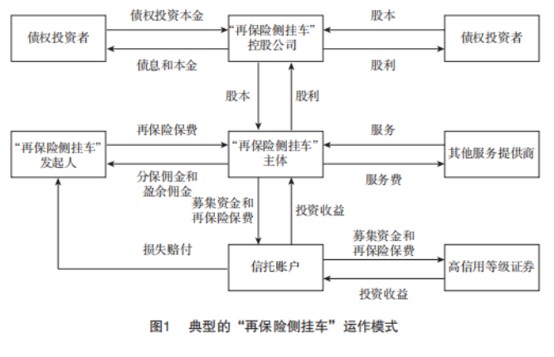
Sidecar is a typical structure of insurance-linked securities. In the 2025 issue of "Insurance Theory and Practice," published by Nankai University's Nankai–Taikang Insurance and Actuarial Research Institute, Associate Professor Zhao Yang and his team introduced the specific structure and operational model of the sidecar: an insurer (the sponsor) transfers insurance risk via proportional reinsurance to a specially created special purpose insurer (SPI). The SPI raises indemnification funds by issuing equity or debt securities and deposits these funds into a trust account, investing them in low-risk, highly liquid assets to ensure timely claim payments. Meanwhile, investors such as private equity funds and hedge funds from the capital markets establish a holding company that owns all shares of the SPI. A service provider handles day-to-day operations and management.
According to PICC Property and Casualty Company Limited, as the issuer in this offering, it issued side-car notes through Great Wall Re Limited, a special purpose insurer based in Hong Kong.
"Sidecar" insurance-linked securities tie their returns and losses to catastrophe reinsurance contracts. Their issuance structure embodies the core characteristics of shared profits, shared risks, and flexible deployment between insurers and capital market investors—hence the nickname "sidecar." According to the Zhao Yang team, typically, if no catastrophic event triggers a payout during the security's lifespan (generally not exceeding 3 years), funds in the trust account are returned to investors, who receive dividends or interest payments plus principal. Following this, the parent company and its holding entity may be dissolved. If a catastrophic event occurs and reaches the trigger threshold, the trust account funds are used to cover insurance losses, and investors may lose part or all of their principal and expected returns.
In 2025, the National Financial Regulatory Administration issued the "Notice on Matters Concerning the Issuance of Certain Insurance-Linked Securities by Domestic Insurers in the Hong Kong Market," supporting eligible domestic insurers to issue "sidecar" insurance-linked securities in the Hong Kong market. Complementary to catastrophe bonds that use excess-of-loss reinsurance for risk transfer, this instrument provides a new tool for Chinese insurers to diversify their risk management channels and enhance underwriting capacity.
PICC Property and Casualty Company stated that this issuance further explores a new model for accessing proportional reinsurance coverage through international capital markets, strengthens the dual-pillar risk diversification system of "reinsurance + insurance risk securitization," and accumulates practical experience to enhance catastrophe insurance underwriting capacity and support the national multi-layered catastrophe risk protection system.
On the other hand, all catastrophe bonds issued in Hong Kong to date have followed a standard structure. This "sidecar" issuance diversifies the transaction structures and business scenarios for insurance-linked securities (ILS) in Hong Kong. Mr. Henry Tang, Secretary for Financial Services and the Treasury, stated that this issuance marks significant progress under national support in risk transfer and alternative capital deployment within Hong Kong's insurance and capital markets, while further enhancing the market's capacity to address catastrophic events and other specific risks.
How does it differ from catastrophe bonds and reinsurance?
China frequently experiences major disasters such as floods, typhoons, and earthquakes. Under climate change, managing catastrophic risk is becoming increasingly critical. In this context, China has placed high priority on the high-quality development of its catastrophe insurance system.
The Zhao Yang team stated in the article that catastrophe risk transfer is a key component of the catastrophe insurance system. While reinsurance remains the most widely used tool for transferring catastrophe risk domestically and internationally, innovative instruments such as catastrophe bonds and sidecars have developed rapidly in recent years. These tools shift catastrophe risks from insurers to capital markets with greater risk-bearing capacity, addressing the failure of risk transfer caused by underwriting cycles and insufficient capital capacity in the reinsurance market.
The Zhao Yang team analyzes that, unlike catastrophe reinsurance which is an on-balance-sheet activity, "sidecars" and catastrophe bonds are off-balance-sheet initiatives for the sponsor. They do not affect the balance sheet or capital structure, and carry no counterparty credit risk due to full collateralization. Both utilize multi-year structures, mitigating market risks associated with underwriting cycles (soft/hard markets) common in most one-year catastrophe reinsurance contracts. Furthermore, while catastrophe reinsurance relies on insurance mechanisms with capital sourced primarily from within the industry, sidecars and catastrophe bonds draw capital from a broader range of capital markets.
Regarding the distinction between "sidecars" and catastrophe bonds, an executive from the aforementioned property insurer explained to reporters that cat bonds typically take the form of excess-of-loss reinsurance risk, covering high-layer losses with a standardized structure. In contrast, sidecars primarily operate under proportional reinsurance risk, allowing for direct exposure to underlying shared risks. They exhibit clear non-standard characteristics, feature longer claim settlement periods and tail effects, but offer relatively higher returns.
In recent years, China's insurance industry has begun building a multi-layered catastrophe risk transfer system through the issuance of catastrophe bonds. According to data from Zhao Yang's team, in 2015, China Reinsurance (Group) issued its first catastrophe bond in Bermuda. Between 2021 and 2024, multiple insurers issued catastrophe bonds in Hong Kong, raising nearly $3 billion USD in total.
In contrast, while the issuance of "sidecars" by domestic insurers in China is just beginning to gain traction, the international market has already achieved significant scale. According to Zhao Yang's team, from 2005 to 6 30, 2024, a total of 230 sidecars were established globally, providing over 550 billion USD in risk capital for the insurance industry. This includes 321 billion USD in property risk capital, 133 billion USD in life risk capital, and 105 billion USD in other risk capital.
The Zhao Yang team states that using "catastrophe risk sidecars" for transferring catastrophe risks offers significant advantages, including structural flexibility, diverse financing methods and funding sources, the ability to transfer multiple types of catastrophe risks simultaneously, and the absence of basis risk or market risk. However, their operational structure is relatively complex, and there is no secondary trading market. Additionally, due to their innovative nature, uncertainties remain in relevant regulations and supervision. Compared to catastrophe reinsurance and catastrophe bonds, they also have certain limitations.
Despite supportive government policies, the evolving catastrophe insurance framework, and accumulated experience in catastrophe risk securitization in China, the team led by Zhao Yang and executives from the aforementioned property insurers remain optimistic about the future of "sidecars" within China. The team further recommends establishing dedicated operational guidelines to facilitate the growth of sidecars. Given that sidecars are complex financial products, their participation should be restricted to professional investors with sufficient expertise and high risk tolerance. Since sidecars do not involve direct insurance business, they should not be subject to stringent capital adequacy requirements applicable to primary insurers. Regulators may treat them as reinsurers, develop a corresponding solvency framework, and ensure alignment with international regulatory standards.


