

Source: Baoguan
Over the past two years, personnel changes in the insurance industry have accelerated significantly. Against this backdrop, a notable dual hiring trend has emerged: on one side, insurers such as AIA, JD Anlian, and Hengqin Life are bringing back retired industry veterans to serve as core executives—either to stabilize their operational foundation or to drive greater business breakthroughs; on the other side, companies including Ping An Life, Oriental Jiafu Life, and Ai Xin Life are accelerating youth-focused reforms, with a wave of post-80 young executives stepping into top leadership roles such as Chairman and General Manager.
The simultaneous appointment of an experienced veteran and a young insider, alongside the strategic import of external talent and cultivation of internal successors, represents more than just a routine executive succession. In a challenging period marked by declining interest rates, margin compression pressures, channel transformation, equity restructuring, and risk cleanup, this dual approach reflects a precise balance between ensuring short-term stability and driving long-term high-quality development in the insurance sector.
1
Why do insurance companies keep inviting "veterans" to return?
Let's first look at the return of veteran retirees. This group typically has over 20 years of full-cycle industry experience, having navigated multiple cycles including industry expansion, regulatory tightening, spread fluctuations, and channel transformation. They are currently a scarce resource of "cycle-proficient talent" in the industry.
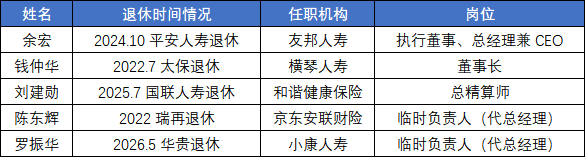
Yu Hong, General Manager of AIA Life Insurance, is the most emblematic figure in this wave of veteran executives returning to lead localized transformation. As a core founding executive cultivated within Ping An Life's system, Yu has dedicated 27 years to the life insurance industry. He was the key leader behind Ping An Life's refined reform of its individual sales channel, improvement of agent quality, and value-driven transformation, personally witnessing and driving the sector's complete evolution from scale expansion to value-based operations. In 2024 year 10 month, Yu officially retired from Ping An Life after completing his re-employment term, fully exiting the Ping An system. By 2025 year 7 month, the National Financial Regulatory Administration formally approved his qualifications as Executive Director and General Manager of AIA Life, enabling him to assume full responsibility for the overall management and operations of AIA's mainland business.
AIA's cross-industry recruitment of a retired veteran carries strong strategic intent. Over the past two years, AIA Life has expanded rapidly in mainland China. However, as a foreign insurer, it still lags behind top domestic insurers in understanding local regulatory rules, channel strategies, and market dynamics. Yu Hong's appointment directly addresses this localization gap. Leveraging his mature end-to-end life insurance expertise, he will drive agent force reform, launch value-driven products, and improve regional operational efficiency—enabling AIA to achieve deep alignment between its international structure and local operations. This case exemplifies how foreign life insurers can leverage seasoned domestic executives to break through business barriers.
Qian Zhonghua, former chairman of Hengqin Life, exemplifies the "restructuring savior who steps back after success" narrative common among smaller insurers. With years of experience within the China Pacific Insurance (CPIC) system, he previously served as General Manager of CPIC Life and Chief Auditor of CPIC Group, bringing expertise in frontline life insurance operations, group audit and risk control, and capital compliance management. He officially retired from CPIC at age 2022 in 7. At that time, Hengqin Life was facing its most challenging period: unstable shareholding structure, weak capital base, immense pressure to increase capital, an imperfect governance framework, and significant operational pressures.
In 2024, Hengqin Life Insurance, which had completed its preliminary equity restructuring and was about to be taken over by state-owned capital, officially appointed Qian Zhonghua as Chairman. He received regulatory approval for his appointment in 7 of the same year. During his tenure, he leveraged his extensive resources and cyclical experience as a senior executive from a leading traditional insurer to lead the company's capital increase and share expansion, standardize its equity structure, rectify internal governance, and eliminate risk exposures. He systematically resolved long-standing issues related to capital and governance that had plagued the company for years. Once the company's equity structure stabilized, its operational foundation solidified, and the state-owned controlling framework was established, Qian Zhonghua voluntarily resigned in 1 of 2026, completing his interim turnaround mission.
This year has already seen several high-profile retiree comebacks. Recently, Chen Donghui, former President of China at Swiss Re and General Manager of its Beijing Branch, officially took over as the interim head of JD Allianz Property & Casualty Insurance, assuming the general manager's responsibilities. Previously, Chen retired from Swiss Re in 2022, bringing together deep local experience in P&C insurance with an international reinsurance perspective, making him a rare veteran skilled in both property-casualty and reinsurance. By entrusting this critical role to Chen, we believe JD Allianz is aiming for significant business breakthroughs.
Taking JD Anlian Property & Casualty's business structure as an example, its largest line of business, categorized as "Other" (return freight insurance), generated 25.72 billion yuan in premiums—a result of heavy reliance on Jingdong's logistics and return scenarios. Notably, the related commissions paid by JD Anlian to Jingdong Insurance Brokerage reached 8.30 billion yuan, accounting for 64.6% of total commission expenses. This indicates extreme channel concentration, with commission growth far outpacing premium growth, further squeezing underwriting profits. Additionally, the company has limited branch coverage, leaving room for market expansion. Whether Chen Donghui's extensive experience can drive meaningful breakthroughs for JD Anlian's property and casualty business remains to be seen.
Additionally, in 5 this year, after retiring as General Manager of Huagui Life, Luo Zhenhua immediately assumed the role of Acting Head of Xiaokang Life, helping stabilize its operations during a period of shareholder restructuring and business reorganization.
Overall, this group of returning veteran executives spans core areas including corporate management, capital governance, actuarial risk control, and reinsurance. They directly address the most pressing transformation, governance, and risk challenges facing insurers today, emerging as a key force in recent industry-wide risk mitigation and transformation efforts.
2
"Start moving into core management roles after 80, Oriental Jiafu Life has formed a 'post-80 general officer team'."
Unlike the short-term logic of veteran executives stepping in to handle emergencies, over the past two years, a large number of post-80 executives have assumed core roles at insurance companies. Their focus is on "ensuring succession, shaping governance, and planning for long-term growth," making them the driving force behind the industry's shift toward youthfulness and professionalism. These executives mainly fall into two categories: those cultivated through internal systems and those seconded by shareholders.
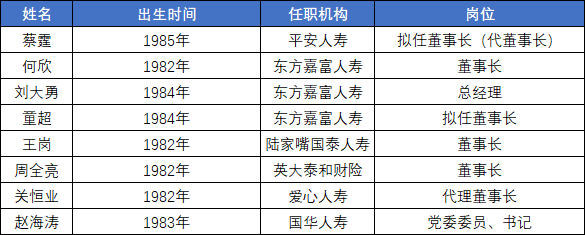
The generational shift among top insurers is highly symbolic. In 1985, Cai Ting's appointment as Acting Chairman of Ping An Life Insurance served as a microcosm of the industry. A key leader cultivated within the Ping An ecosystem, Cai Ting has extensive experience across group strategy, finance, human resources, and life insurance. Assuming chairmanship duties in 2026, this move reflects Ping An Group's proactive effort to manage succession and align with digital and high-quality transformation goals. It also marks the first time a core leader from the 85 generation has taken the helm of a leading domestic life insurer.
Furthermore, Orient Jiafu Life Insurance is a prime example of industry leaders embracing youthfulness. This state-owned insurer, restructured from the former China-Korea Life, has welcomed several core executives born in the 80s: He Xin, born in 1982, was approved as Chairman to establish governance during the initial restructuring phase; Liu Dayong, a PhD from Peking University born in 1984, was appointed General Manager to lead insurance technology and business innovation; Tong Chao, born in 1984, subsequently took over as Acting Chairman, continuing the trend of youthful leadership and creating a rare generational combination of generals and commanders in the 80s.
At the same time, a group of 80-year-old senior executives dispatched by shareholders took office: Wang Gang (born in 1982) became Chairman of Lujiazui Guotai Life Insurance, focusing on capital risk control; Zhou Quanliang (born in 1982) assumed leadership of Yingda Taikai Property & Casualty Insurance, bridging industry and insurance synergy; Guan Hengye (born in 1982) was appointed Acting Chairman of Aixin Life Insurance, promoting integrated development of medical and pension insurance; and Zhao Haitao (born in 1983) joined as a Party Committee Member and Secretary of Guohua Life Insurance. These young executives typically possess combined expertise in finance, law, and risk management, are skilled in modern corporate governance, and bring fresh vitality to the industry.
3
A bidirectional hiring model spanning both seniors and youth aligns better with industry trends.
The emergence of the dual-generation recruitment model—engaging both experienced and young professionals—is not a blind choice by insurers, but a rational response to industry realities. Both approaches offer distinct value and complement each other, adapting to different business scenarios and development stages.
Selecting "Veteran" is a necessary choice driven by the industry's entry into the deep waters of risk resolution and transformation, underpinned by strong industry logic and practical rationale.
First, the industry is entering a complex cycle, and new-generation executives generally lack experience in navigating it. The insurance sector currently faces multiple pressures: persistently low interest rates, rising spread-loss risks, shrinking traditional agent channels, evolving customer demands, and increasingly stringent regulation. These复合型 and systemic challenges cannot be quickly mastered by newly appointed young leaders. In contrast, this round of returning retired veterans have experienced the full industry cycle—from粗放 expansion and deep regulatory crackdowns to structural transformation and interest rate volatility. They have seen the complete landscape of industry risks and are familiar with crisis management pathways. They can precisely identify operational hazards, control the pace of transformation, and stabilize the company's core business amid complex environments.
Second, these veteran executives possess rare end-to-end operational capabilities and industry resources. Unlike younger executives with experience limited to a single segment or domain, these veterans have spent over 20 years deeply rooted in the industry. They master the entire value chain—from product development and distribution to actuarial science, risk control, compliance, and capital operations. They understand both frontline market strategies and top-level governance and regulatory frameworks. Whether it's AIA's need for localized channel reform, Hengqin Life's requirement for capital restructuring and governance, or Harmony Health's demand for actuarial risk mitigation, these are complex, system-wide initiatives that rely heavily on comprehensive experience. For new hires, the cost of trial and error is prohibitively high; veterans can step in immediately, execute effectively, and mitigate risks from day one.
This model has inherent limitations. Some veterans retain traditional growth mindsets and lack sufficient adaptability to new tracks such as digital operations, internet-based insurance, youth-focused customer engagement, and integrated medical-care collaboration. Consequently, their core value lies in "maintaining the foundation, mitigating risks, solving critical issues, and stabilizing operations." They primarily serve short-term stabilization and攻坚 roles, making it difficult for them to independently drive long-term innovation and strategic transformation.
If veterans are the "stabilizers," then 80's young commanders are the industry's "new engines." The core value of appointing young executives lies in aligning with the sector's long-term need for high-quality transformation. On one hand, in recent years, numerous insurance companies have undergone equity changes. After state-owned and industrial capital took control, they appointed loyal young cadres to streamline corporate governance, eliminate past issues of shareholder interference and chaotic management seen in private insurers, and solidify the foundation for standardized development.
On the other hand, new-generation executives from the 80 generation have broken away from the traditional insurance industry stereotype of prioritizing sales and scale. They are proficient in finance, risk management, actuarial science, and digital operations, aligning with the industry's shift from "scale first" to "value-driven" and "risk-first." Meanwhile, senior executives born after 70 are entering retirement, marking a critical inflection point for generational transition. Proactively building a core talent pipeline from the 80 generation is essential for the sustainable growth of insurance companies.
The corresponding weaknesses are also prominent. Most senior executives 80 after being seconded by shareholders lack hands-on experience in frontline insurance operations. While they understand governance and capital management, their control over core business functions such as channel operations, product implementation, and customer acquisition is insufficient, often leading to an imbalance where oversight takes precedence over actual business performance.
The two-way personnel iteration in the insurance industry today is a true reflection of its transformation into deeper waters. The return of retiring veterans meets the industry's intense demand for cyclical experience and risk control capabilities, securing the foundational business and resolving many persistent operational and governance challenges. Meanwhile, the rise of post-80 young leaders represents the industry's proactive breakthrough toward embracing change and high-quality development, ushering in a new chapter of modern governance.
In the short term, a balanced mix of experienced and young professionals represents the optimal solution for insurers to manage risk while driving growth. In the long run, as industry risks are gradually resolved and governance systems improve, younger, more specialized, and versatile talent will become the industry standard. This two-way personnel transformation will not only facilitate leadership succession but also drive China's insurance sector from scale-driven expansion to high-quality development.


