

Recently, the Shanghai Bureau of the China Securities Regulatory Commission issued Administrative Penalty Decision No. Hu [202026] 38, penalizing Yun, a research analyst at the research department of an insurance asset management company, for trading on undisclosed information (commonly known as "rat trading"). The penalty orders the illegal disposal of securities held and imposes a fine of 50 million yuan. This case spanned 3 years and 8 months; although the convergent trades ultimately resulted in losses, the 50 million yuan fine represents the statutory minimum given that no illegal income was generated.
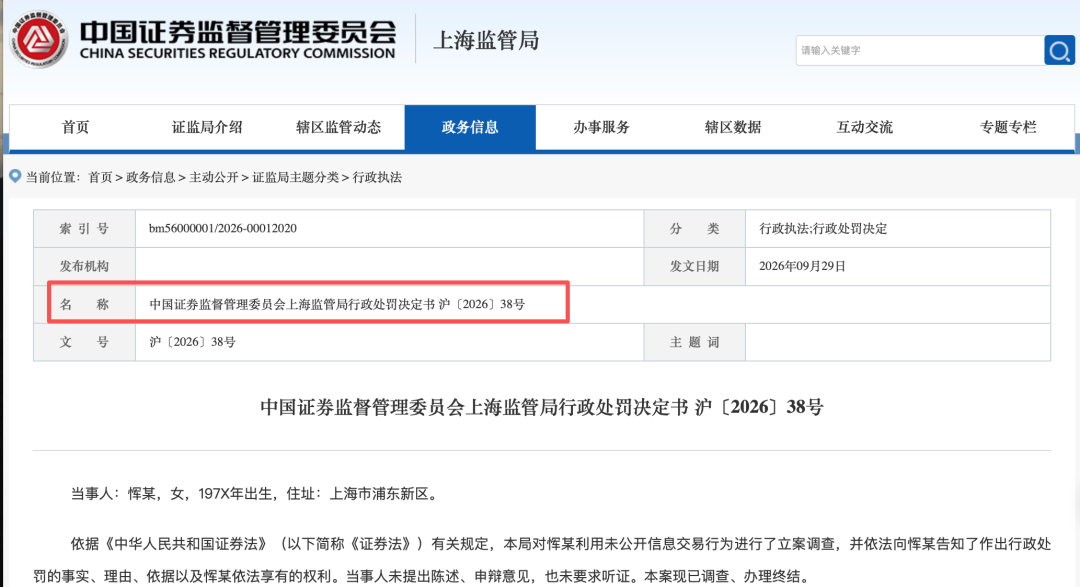
The penalty notice indicates that Yun, female, born in 197X, works as a researcher in the research department of an asset management company. She served as the portfolio researcher for the investment portfolio involved in the case and was responsible for its investment decisions, among other duties. She had access to non-public information regarding the portfolio's holdings and transaction details. The asset management company holds an insurance license.
Between 2022 and 1, Yun controlled two Everbright Securities accounts under the names "Huang Mouju" and "Zhu Mouxiang." Using non-public information obtained through their position, Yun engaged in securities transactions that mirrored those of the relevant portfolio, either independently or by directing others (explicitly or implicitly), resulting in losses. The funds in these accounts were primarily sourced from and directed to Yun and their spouse.
Ultimately, the Shanghai CSRC determined that Yun's actions violated Article 54, Paragraph 1 of the Securities Law and constituted an illegal act as described in Article 191, Paragraph 2 of the Securities Law. Pursuant to Article 191, Paragraph 2 of the Securities Law, individuals who trade using undisclosed information with no illegal gains or with illegal gains under 500,000 RMB shall be fined between 500,000 and 5,000,000 RMB. Since there were no illegal gains in this case, the penalty was set at the lower end of the range.
Insurance asset management companies are other financial institutions as referred to in this Article. Employees of such companies who use their positions to obtain non-public information for trading shall be subject to this Article.
The most intriguing aspect of this fine lies not only in the fact that one loses money and still gets penalized, but also in the identity of the individual involved. Although Yun was nominally a research analyst, they were determined to be "responsible for investment decisions regarding the portfolio in question." Typically, investment decision-making authority rests with fund managers, while analysts provide research support—a standard division of labor at most asset management firms. However, it is true that in some smaller or mid-sized asset management institutions, analysts do play an active role in making investment decisions.
"This enforcement case confirms that the standard for identifying insiders of non-public information in capital markets is substantive authority, not the job title listed on an organization's public registry," said Bi Menglan, a researcher at Gege Fund, to the Shanghai Securities Journal. In this case, Yun's publicly stated research analyst title was not used as the basis for determination. Regulators focused on the individual's actual work authority, finding that Yun participated in investment decisions for the portfolio involved, had access to non-public information such as portfolio holdings and trading plans, and was therefore classified as an insider of non-public information.
Bi Mengran stated that China's asset management industry traditionally builds its information barrier systems based on job levels and departmental divisions. This conventional approach leaves clear regulatory blind spots. Although some research analysts and back-office support staff lack formal titles such as fund manager or investment manager, they are deeply involved in investment research decisions and have access to core trading data. Traditional information barriers only segment permissions by job labels, failing to cover personnel who substantively handle sensitive information, thereby creating compliance vulnerabilities.
Prof. Tian Lihui, a finance professor at Nankai University, told the Shanghai Securities News that current information barriers rely too heavily on static job levels and departmental divisions, overlooking power overreach and cross-functional interactions in actual business workflows. Asset management firms must shift from role-based confidentiality to authority-based confidentiality, dynamically tracking information access logs and trade order flows to precisely define the boundaries of persons with access to non-public information.
From a legal perspective, Dong Yaohui, rotating president of the Shenzhen Financial Stability and Development Research Institute, told Shanghai Securities News that this case reflects an enforcement approach to trading on undisclosed information where profit is not a constitutive element: any convergent trading using non-public information obtained through one's position constitutes a violation, regardless of whether it results in gains or losses. Even if there were losses and no illegal income, the statutory minimum fine of 50 yuan remains a mandatory penalty for the violation.
"Rat trading" typically occurs in licensed financial institutions, such as public and private funds, that hold or have access to large investment portfolios. According to a journalist's incomplete statistics, from 2021 to 2025, the China Securities Regulatory Commission (CSRC) launched investigations into 42 "rat trading" cases and transferred 17 of them to public security authorities. In terms of penalty distribution, public fund sectors are the most frequent, but regulatory enforcement is gradually extending to insurance asset management, securities firms, and other areas.
Why are "rat trading" penalties rare in the insurance asset management sector? Tian Lihui explains that the scarcity of such penalties does not indicate lower moral hazard, but rather stems from monitoring barriers such as long investment horizons, low trading frequency, and complex account nesting.
However, monitoring barriers are gradually being dismantled by regulatory technology. Dong Yaohui believes that this case, which involved nearly 4 years of tracking and precise identification of illegal facts, demonstrates the enhanced capabilities of regulators in identifying low-frequency convergence and constructing long-term behavioral profiles. Regulatory technology can now detect anomalous trajectories within massive volumes of low-frequency transactions.
For asset management firms, Dong Yaohui recommends: close the gap in underlying account transparency reporting and identify hidden accounts held by employees and their related parties; break down internal data silos to establish a dynamic sensitive information blocking mechanism covering research, investment, and trading; and develop customized anomaly detection algorithms tailored to the low-frequency trading and long-term holding characteristics of asset management products, building a digital compliance defense aligned with your business logic.
"Defining sensitive information roles should not rely solely on job titles, but rather on the actual access to and influence over non-public information. Whether in research analysis, trade execution, risk control, or performance evaluation, any role that substantively accesses or infers core holdings and trading intent must be classified as a sensitive position," said Dong Yaohui.


