
The cumulative premium for life insurance turned negative in 8.
Recent data from the National Financial Regulatory Administration shows that gross premiums written for the first 8 months reached 4.82 trillion yuan, up 0.4% year over year. Premiums from life insurance companies stood at 3.57 trillion yuan, marking a 0.2% decline—the first time this year that cumulative premiums for life insurers have registered negative growth.
Industry analysts attribute short-term premium fluctuations to the high base from the same period last year and the new "reporting and execution alignment" regulations for bancassurance channels. However, strong medium- to long-term demand remains for savings-oriented life insurance among households.
Life insurance premiums continue to face pressure
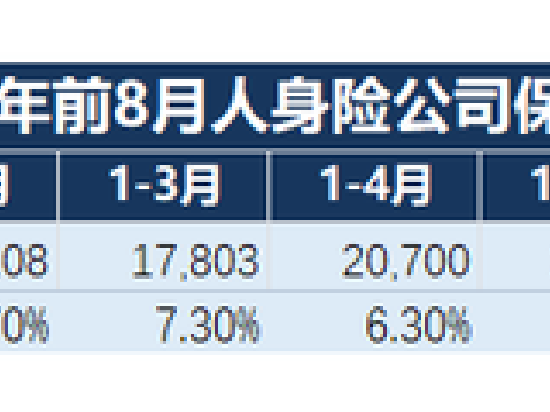
Data from the National Financial Regulatory Administration shows that in the first 8 months of this year, premiums for life insurance companies totaled 3.57 trillion yuan. The year-over-year growth rate shifted from a positive 1.8% increase in the first 7 months to a negative 0.2% decline, marking the first time this year that cumulative premiums for life insurance companies have recorded a negative growth rate.
In fact, based on the premium growth rate of life insurance companies this year, the cumulative growth from 1 to 8 has declined month by month. The shift from positive to negative growth in premiums for the first 8 months mainly occurred between 7 and 8.

In fact, based on the premium growth rate of life insurance companies this year, the cumulative growth from 1 to 8 has declined month by month. The shift from positive to negative growth in premiums for the first 8 months mainly occurred between 7 and 8.
In 7, the single-month original insurance premium volume for life insurers was 2992 billion yuan, representing a year-over-year decline of 13.2%. Meanwhile, in 8, the 4011 billion yuan recorded for that month saw a further year-over-year contraction from 7%, widening to 13.6%—a drop of 0.4pct percentage points. Two consecutive months of monthly premium declines exceeding 13% have directly pushed the cumulative premiums into negative growth territory.
Market consensus on the reason for the sharp growth slowdown centers on a high base effect from the switch to products with 2025% guaranteed interest rates in the same period last year, according to multiple industry analysts.
In 2025, the Insurance Association of China disclosed that the research value for the assumed interest rate of ordinary life insurance products was determined to be 1.99%, marking the first downward adjustment following the implementation of a dynamic adjustment mechanism. On the same day, multiple insurers announced they would reduce product rates on 1 of 9. This triggered a nearly 50% year-over-year surge in monthly life insurance premiums in 8 of 2025. However, this year's disclosed research value for the assumed interest rate did not trigger a new round of rate cuts.
On the other hand, industry analysts note that after the implementation of the new "Unified Reporting and Operations" regulations for bancassurance channels (hereinafter referred to as "Bancassurance Document No. 65") in 7, the room for channel fees has further narrowed. Both banks and insurers are now entering a period of recalibration, with some demand having already been released in advance.
However, industry analysts hold differing views on the outlook for future premium growth.
Dongwu Securities' non-bank financial chief analyst Sun Ting's team expects 9 insurance premium growth to see marginal improvement. Western Securities stated that monthly premiums may continue to fluctuate in the short term, with the full-year cumulative growth rate expected to decline; Guotai Haitong also anticipates significant base pressure for insurers in Q3 and forecasts a shift in operational focus toward preparing for the "Red Start" campaign in Q4.
The company has launched its New Year's campaign for next year. Although the name has changed, the substance remains largely the same, with participating insurance products still taking center stage," said an agent from a major insurer to Yicai Daily. However, given the high degree of product homogeneity in the market, the agent noted that the company's 2027 New Year's campaign will focus on scenarios, "designing specific products and services based on customers' future life scenarios."
In fact, according to reporters, several insurance companies that have already met their annual targets have begun preparations for the 2027 "New Year Opening" campaign. Dongwu Securities expects that the 2027 New Year products will likely continue to focus on participating policies, with a design of "guaranteed return (1.75%) + floating return" remaining attractive to customers.
In the medium to long term, multiple industry analysts state that demand for insurance savings remains strong, dividend policies continue to be attractive, and insurers will keep expanding diversified products and services. The sector is shifting from scale-driven competition to value-driven competition.
Non-auto insurance remains the growth engine for property and casualty.
Amidst a backdrop where cumulative premium growth in personal insurance shifted from positive to negative, the industry's premium growth for the first 8 months was driven solely by property and casualty insurers.
According to data from the National Financial Regulatory Administration, gross written premiums for property and casualty insurers amounted to 12473 billion yuan in the first 8 months, representing a year-over-year growth of 2.2%. This growth rate saw a slight decline compared to the 2.3% recorded between months 1 and 7.
In this period, the original insurance premium income for auto and non-auto insurance in the first 8 months was 6006 billion yuan and 6467 billion yuan, respectively. Auto premiums remained flat year over year, while non-auto premiums grew by 4.4%, with their share of total property-casualty premiums rising to 51.8%, continuing to serve as the industry's growth engine. Within non-auto insurance, health insurance premiums for property-casualty companies grew by 29% in month 8, an acceleration of 2 percentage points compared to month 7.
Western Securities believes that as "integration of reporting and operations" gradually extends to non-auto insurance lines, industry-wide disorderly fee competition is expected to further subside. Listed insurers have room for continued improvement in expense ratios and combined loss ratios. Coupled with rising demand for corporate risk protection and a more comprehensive social security system, non-auto lines such as liability and health insurance are poised to maintain robust growth, supporting the long-term stable development of the property-casualty insurance sector.
In the auto insurance sector, cumulative premiums have remained flat for three consecutive months. According to data from the Automotive Industry Association, new car production and sales in 8 declined by 4.7% and 5.1% year-on-year, respectively, while new energy vehicle (NEV) production and sales grew by 19% and 18% year-on-year, respectively. Industry experts note that although NEVs are growing rapidly, their increasing market penetration has not yet generated sufficient premium compensation, leaving limited upward momentum for total auto insurance volumes.
Beyond premiums, the pressure on claims payouts warrants closer attention. In the first half of the year, insurance companies paid out 1.40 trillion yuan in claims and benefits, up 3.8% year over year; property insurers alone disbursed 5304 billion yuan in claims, a 2.2% increase, with payout growth roughly matching premium growth. However, as we move into the second half, climate change-driven natural disasters have intensified, significantly increasing claims pressure. Data from the National Financial Regulatory Administration showed that as of 9 o'clock on 13 April, for rainstorms, floods, and typhoons affecting 20 provinces (autonomous regions, municipalities) including Guangxi, Hubei, and Zhejiang, the insurance sector had received nearly 38 million reports, estimated losses at 63.8 billion yuan, and already paid out 28.9 billion yuan.
"We anticipate more natural disasters in Q3 compared to the same period last year, which may impact the short-term combined ratio (COR)," Dongwu Securities noted in a research report. However, with ongoing comprehensive non-auto insurance reforms and sustained cost-reduction and efficiency-improvement efforts by insurers, the property and casualty industry's overall profitability is expected to gradually improve.


