
Source: Economic Daily
Less than 24 hours after the disaster, the first round of insurance payouts was deposited into accounts of victims' families. From 7 to 7, Typhoon "Maysak" and the Meiyu front combined to trigger extreme convective weather in eastern Hubei, causing severe tornadoes and resulting in significant casualties and property damage. Once the event met the catastrophic insurance claim threshold, Hubei immediately activated its claims process. As co-lead underwriters for Hubei's Catastrophic Insurance Consortium, PICC Property and Casualty Company Limited (Hubei Branch) and Changjiang Property & Casualty Insurance Company Limited (Hubei Branch) deployed over 400 surveyors to the affected areas. Within less than a month, they completed assessments for more than 1.4 households, disbursing a total of 4691 million yuan in compensation directly to victims.
The role of catastrophe insurance is becoming increasingly evident in disaster response efforts. China faces a wide range of natural disasters, spanning diverse regions with high frequency. Moreover, as climate change intensifies, the uncertainty surrounding extreme events like heavy rainfall, flooding, and typhoons continues to grow. How can insurance mechanisms effectively disperse concentrated, massive disaster losses? How can insurance evolve from post-disaster compensation to pre-disaster prevention? And how can insurers strengthen their risk resilience following an extreme catastrophic event? Addressing these questions is critical to improving China's catastrophe insurance framework.
Expand coverage and improve quality
Catastrophes are typically low-frequency, high-impact events with widespread consequences and highly concentrated losses. A major disaster can cause significant casualties and property damage simultaneously, which neither affected entities nor post-disaster fiscal aid alone can fully absorb.
Professor Liu Xinli of the School of Economics at Peking University argues that catastrophe insurance should not be limited to compensating individual losses but should instead serve as a "stabilizer" for economic and social resilience. First, it provides reconstruction funds for affected households and businesses by transferring risk. Second, insurance payouts can quickly flow into disaster zones, accelerating the recovery of production and daily life. Additionally, pre-disaster mitigation measures can reduce overall societal risk exposure.
This major disaster claim in Hubei serves as a microcosm of the broader response. Following the disaster, Yangtze Property & Casualty Insurance Company's Hubei Branch transferred the first batch of 100 yuan in compensation to the accounts of 5 families of victims on 7/7. The entire process from the incident to payment receipt took less than 24 hours. The following day, PICC Property and Casualty Insurance Company's Hubei Branch completed the initial payouts for Ezhou and Huangshi.
Behind the rapid claims settlement lies a mechanism innovation. PICC Property and Casualty Company, Ezhou Branch, adopted a "survey-and-assess simultaneously" model, negotiating damage assessment standards with affected households during home visits. In collaboration with local governments, village organizations, and affected households, PICC Property and Casualty Company and Changjiang Property and Casualty Insurance established a "four-party consultation" mechanism, introducing "publicize-and-pay simultaneously" to further shorten the time for claim disbursement.
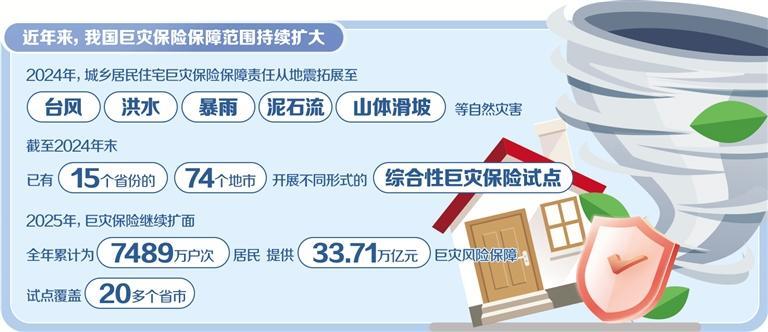
In recent years, China's catastrophic insurance coverage has continued to expand. In 2024, the scope of coverage for residential catastrophic insurance for urban and rural residents was extended from earthquakes to natural disasters including typhoons, floods, rainstorms, mudslides, and landslides. By the end of 2024, comprehensive catastrophic insurance pilot programs had been launched in 74 cities across 15 provinces. In 2025, the program expanded further, providing a total of 33.71 trillion yuan in catastrophic risk protection to 7489 household visits nationwide, with pilots now covering more than 20 provinces and municipalities.
Insurance companies' participation continues to rise. China Insurance's 2026 semiannual report shows that it has contributed to the national catastrophe insurance system, with local coverage spanning 23 provinces, autonomous regions, and municipalities in 169 cities, protecting nearly 5 billion people.
Overall, however, insurance coverage for natural disasters in China remains insufficient. Data shows that disaster payouts account for only about 10% of direct economic losses from natural disasters in China, compared to a global average of 40% to 50%. This represents a significant coverage gap.
How can we further close protection gaps? A key direction is building a multi-layered system that connects basic coverage with commercial insurance. Some regions are already piloting the model of "government covers essentials, individuals and markets cover additional needs." For example, Anhui divides coverage into three tiers: Basic Package, Enhanced Package, and Customizable Package. The Basic Package is funded by the government, while residents and small businesses can opt to add enhanced or customized coverage as needed.
This means that expanding catastrophe insurance coverage should not focus solely on increasing the number of policies, but must also improve the level of effective protection. Tailored coverage solutions should be developed based on regional disaster risks, economic development levels, and resident needs to better leverage insurance as a supplement to fiscal disaster relief.
Extend services before disasters
Fast payouts are important, but minimizing losses matters just as much. This year, natural disasters have increased claims pressure on the insurance industry. PICC Property and Casualty, CPIC Property and Casualty, Ping An Property and Casualty, and China Life Property and Casualty reported that their combined natural disaster payouts for 5 and 6 this year reached 18.38 billion yuan (before reinsurance). In response to shifting disaster risks, insurers are expanding from post-event claims handling to include pre-event warnings, mid-event loss reduction, and post-event compensation.
Technology serves as a critical enabler. In the first half of 2026, Ping An Property & Casualty's self-developed "Eagle Eye DRS3.0" issued over 60.2 billion disaster alerts for typhoons, heavy rains, and floods, reaching 1.2 billion vehicle owners, businesses, and farmers. The end-to-end agricultural disaster risk control system launched jointly by Ping An P&C and Ping An Technology delivered more than 4330 million valid alerts in the first half of the year, reducing losses by over 3170 yuan and serving 39.9 million households.
Shifting from "pay after a claim" to "alert before disaster strikes" reflects moving the insurance risk management focus upstream. However, to achieve effective early warning and precise pricing, we must first answer one critical question: How severe is the risk? Catastrophe risk assessment is far more challenging than standard insurance evaluation. Liu Xinli notes that due to insufficient historical data, coupled with climate change and human activity impacts, predicting both the frequency and severity of catastrophic events remains difficult. Moreover, a single disaster can simultaneously damage numerous insured assets in the same area, challenging traditional risk assessment methods that rely solely on historical claims data.
Catastrophe models have thus become critical infrastructure. By incorporating factors such as hazard intensity, terrain, population distribution, and asset exposure, these models simulate potential losses under various disaster scenarios, providing the basis for insurance product design, rate setting, and risk management.
In recent years, China Reinsurance has continuously strengthened the development of catastrophe models and climate risk quantization technologies. It has independently developed a comprehensive Chinese catastrophe model suite covering major perils such as floods, typhoons, droughts, and extreme cold. These technological achievements have secured 22 national patents and been deployed in over 30 institutions.
In 9 of this year, China Re further released a flood stress test model for physical climate risks. By identifying the impact of climate change on flood risk, it converts these into quantifiable and manageable financial risks, helping financial institutions assess potential losses. CPIC also conducted multi-model comparison and empirical integration research focused on climate risk quantification. In collaboration with China Re Catastrophe, it leveraged the Climate Risk Insight Platform to strengthen related capabilities.
Achieving more precise risk assessment is not just about reducing payouts for insurers; it's fundamentally about driving risk reduction. The Hebei Comprehensive Catastrophe Insurance program serves as a prime example. In 2024, the first nationwide all-hazard, broadly covered, long-term comprehensive catastrophe insurance policy was issued in Hebei, providing housing, property, and personal protection to 2635 households and over 7400 million people. PICC Property and Casualty served as the lead underwriter and executing agency, with domestic 26 direct insurers and multiple reinsurers sharing the coverage. The project includes a dedicated disaster prevention and loss mitigation fund and established a joint laboratory for risk reduction services with emergency management authorities, extending insurance services from pre-disaster prevention to mid-disaster response and post-disaster reconstruction.
Shifting from post-disaster claims to comprehensive risk management helps reduce losses for individuals and businesses while enhancing the sustainability of insurance operations. Moving forward, we must further integrate data across meteorology, water resources, and emergency management sectors to improve risk identification and early warning capabilities, enabling insurance to play a greater role in societal disaster prevention and mitigation.
Enhance risk resilience
Catastrophe insurance must also address a critical question: can insurers withstand super-scale disasters? In the second quarter of this year, PICC Property disclosed rainfall payouts of 11.06 billion yuan (before reinsurance); CPIC Property reported combined payouts for 11 disaster types—including Hebei and Hubei rainstorms and Hebei hail—in total 2.09 billion yuan (before reinsurance); Ping An Property & Casualty disclosed major disaster payouts totaling 3.85 billion yuan (before reinsurance).
Catastrophes are characterized by concentrated loss releases. If a large volume of risk is concentrated within a single insurer, it could threaten operational stability and solvency in extreme scenarios. Therefore, catastrophe insurance should not merely transfer risk from households and businesses to insurers; it must also establish broader risk-sharing mechanisms.
Reinsurance is a key component. Zhuang Qianzhi, Party Secretary and Chairman of China Re, stated that reinsurance enables risk dispersion across regions and entities, mitigating the impact of extreme disasters on the balance sheets of individual markets and financial institutions. Additionally, through professional risk pricing, catastrophe modeling, and portfolio management, it enhances the entire financial system's capacity to absorb major disaster losses.
Currently, China Re has deeply participated in the catastrophic insurance pilot programs in 21 provinces and cities, serving as the lead reinsurer in 80% of these projects. In 2024, China Re assumed domestic flood and typhoon risk liability totaling 18.1 trillion yuan and promoted the implementation of comprehensive catastrophe insurance projects covering all disaster types, broad coverage, and long cycles in Hebei and Hubei provinces.
In addition to reinsurance, a multi-layered risk-sharing framework is needed. According to Liu Xinli, the primary insurer should absorb the first layer of risk, reinsurers handle peak risks, catastrophe bonds and other capital market tools can further disperse risk, and government entities cover tail risks in extreme scenarios—creating a multi-tiered capital pool for risk absorption.
Risk needs to be diversified over time. For catastrophic events, some years may be calm while others see concentrated major disasters. Liu Xinli suggests using multi-year risk reserves or catastrophe funds to transfer surplus from low-loss years to cover losses in high-impact years, achieving "use abundance to offset scarcity." Additionally, mechanisms such as combining catastrophe reserves with catastrophe securitization can be explored.
This means a mature catastrophe risk-sharing system should involve multiple stakeholders: the government provides foundational policies and support; insurers leverage their expertise in product design, pricing, and claims handling; reinsurers spread concentrated risks; and capital markets offer broader capacity for risk absorption.
From compensating over 1.4 households affected by disasters in Hubei to enrolling more than 7400 million people in Hebei into comprehensive catastrophe insurance coverage, China's catastrophe insurance is evolving from a single-loss compensation tool into an integrated risk governance mechanism—shifting from rapid post-disaster payouts to proactive risk reduction through modeling and early warning systems.
To address the long-term challenges posed by climate change, we must expand effective coverage, refine a multi-tiered risk-sharing mechanism involving fiscal policy, insurance, reinsurance, and capital markets, accelerate foundational capabilities such as catastrophe modeling and risk mapping, and extend insurance services further toward pre-disaster prevention and mid-disaster loss reduction. Only by gaining clearer visibility into risks, strengthening defenses, and distributing losses more effectively can we better fulfill insurance's role as an economic "shock absorber" and a social "stabilizer," providing a more robust foundation for enhancing societal resilience to major natural disasters.


