

21 Century Business Herald reporter Sun Shihui, Shanghai
On 10/8, the Shanghai Bureau of the National Financial Regulatory Administration released 31 penalty notices in a single announcement, including 21 related to insurance and 10 for banks and non-bank institutions.
Based on the violation types, insurance penalties primarily fall into four categories: operating across regions, non-compliant policy terms and rates, submission of false documentation, and intermediary fraud. Among these, cross-regional operations emerged as the most common violation in this batch, resulting in fines for Shanghai branches of Pacific Health Insurance, Taikang Pension, and Dinghe Property & Casualty.
Additionally, regulatory accountability being pushed down is a key feature of this batch of penalties. Among the 31 fines issued, individuals account for 4 out of 10 cases. The penalties involve not only branch general managers and deputy general managers but also frontline execution roles such as heads of business development departments and deputy heads of non-auto insurance departments.
Three institutions cross the "cross-regional operations" red line
Based on the penalty information, three institutions share highly consistent violations: all engaged in "operating insurance business across regions" and simultaneously violated regulations by "failing to use filed insurance terms and rates."
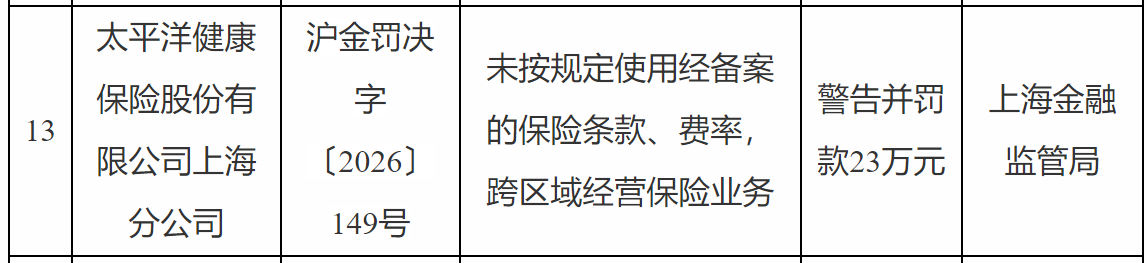
Pacific Life Insurance Shanghai Branch was warned and fined 23 million yuan for failing to use filed insurance policy terms and rates in compliance with regulations and for conducting insurance business across regions. Zheng Wenhao, then Manager of the Business Development Department III at the East Region's Key Customer Business Center, was warned and fined 4 million yuan.
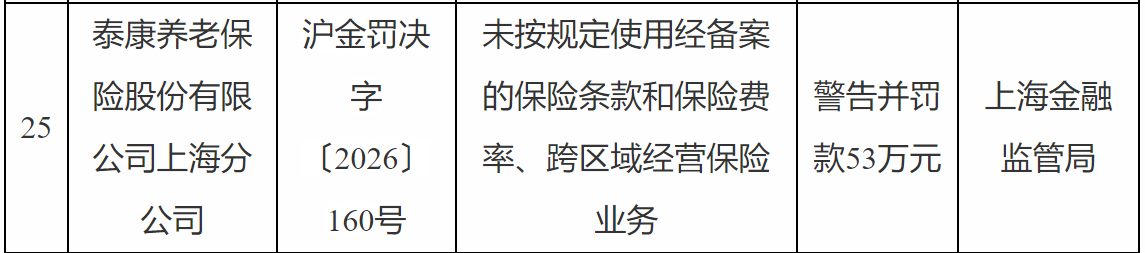
The Taikang Pension Shanghai Branch was warned and fined 53 million yuan for failing to use filed insurance policy terms and rates as required, and for conducting insurance business across regions. The then-General Manager, Zheng Tingqiang, was also warned and fined 10 million yuan.
Dinghe Property Insurance's Shanghai Branch had the most concentrated violations, including operating insurance business across provinces, autonomous regions, and municipalities. It was also cited for submitting false reports and failing to use filed insurance policy terms as required. The branch received a warning and was fined 54 million yuan—the highest penalty among all insurance-related fines in this batch. Zhang Wei, then Deputy General Manager (acting), was fined 7.5 million yuan for fabricating reports. Ma Liang, then Deputy Manager of the Non-Casualty Department (acting), was fined 1.2 million yuan for violating premium rate regulations.
Cross-regional insurance operations are a longstanding regulatory requirement. Article 41 of the "Provisions on the Administration of Insurance Companies" explicitly states: Branch offices of insurance companies shall not conduct insurance business across provinces, autonomous regions, or municipalities directly under the Central Government.
However, this rule is not without exceptions. Insurers may participate in co-insurance, operate large-scale commercial insurance or umbrella policy businesses, and underwrite policies across provincial boundaries via the internet or telemarketing, provided they comply with regulatory requirements.
The core issue is that cross-regional business at the branch level often falls into a "gray area." Compliance cases show that some institutions attempt to circumvent restrictions on cross-regional operations by altering the subject address, splitting policies, or using intermediaries as bridges. Regulators still deem such practices as non-compliant out-of-area underwriting.
An insurance agent told the Century Economic Daily reporter that cross-regional business may be driven by performance pressure. "In actual sales, such violations may occur to 'secure business.'"
When cross-regional business violations and "non-compliant terms and rates" occur simultaneously, the official explained that under performance pressure, branches may take two actions: loosening standards for terms and rates to attract customers, and exceeding operational boundaries to expand their customer base.
However, looking at the fine amounts, the direct penalties for cross-regional operations are not particularly high. According to Article 69 of the "Provisions on the Administration of Insurance Companies," fines range from up to 1 million yuan if there is no illegal income, or between 1 and 3 times the illegal income (capped at a maximum of 3 million yuan) if illegal income exists. The substantial fines primarily stem from "failure to use filed policy terms and rates as required"—a violation under Article 170 of the "Insurance Law," which imposes fines ranging from 10 million yuan to 50 million yuan on the institution.
Regulatory accountability is being pushed down from the General Manager to frontline business managers.
Out of 31 total fines, 19 were issued to institutions and 12 to individuals, with individual fines accounting for nearly 40%. Among the individual penalties, recipients included branch general managers, deputy general managers, heads of business development departments, deputy heads of non-auto insurance departments, client managers in the personal finance department, and assistant bank presidents—covering frontline execution roles across the board.
Looking at the severity of penalties, individual fines show a clear gradient: Zheng Tingqiang, General Manager of Taikang Pension Shanghai Branch, was fined 10 million yuan—the highest among individuals; Zhang Weizong, Deputy General Manager of Dinghe Property Insurance Shanghai Branch, was fined 7.5 million yuan; Song Yi, Deputy General Manager of Sino-Italian Property Insurance Shanghai Branch, was fined 7 million yuan; Huang Jian, Assistant to the President of Bank of China Putuo Sub-branch in Shanghai, was fined 5 million yuan; and Zheng Wenhao, Manager of Department 3 for Business Development at Pacific Health Insurance, was fined 4 million yuan.
More notably, industry bans were imposed. Wang Jun, an agent at Qianhai Life Insurance's Shanghai branch, was banned from the insurance sector for 10 years due to "contract fraud"; Zhuang Rong, a client manager in the Market Division II of Baoshan Branch of Shanghai Rural Commercial Bank, was barred from working in the banking industry for 10 years; and Gu Yanqing, Assistant Manager of Retail Market Division I at the same bank, was prohibited from banking work for 5 years. Unlike fines, these bans do not involve monetary penalties but instead terminate the individuals' careers outright, making them the most severe type of sanction.
From the penalty details, individual penalties closely align with institutional violations: For institutions penalized for fabricating materials (Taiping Life, Fosun United Health, Dinghe Property & Casualty), individual accountability spanned multiple levels including department managers of personal business, branch general managers, and deputy general managers. Penalties for clause and rate violations corresponded to accountability for managers of business development departments and deputy managers of non-auto insurance departments. Bank penalties for credit management violations matched accountability for client managers and assistant bank presidents.
This "institution-plus-individual" dual-penalty model has been explicitly reinforced in previous comprehensive non-auto insurance governance action plans. Previously, the cost of violations by branch offices was borne primarily by the institution—the institution paid fines while individuals submitted self-criticisms. Now, regulatory accountability is shifting from penalizing institutions alone to equally penalizing both institutions and individuals, with the scope of accountability extending from management roles to execution roles. This means that for every violation, any responsible person along the chain—from decision-making to execution—could face accountability.
Beyond pushing regulatory accountability downward, the "immunity upon departure" myth has also been shattered. On 7/31, the National Financial Regulatory Administration, the People's Bank of China, the China Securities Regulatory Commission, and the Ministry of Finance jointly issued the "Implementation Opinions on Improving Financial Institution Governance." The document explicitly states that "lifelong accountability will be enforced for major issues in accordance with laws and regulations"—meaning even after leaving office or retiring, individuals will still be held accountable if their illegal or non-compliant actions during their tenure caused significant losses. This fundamentally eliminates the侥幸心理 (luck-based mindset) that one can profit while in office and remain safe once they leave.
From penalizing institutions to penalizing individuals, from accountability during employment to lifetime liability, regulatory oversight is extending, deepening, and piercing through. For financial institutions, compliance is no longer just a "company issue"—it's "everyone's responsibility."


