

Lin Hanyao, reporter at 21 Century Economic News
From product searches and policy interpretation to clarifying family protection needs, insurance AI agents are embedding services that consumers previously had to actively search for or consult sales representatives into AI conversations.
Recently, Alibaba Qwen expanded its agent ecosystem by integrating over a dozen financial services agents, including insurance providers Xiaoyus伞 and HuiZe Insurance.
At the same time, the insurance agent on Ant Afu App is expanding. On 10 month 10, Fosun Prudential Life Insurance Co., Ltd. (hereinafter referred to as "Fosun Prudential") and Ant Yikang (Guangzhou) Information Technology Co., Ltd. (hereinafter referred to as "Ant Health") announced that they will build a dedicated agent on the Ant Afu App to integrate insurance with professional health management.
Additionally, insurers including PICC Property and Casualty, Pacific Health Insurance, CPIC Property & Casualty, Zijin Property & Casualty, Guotai Property & Casualty, and Manulife have also established their presence on the Ant Aifu App.
As consumers increasingly describe their family situations, medical budgets, and coverage needs to AI—and rely on it to research insurance products and compare coverage—insurers are accelerating their push to secure AI entry points.
Insurers compete for AI-driven consumer access points
When an insurance agent enters the AI platform, the first change is how consumers access insurance services.
Traditional insurance purchases typically begin with searching for policy types, browsing products, or contacting sales agents. For consumers unfamiliar with insurance, key barriers to decision-making include understanding the differences between critical illness, medical, and life insurance; grasping concepts like deductibles, waiting periods, and exclusions; and comparing coverage specifics across different products.
AI conversations offer another approach: consumers can first describe their family structure, budget, and concerns, then progressively clarify the specific risks they need to address. Insurance agents use this information to provide product searches, policy explanations, underwriting guidance, and coverage comparisons.
Recently, Qwen announced the launch of its first batch of financial agents, including insurance providers Zhong'an Insurance, Xiaoyusan, and Huize. With these insurance agents now available on the Qwen platform, users can directly access professional services from different institutions within a general-purpose AI application, without relying solely on traditional search engines or institution-specific channels.
(Alibaba Qwen Platform Insurance Agent)
Reporters from Century Economic News discovered that Xiaoyusan and HuiZe Insurance are presented as independent agents, allowing consumers to access their respective service pages and ask insurance-related questions through conversation.
"As more users rely on large models to access information and make comparisons, the entry point for insurance consulting is evolving," said Xu Zimo, project lead at Huize Insurance Brokerage's AI division. He told reporters that Huize joined Tongyi to bring professional insurance services directly to where customers express their needs.
He revealed that the current collaboration focuses on information retrieval and consultation. HuiZe's AI agent primarily offers capabilities such as product search, interpretation of terms and coverage responsibilities, underwriting rule inquiries, multi-product benefit comparisons, and family insurance needs assessment, with search and comparison covering all products currently available on HuiZe. Qwen introduces a new service channel for HuiZe, along with user-initiated insurance questions and requirements.
Xu Zimo stated that, as the partnership is in its early stages, both sides are prioritizing response accuracy, understanding of requirements, and whether users receive effective assistance.
Qwen responded to reporters, stating that all agents on the platform are not involved in any commercial initiatives or plans. The Qwen App is essentially an open platform where brands integrate after completing technical adaptation; services are provided directly by the brands themselves, while Qwen only provides the connection gateway.
Zhu Junsen, a professor of applied economics at Peking University, told reporters that the core purpose of AI agents like Xiaoyusan and Huize Insurance joining Alibaba's Qwen is to secure entry points for insurance consumption in the AI era by proactively identifying user needs and influencing purchase decisions. Leveraging Qwen's traffic and interaction capabilities, insurance intermediaries can reduce customer acquisition costs, expand their client base, improve conversion rates through demand analysis, policy interpretation, and product comparison, and accumulate valuable user data.
Agent-Embedded Policy Health Management
Unlike Alibaba's Qwen, licensed insurers in the Ant Aifu App ecosystem focus their agent deployment on health, medical services, and rights fulfillment.
On 10/10, Fosun Prudential and Ant Health announced a collaboration to explore "Family Coverage + AI Health" services. Specifically, Fosun Prudential will launch a dedicated AI agent on the Ant Afu app, integrating insurance with professional health management. After purchasing coverage, customers not only receive protection but also gain access to a health portal that offers consultation, interpretation, and reminders—enabling dynamic assessment and continuous care for family well-being.
Multiple insurance providers have already deployed agents on the Ant Aifu app.
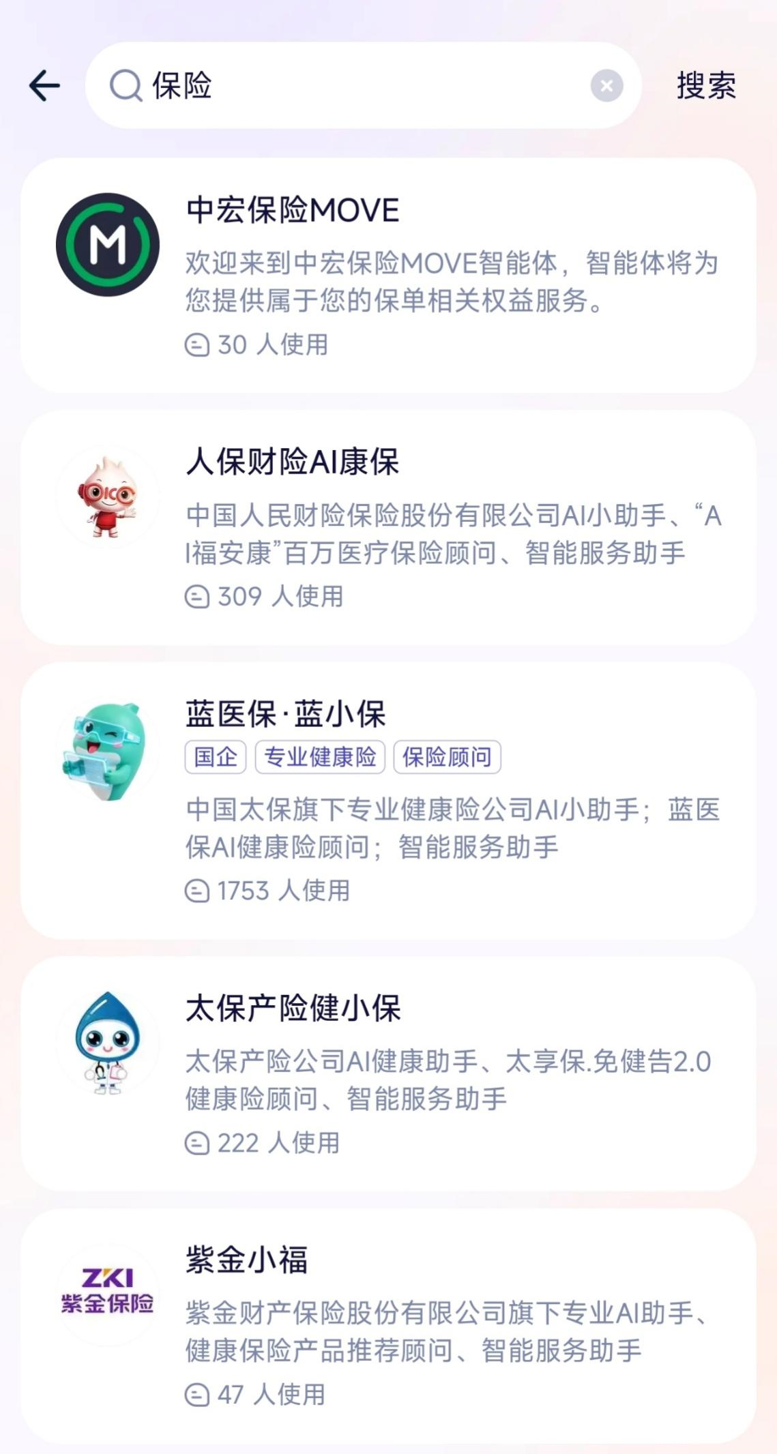
(Ant Aifu Platform Insurance Agent)
For example, Great Eastern Insurance's "Great MOVE", CPIC Health Insurance's "Blue Medical · Blue Small Protection", CPIC Property & Casualty Insurance's "Health Small Protection", PICC Property & Casualty Insurance's "AI Health Protection", Zijing Property & Casualty Insurance's "Zijing Little Fortune", and CTI Property & Casualty Insurance's "Tai Small Protection".
On the Ant Aifu App, insurance providers' AI agents are equipped with real-name authorization to query valid policies under one's name. They also commonly include health service toolkits such as "AI Clinic," "Medicine Box Recognition," "Report Interpretation," and "Skin Analysis," transforming low-frequency post-purchase contracts into daily high-frequency health management companionship.
Taking Lan Yibao - Long-term Medical Insurance Without Health Declaration (Fu Edition) as an example, it introduces a comprehensive health management service combining "AI Health Concierge" and "Real Human Health Advisor." Policyholders can enjoy free health consultations, report interpretations, and more daily via the A-Fu app.
CPIC President Zhao Yonggang stated that the collaboration between Blue Medical Insurance and Afu will deepen health services, shifting from "people seeking services" to "services reaching people." This makes health services tangible, accessible, and actionable, driving a fundamental industry transformation from "passive claims settlement" to "proactive health management."
Zhang Junjie, Vice President of Ant Group and President of Ant Health Business Unit, stated that the "AI + Human" collaborative health service model provides users with end-to-end solutions and companionship ranging from daily health inquiries to medical consultations, driving the evolution of health insurance from a "low-frequency claims" model to a "high-frequency service" model.
Still faces "AI hallucinations" and data compliance boundaries
As agents scale to serve consumers directly, responsibilities such as information accuracy and personal data protection must be clearly defined.
Insurance products are highly specialized and contractual. For consumers, exclusions, waiting periods, health declarations, renewal conditions, and coverage scope often impact their rights more directly than the advantages highlighted in product marketing. If AI misinterprets terms, omits critical restrictions, or recommends unsuitable products based on incomplete information, consumers may make incorrect decisions.
Tian Hongzhen, Party Secretary of Fosun Prudential, noted that while AI can produce hallucinations, the financial insurance sector demands high information accuracy. In high-risk scenarios such as underwriting and claims processing, AI applications must be used cautiously, with key decisions still requiring human confirmation.
To reduce AI hallucinations, Xu Zimo emphasized that responses must be grounded in reliable product documentation and contractual terms.
Regarding AI hallucination mitigation, he stated that Huize has established a domain-specific knowledge base for the entire insurance industry and continues to expand product coverage. By consolidating knowledge around products, terms, and specific coverage responsibilities, we provide AI with sufficient context and evidence for decision-making. When information is insufficient or a query exceeds our capabilities, we clearly communicate these limitations to avoid presenting unfounded conclusions as facts.
Zhu Junsheng suggested that insurance agents should build a knowledge base grounded in formal policy terms, product brochures, and underwriting rules, with continuous updates. Key information—such as exclusions, health disclosures, and renewal conditions—must be rigorously validated; the agent should proactively seek missing details and escalate to human support when necessary. Institutions should also retain consultation records and recommendation rationales while conducting ongoing monitoring.
Regulators have also issued clear requirements for the use of AI in the financial sector regarding information protection.
On 2026-6-18, the National Financial Regulatory Administration issued the "Guidance on Safe Development and Application of Artificial Intelligence in Banking and Insurance," requiring financial institutions to assume primary responsibility for AI applications, refine human-machine collaboration management processes, and implement classified and graded management for application scenarios.
The document also specifies that generative AI applications involving underwriting and claims processing, risk management, or those directly impacting customer interests and the execution of financial contracts are classified as high-risk scenarios requiring stringent oversight.


