
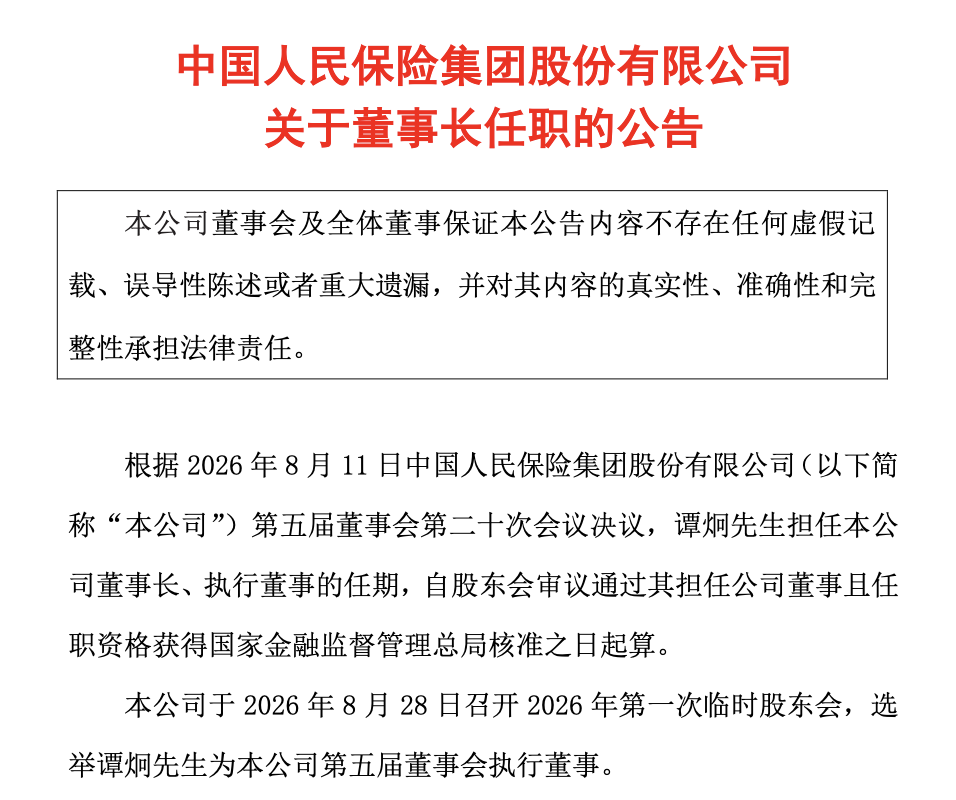
On 10 13, PICC Group Co., Ltd. (hereinafter "PICC", 601319) announced that the National Financial Regulatory Administration has approved Tan Jiong's qualifications as a director and chairman of the company. The appointment takes effect on 2026 10 12. According to the announcement, effective from the same date, Tan Jiong also serves as Chairman of the Board's Strategy and Investment Committee/Sustainable Development Committee.
On 7/23, PICC convened a cadre meeting to announce Tan Jiong's appointment as Party Secretary. On 8/11, the Board of Directors approved resolutions nominating Tan Jiong as a candidate for Executive Director and electing him as Chairman. On 8/28, Tan Jiong was elected as an Executive Director by an extraordinary shareholders' meeting. With regulatory approval of his qualifications, Tan Jiong has formally completed the procedures to assume the role of Chairman.
This leadership change comes more than four months after former Chairman Ding Xiangqun departed PICC. In 2026 year, 5 month, Ding was transferred to serve as Party Secretary of the National Financial Regulatory Administration and subsequently appointed as its Director. The 62-year-old Tan Jiong brings extensive experience across commercial banks, local governments, and policy banks, though he has not previously held a senior executive role at an insurance company. He now leads PICC, which reported nearly a 40% year-over-year increase in net profit for the first half of the year, although performance across its various business segments has diverged.
Over 30 years of deep expertise in the financial sector, previously leading Bank of China Fund.
Public records show that Tan Jiong was born in 1966 in 6, is from Hanchuan, Hubei, serves as a member of the 14th National Committee of the Chinese People's Political Consultative Conference, holds the title of Senior Economist, and earned a Ph.D. in Economics from Wuhan University.
In 1988, after graduating from Wuhan University, Tan Jiong joined the Wuhan Branch of Bank of China (601988), starting in entry-level roles such as a clerk in the credit department before advancing to management positions. Subsequently, he served as President and Party Secretary of the Tibet Autonomous Region Branch of Bank of China, followed by similar roles at the Yunnan Branch.
In 2011 and 9, Tan Jiong was appointed Chairman of BOC Fund Management Co., Ltd., entering the field of public fund management. In 2015 and 1, he returned to the Bank of China system, serving as Party Secretary of the Guangdong Branch and later as President. After 28 years within the Bank of China system, in 2016 and 10, Tan Jiong transferred to Industrial and Commercial Bank of China (601398) as a member of its Party Committee, subsequently becoming an Executive Director and Vice President of ICBC.
From the Bank of China to the Industrial and Commercial Bank of China, Tan Jiong has accumulated extensive experience in management and operations within large state-owned commercial banks. His career spans credit management, regional branch operations, and asset management.
In 2019 and 9, Tan Jiong's career took a significant turn as he transitioned from the financial sector to local government, serving as Vice Governor of Guizhou Province and member of the Provincial Party Leadership Group. During his tenure in Guizhou, Tan was primarily responsible for matters related to finance and other key areas.
In 2022 4, he was appointed a member of the Guizhou Provincial Party Standing Committee, and later in 5 of the same year, he assumed the roles of member of the Guizhou Provincial Party Standing Committee and Minister of the United Front Work Department. In 2023 2, he returned to the financial sector as Deputy Secretary of the Party Committee of China Development Bank, followed by appointments as Vice Chairman and President of the bank.
In 2026 and 7, Tan Jiong was reassigned from a policy bank to the insurance sector, becoming Party Secretary of PICC. He officially assumed the role of Chairman in 10.
Tan Jiong's career spans long tenures at state-owned commercial banks, leadership roles at public mutual fund companies, government positions, and as the head of a national policy bank. Despite his extensive experience in financial institutions, he has not previously managed an insurance company. Insurance operations differ from banking in key areas such as risk pricing, claims management, liability costs, and asset-liability matching.
In recent years, PICC has seen frequent leadership changes. Since 2020, Luo Xi, Wang Tingke, and Ding Xiangqun have served as chairman in succession, with Tan Jiong becoming the latest leader appointed from outside the group.
H1 net profit grew by 38.5%, with property & casualty insurance driving the majority of earnings.
As Tan Jiong officially assumes his new role, PICC is in a phase of rapid profit growth.
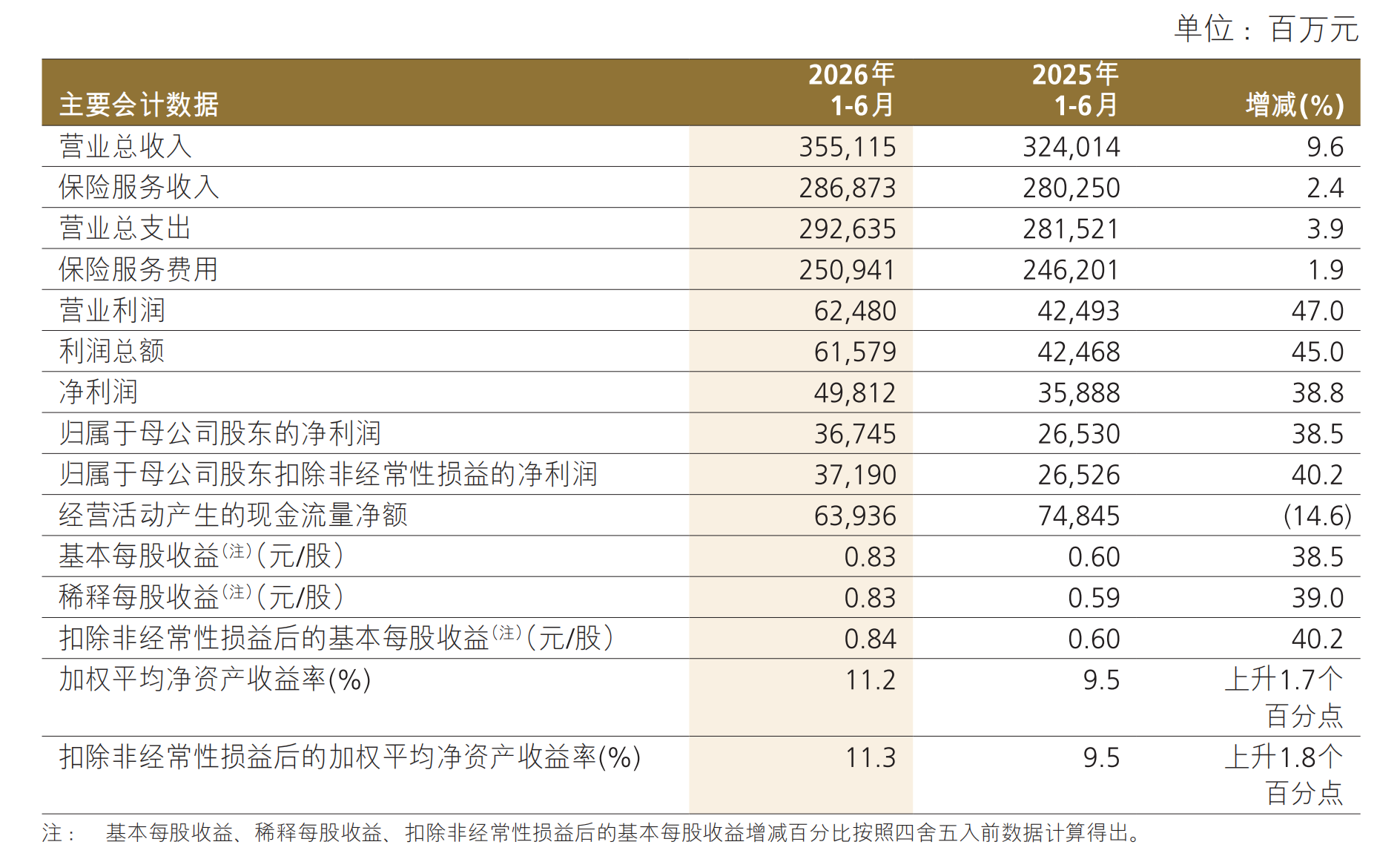
According to the 2026 semiannual report, PICC achieved total operating revenue of 3551.15 billion yuan in the first half of the year, a year-over-year increase of 9.6%; net profit attributable to shareholders of the parent company was 367.45 billion yuan, up 38.5% year over year; insurance service revenue reached 2868.73 billion yuan, up 2.4% year over year. As of the end of 6 in 2026, PICC's total assets amounted to 2.13 trillion yuan, an increase of 4.8% from the end of the previous year; net assets were 4614.32 billion yuan, up 9.8% from the end of the prior year.
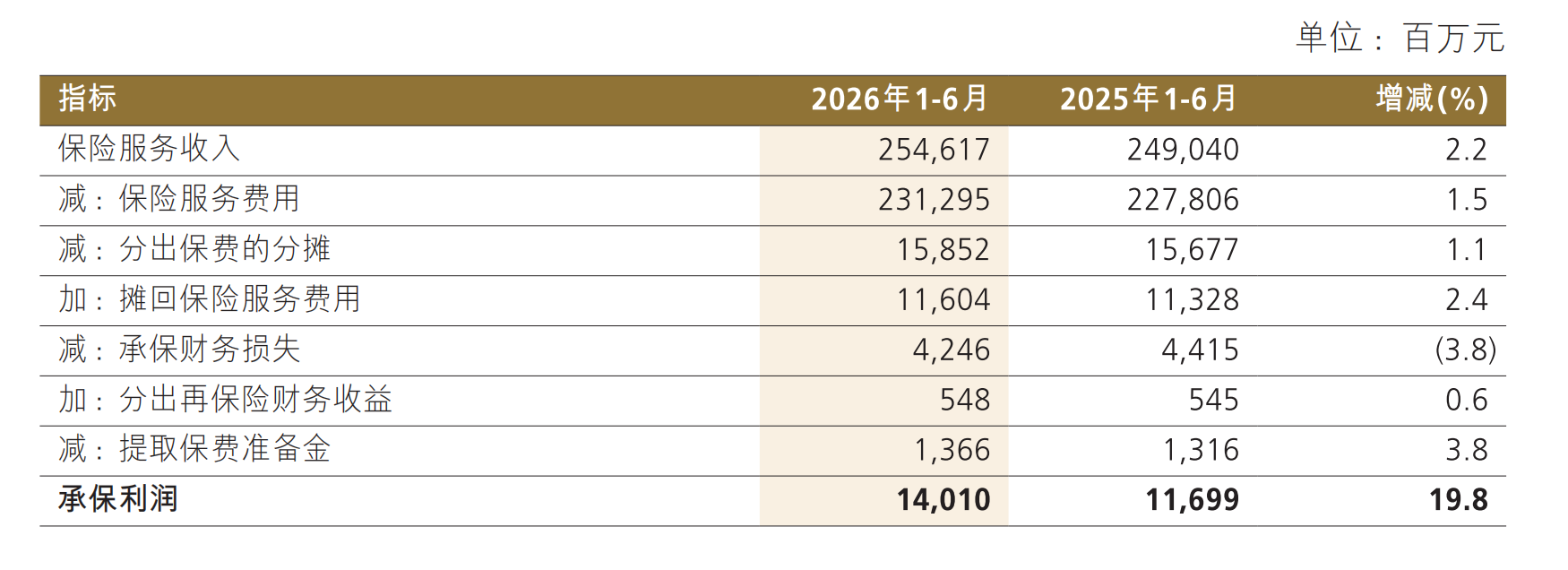
From the perspective of business segments, property insurance remains PICC's primary operational pillar. In the first half of 2026, PICC Property and Casualty (02328) generated gross written premiums of 3275.29 billion yuan, representing a year-over-year increase of 1.3%, and captured a market share of 33.3% in China's property insurance sector.
Despite a modest rise in premiums, underwriting profitability improved. According to the China PICC Group's semi-annual report, PICC Property and Casualty recorded an underwriting profit of 140.10 billion yuan in the first half of the year, up 19.8% year over year; its combined ratio was 94.5%, down 0.8 percentage points; and net profit reached 312.48 billion yuan, up 33.2% year over year.
Motor vehicle insurance remains the core business, generating 1442.27 billion yuan in gross written premiums in the first half of the year, a 0.1% year-over-year increase. Underwriting profit reached 99.17 billion yuan, up 13.6% year over year, with a combined ratio of 93.5%.
However, non-auto insurance performance varied. In the first half of the year, PICC Property and Casualty's liability insurance combined ratio reached 103.1%, resulting in underwriting losses of 6.28 billion yuan, indicating that certain business lines still face significant pressure from claims and cost control.
Life insurance premiums down 5.9%; participating policy income doubled
In contrast to property and casualty operations, China Life Insurance Company's life insurance business shows divergent performance.
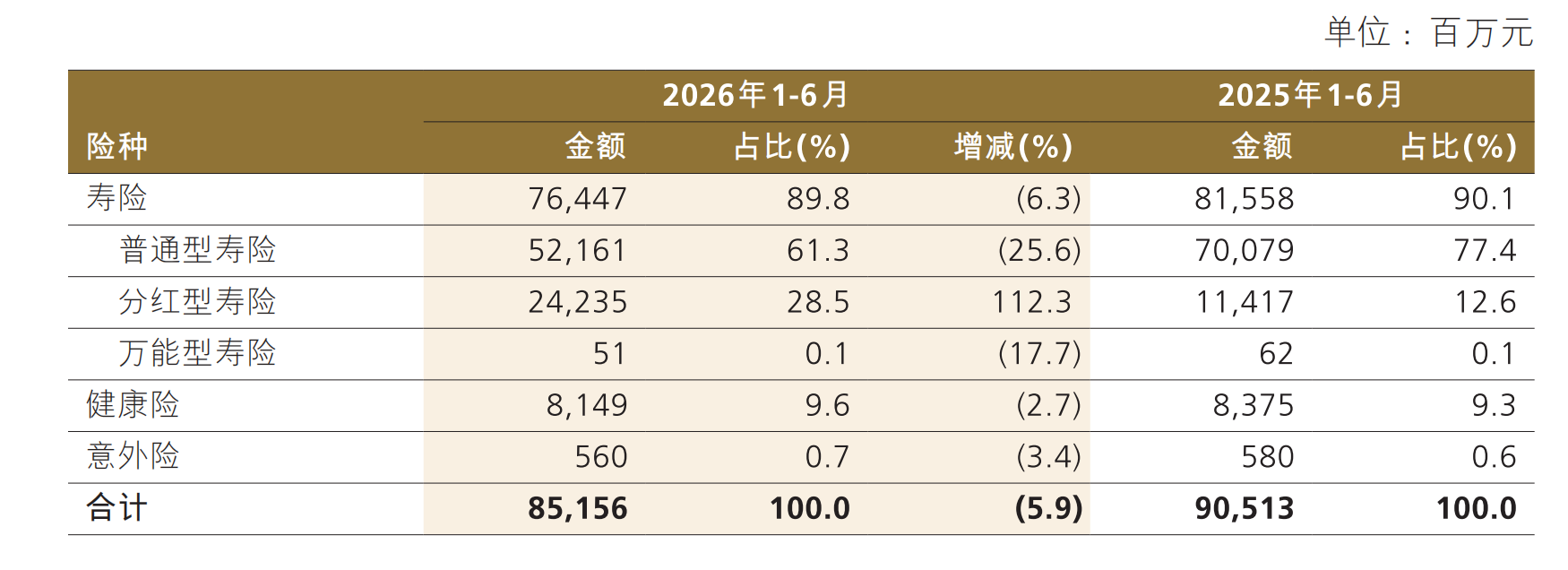
In the first half of 2026, PICC Life achieved original insurance premium income of 851.56 billion yuan, a year-on-year decrease of 5.9%. Among them, ordinary life insurance premiums totaled 521.61 billion yuan, down 25.6% year-on-year; participating life insurance premiums reached 242.35 billion yuan, up 112.3% year-on-year.
By channel, original insurance premium income from the bancassurance channel reached 461.59 billion yuan in the first half of the year, a year-on-year decrease of 13.1%, remaining the primary source of premiums. Premium income from the individual insurance channel was 371.22 billion yuan, up 4.8% year on year.
Despite a decline in total premium income, China Life Insurance's new business value for the first half of the year reached 51.77 billion yuan, representing a 5.2% year-over-year increase on a comparable basis. First-year premiums from single-premium and annual-pay policies with terms of ten years or longer amounted to 18.79 billion yuan, up 95.4% year-over-year.
In recent years, as the prescribed interest rates for insurance products have continued to adjust and pressure on liability cost management has intensified in a low-interest-rate environment, life insurers have accelerated their product mix restructuring. PICC Life is also fast-tracking its shift toward participating insurance. In the first half of 2026, participating life insurance premiums accounted for 28.5% of total direct written premiums, up 15.9 percentage points year over year.
In contrast, PICC Health maintained a growth trajectory. In the first half of 2026, it recorded original insurance premium income of 455.50 billion yuan, representing a year-over-year increase of 12.0%. Notably, nursing insurance premiums reached 92.26 billion yuan, up 24.5% from the same period last year, emerging as a key driver of overall business growth.
Investment income surged nearly 60%, with a significant increase in stock investment scale.
In addition to insurance underwriting, growth in investment income was also a key driver of PICC's profit increase in the first half of the year.
In the first half of 2026, PICC achieved total investment income of 663.27 billion yuan, a year-over-year increase of 59.9%. The total investment return rate was 3.7%, up 1.1 percentage points year over year. However, net investment income for the same period was 305.39 billion yuan, with only a 0.7% year-over-year growth, showing a significant difference from the growth rate of total investment income.
This change indicates that PICC's first-half investment performance was driven not only by relatively stable returns such as interest and dividends, but also by market conditions and fluctuations in related investment gains.
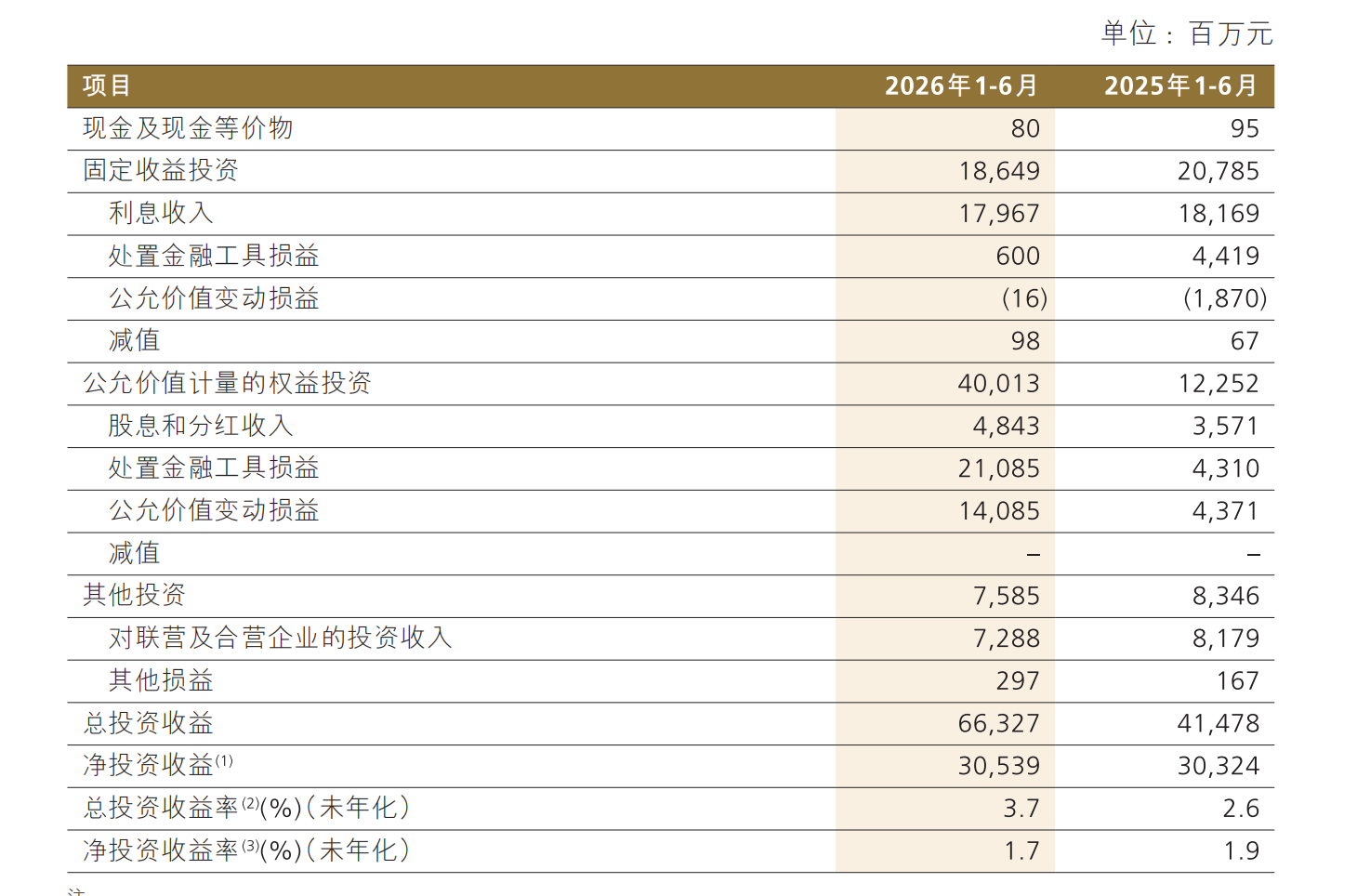
As of the end of 6 in 2026, PICC's investment assets reached 1.998 trillion yuan, representing an approximate 5.1% increase from the end of the previous year. Among these, equity investments grew from approximately 1662 billion yuan at the end of 2025 to 1946 billion yuan, increasing their share of total investment assets from 8.7% to 9.7%.
At the mid-year earnings briefing held on 8/31, Zhao Peng, Vice Chairman and President of PICC, announced that the group purchased approximately 300 billion yuan worth of A-shares net during the first half of the year. Additionally, it completed initial investments in private securities funds totaling 100 billion yuan, driving an increase in the allocation ratio for equity assets.
Overall, China Insurance's H1 profit growth was driven by improved underwriting profitability in property and casualty insurance and a significant increase in investment income. In the life insurance segment, while life premiums declined, dividend-linked products grew rapidly, indicating that the business mix remains in transition.
For Tan Jiong, who is officially assuming office, the key challenge ahead will be to maintain competitive advantages in property and casualty insurance while driving transformation in life insurance and ensuring stable investment returns as he leads PICC.


